Tuesday, November 11, 2008

[truly goddamn terrifying]

You know sometimes you see something that frightens you so badly you're not even embarassed about the girlish noises you've been making for the last hour 30?

[rec]
by Jaume Balagueró & Paco Plaza

That's all the intro this film gets because it scared me so fucking bad that I need to just get to it. This is that rare film where no place is secure, no one is safe, and absolutely everything is out to get you. A woman and her camera man are recording segments for a show about the nocturnal work forces in their town and tonight has taken them to a fire house. They're introduced to Manu and Alex, the two fireman who they'll be making the rounds with, they play basketball, see the mess hall, the sleeping quarters...Alex makes it pretty clear that the life of a firefighter is not one of constant heroics. No sooner has their routine of nothingness begun to sink in for the amateur reporter that the alarm finally sounds. Angela and Pablo, reporter and cameraman respectively, ride along to an apartment where an elderly woman was heard screaming; her door is locked and so no one is able to get her out. Manu, Alex, and two cops everyone has a hard time taking seriously bust the door down and find the old woman in a bad way. She is hunched over at the end of the hallway, speaks only in sickening barks, and is covered in blood. When the elder of the two cops tries to put a hand to her, she bites him in the throat. Anyone with a passing familiarity with the subject matter tackled on these pages knows the score; the poor bastards in the four story apartment building don't.

When Manu and rent-a-cop #2 bring their injured quarry downstairs, a couple of sobering reality checks are waiting for them. The first is that the authorities have locked everyone in the building; voices on megaphones assure them that decisions are being made for the best outside and that they should stay put. Next, Alex's body falls three stories and slams face first in the middle of the floor. When Guillem, a medical intern and possibly the landlord, gets the two injured men in stable conditions, Manu and the remaining cop go back upstairs. The old woman has gotten right the hell back up and it takes a gunshot to put her back down. Still don't know what's going on? Well here's a man in a yellow haz-mat to clear the air. Seems there's some kind of infection scare going on and priority one is, you guessed it, containment! So, what does that mean for the 15 people still inside. Well they're just fucked aren't they?

I love zombie films and one of the things that really makes a zombie film for me is when they're I don't know...scary. So many zombie films, in fact I'd go so far as to say most of them, simply think they can exist on nominal horror: i.e. there are zombies, it must be scary. Not so. The success of most zombies films is, admittedly, in the stories they tell, but I call a zombie film great when it scares me. 28 Days Later, scary. Dawn of the Dead, scary. Zombies are endlessly entertaining as the endless blog reel can tell you. As horror writer Jonathan Maberry put it when explaining why the Dawn remake was his favorite zombie film, these films were great because they 'made zombies scary again'. So, what does [rec] bring to the table? Quite frankly the best use of shaky-cam (and unlike the American remake, the film stock is actually the sort favored by local news stations) and the most claustrophobic nightmare ever committed to film. Jaume Balagueró was in the red with me after his laughably boring Darkness, but he's more than redeemed himself here. Just after I'd gotten over the shock of a reality based horror film with believable performances from EVERY actor, then came the horror. Aside about the acting; everyone is great. Everyone who is annoying is annoying in a completely truthful real-world fashion. The eccentric racist, the protective mother, the agitating junior reporter, the monomaniacal cameraman; all people I've encountered before and their behavior is precisely as it would be in this situation. At 89 minutes long, [rec] doesn't have time to fuck around, and it knows it. After the obligatory-yet-reasonable character development scene (SCENE. Singular, take a page J.J. Abrams! We don't care who these people are dating because it has, surprise, surprise, nothing to do with the plot!) we're treated to shock after squeal-inducing shock. Zombies are frightening only when you know you can't get away from them, and writers Balagueró, Plaza, and Luis Berdejo give our heroes less and less ground to feel safe in; for a few blistering minutes they are completely without shelter (the fact that they lose floors of a building when they lose ground reminded me increasingly of It! The Terror From Beyond Space). These guys know how to draw screams as well as any Japanese director of the last 15 years. And like the best Japanese directors, their gore is never obscene; rather it is always well-played and even-handed, if incredibly intense. The production design is flawless; the real apartment interior adds to the truly horrendous nature of the terror. You are never drawn out of the film by some short-coming; in short everything works.

The film is not without it's influences, those two new school runner flicks foremost among them (there's a scene with a little girl that had my head sideways for a few seconds, but it recovered soon after). But where Balagueró and Plaza really leave the ranks of the average and enter the realm of those most gifted of horror craftsmen (Friedkin, Boyle, Carpenter) is the ending. The way they explain zombies is not only wholly original (not that some d grade Italian productions haven't tried it before with horrid results, but boy does that ever not count), but its fascinating given Spain's cultural obsessions. Its also one of the single scariest things I've seen in my life (this combines a number of my greatest fears and they win points for this, even if the last shot, the one that the American remake insists on showing you in all the adverts, is completely uninspired). I'll go no further in the details, but suffice it to say that it's brilliant, and so is [rec].


Addendum:
It couldn’t be clearer that foreign countries know how to make horror movies that make American films look like vomit on a canvas. Funniest to me is that new countries keep emerging from the woodworks with tiny films that show up every American horror film in the year of its release. [rec] has been remade as Quarantine, as those of you who’ve seen the truly stupid advertising campaigns know, and it looks like Let The Right One In is next for a bastardized American clone. Let me first explain that the Swedish film hasn’t even been out a month…usually these things take time. No, so quickly is Hollywood running out of ideas that Matt Reeves, director of this year’s realist Grand Guignol Cloverfield, has already been attached to direct. This is deeply saddening and pathetic and no one knows this better than Tomas Alfredson, the film' director. As he explained to Nyheter, a Swedish film website, "Remakes should be made of movies that aren’t very good, that gives you the chance to fix whatever has gone wrong, “I’m very proud of my movie and think it’s great, but the Americans might be of another opinion. The saddest thing for me would be to see that beautiful story made into something mainstream….if you’d spent years on painting a picture, you’d hate to hear buzz about a copy even before your version…Why can’t you just read the subtitles…?” Too right. [rec] didn't need to be retold; Let The Right One In shouldn't be retold.

The American remake culture is not, however born out of artistic necessity, but out of artistic poverty. If American studios would hire real minds with real ideas, they wouldn’t need to sink all their money into reproducing, shot for shot in many cases, subtle, cultural-specific fright films. I don’t know about you, but I don’t think that The Day The Earth Stood Still, Ju-On, The Omen, or Psycho called out for repairs. Look at the last bout of remakes and you tell me if they were needed: Mirrors, The Eye, Bangkok Dangerous, Shutter, Prom Night, One Missed Call need I go on? My point is if they were arrogant enough to think that The Hills Have Eyes and Dawn of the Dead needed reinterpretation (two of the kinder ones, mind you) then where does it all end? The Thing*? The Exorcist? Alien?

Addendum Addendum
*Remake to hit theatres later this year

Thursday, October 9, 2008

October Shall Be Voodoo Month!

Ok, now it’s time for a history lesson. Not a very in depth one, and nothing below the surface, but it’s still important, damn you. A little while ago I sat in on a zombie panel at the release of Jonathan Maberry’s Zombie CSU and the question of the first zombie movie we’d seen came up. Fantasy author Gregory Frost's answer was I Walked With A Zombie, which he thought might have been the first zombie movie ever made. I, the upstart of the group, told him otherwise. So the inevitable next question was, “Just what was the first zombie film?” The answer in a moment, but first a digression. It’s no secret to anyone with an interest in ethnobotany or more than a passing familiarity with zombies that zombies are in fact a real thing. They aren’t the George A. Romero-created horror paradigm that so many of us are obsessed with but rather laborers who ingest one drug that stops their hearts so they can be revived later by another drug (Maberry and the other panel members knew more about the actual cocktail you have to take to get undead). This practice is not new and there are a few books on the subject (Harlem Renaissance pariah Zore Neale Hurston’s 1937 account of her trip to Haiti, Tell My Horse, and Wade Davis’ 1985 expose on the subject, The Serpent and the Rainbow, to name a few), but we’re here for the cinematic side of things. Before those books were published, there was exactly one account of zombies as we know them in American culture until 1932; a 1926 short story by H.P. Lovecraft called Cool Air was really all there was. In 1932 the first [voodoo] zombie movie was directed by Victor Halperin and produced by his brother Edward. Bela Lugosi plays the ring leader of the zombies and the story is not unlike many of his other post-Dracula roles.

White Zombie
by Victor Halperin
A young couple, not unlike the one from The Black Cat, The Raven, or The Old Dark House, ride through the night in a horse drawn carriage. The two lovebirds, Neil and Madeline, are in Haiti and they’re to be married that night. Why have they come here of all places? Well, they’re seeing an old acquaintance of the young woman named Charles Beaumont. He’s graciously offered his hacienda as the site of their nuptials, but what the husband in this equation doesn’t realize is that this acquaintance has a different marriage in mind. Seems Beaumont and Madeline used to have a bit of a thing and Beaumont isn’t really over the young lass. Seems he brought her here to win her back and he’s got an ace up his sleeve if she says no. As if it needed to be said, she does, which sends Beaumont for his lifeboat, an old man by the name of Murder Legendre. We know this man is evil because he’s played by Bela Lugosi, and also because he runs a sugar mill staffed entirely by zombies. Beaumont and Murder (well I'll never be able to type those names together again) have come to a little agreement; Beaumont wants some of Murder’s zombie powder - the stuff that made his staff so efficient - so he can administer it to his former lover and have her all to himself. You know how this goes: she gets drugged, seems to die, the body gets stolen, revived in private. Now both Neil and Beaumont have pretty awful prospects staring at them. Neil and Dr. Bruner, the missionary who was to wed the young lovers set about trying to find the body after Neil spies Murder’s zombie minions making off with it. Once Madeline gets her second wind she acts not like the lively young lass Beaumont envisioned, but as catatonic as the workers in the mill; the White Zombie of the title. Careful what you wish for, eh?

White Zombie, as many others have noted, is one of the best American horror films of the early sound era. It's straight-faced, unlike Dracula or The Invisible Man, engaging, unlike The Mummy, and not too wierd like The Black Cat. It does, however lose a bit of it's frightening quality after the first act, not unlike Island of Lost Souls. It is however nicely paced, has a few decent shocks, and a mostly reigned in performance by Bela Lugosi. His supporting cast are really just that (all competent, no one exceptional. Madge Bellamy does a fine job as a vegetable, Robert Frazer the same as a jilted eccentric). The 1932 release date explains a lot (the scripts reliance on a christian in Haiti to do all of the spiritual and physical legwork, the attitude towards the natives). There are, as I said, many fine moments, the introduction the sugar mill being the very best. There's also the Matte painting that stands in for Murder's lair that looks sufficiently spooky. The ending is a bit romantic (even by 30s standards), but I can't really expect much else. Thoroughly confusing is why the only black person in the film is Neil and Madeleine's chauffeur and why Victor Halperin made no effort whatsoever to make the natives appear as anything but porky white guys. Perhaps it was this ethic that brought about the ruin of his career four years later when he and his brother attempted to cash in on their success. The simple and haunting White Zombie gave way to the dull and wrongheaded Revolt of the Zombies, a movie with no connection to this except for some recycled footage of Bela Lugosi in close-up and the same men behind the lens. All in all, at an hour and 5 minutes, you could do a right sight worse.

It would be a while before anyone got the voodoo zombie formula right again, so viewers with a taste for the islands had to mire in thoughtless crap like King of the Zombies and Ouanga or Drums of the Jungle. It was in 1943, a full decade after the first zombie film that we have the second great one. Incidentally, it's the first one Gregory Frost ever saw.

I Walked With A Zombie
by Jacques Tourneur
Curt Siodmak's screenplay begins (as his often do) in transit. Betsy Connell is a nurse headed to the West Indies to care for a woman named Jessica in a vegetative state (sound familiar). She is part of the wealthy, but incredibly petty Holland family. Paul Holland, the husband of said patient-to-be, is a reserved man who is himself in something of a catatonic state. He's become incredibly reserved since his wife's coma struck and rarely leaves his house. Wesley is Paul's half-brother and he is a drunk who clearly harbours more than a little resentment towards Paul. Wesley it seems, is the one who really cares enough about Jessica to get her help, not her husband. And then there's Wesley's mom who oversees the whole thing like a Tennessee Williams character. She discovers this in a series of rather awkward encounters with both men, and once those are out of the way, Tourneur starts turning on the creep.

One night shortly after arriving, Betsy hears a strange crying coming from an empty stone tower on the Holland's property. When she sneaks out to discover its origin, she comes face to face with Jessica in ghastly white robes. Paul calms the frightened nurse while Wesley grabs Jessica and carries her back to the house. Talk about priorities. And as for that, Betsy finds herself tragically falling love with Paul (Christ the 40s were a melodramatic time). Anyway, so Betsy realizes she and Paul can't be together, but she wants to make him happy, and gets it into her head that the only way to do this is to take Jessica, in secret, to a voodoo ceremony to see if someone can't magic all the coma out of her. So, in the middle of the night, nurse guides patient through a dead field to the ceremony where they come face to face with....A Zombie! And a scary bastard he is. The ceremony doesn't go as expected, it just has the effect of making the voodoo worshippers interested in kidnapping Jessica to add to their zombie collection. A whole slew of starcrossed lovers, an antsy voodoo cult, and a zombie wandering about. Sounds like fun to me.

A precursor to both Bernardo Bertolucci and David Cronenberg, Jacques Tourneur was able to make very effective films that dripped with sexual overtones. He was at his best, strangely, with his first few films working for notorious noirror film producer Val Lewton. Tourneur's three films for Lewton (Zombie, Cat People, and The Leopard Man) are standouts in Lewton's RKO output and as horror films that stand the test of time. Cat People is quite simply one of the finest movies ever made, genre aside. After parting ways with horror he made a good many movies in the 40s and 50s, the most famous of which, Out Of The Past, is a delicious bit of noir filmmaking; many of Lewton's lessons clearly paid off. He would make one last masterpiece - 1957's Curse of the Demon - before fading into the limbo state of Italian no-budget filmmaking and bad TV, poor Jacques. But what he was able to accomplish before the art world turned cold and shut him out is enough to make any filmmaker green with envy.

I Walked With A Zombie gets mixed reviews from the zombie loving crowd. Some find it tedious and boring, others calculated and chilling. Everyone however agrees about the power of the films best scenes. The first, the discovery of Mrs. Holland in the bell tower and the second, the first appearance of the zombie. Personally I don't think there's been a better cinematic zombie than the one Darby Jones portrays here. Rigid posture, bugging eyes, Jones has some real cosmic menace. His performance is about the one thing everyone finds to like about I Walked With A Zombie. There are some other decent performances here, but I for one don't really get Tom Conway as a romantic lead. Depressed husband I get, but not future prospect. He did better playing stodgy men of science and perverted psychiatrists. That voice and his mad appearance lend themselves to characters, not leads, if you get my meaning. Frances Dee is wholly uninspiring, but Edith Barrett as Mrs. Rand and James Ellison as Wesley make up for it. Ellison's finest moment comes when he spies Jessica leaving the premises, headed for the voodoo priest bidding her with spiritual finger come hither. His wordless response is perfect and the movie closes on a simultaneous up and down beat. It's one of my favorite ending shots of all time. The film has a sort of sun-drenched look to it that Tourneur delivers flawlessly and it makes me love I Walked With A Zombie all the more. I really like this film and I think it's one of those rare works of art that lends weight to the horror genre's transcendent power. It is very thoughtfully composed, a little heavy-handed, legitimately scary at times, and quite beautiful to watch.
Incidentally, if you happen upon the Val Lewton Collection of this, it's worth it to watch again with Kim Newman's commentary. The man is brilliant and knows everything there is to know about this film. Plus who doesn't like the sound of a British film critic's voice?

Wednesday, October 1, 2008

Children of the 80s

The 80s saw the last hurrah of the real horror film (it wouldn't see it's renaissance until 2002). Horror movies really got going at the end of the 60s, held their gory, gnarled fingers on the pulse of audiences all throughout the 60s and finally flatlined somewhere around 1986. Gone were bawdy exploitation fright films worth watching, even for a laugh; gone were creatures that gave us nightmares; gone were shameless but fun cribbing from the writings of Richard Matheson and H.P. Lovecraft, gone, gone all of them gone right around 1986. Granted there was horror between then and 2002, but my god, talk about slim pickens. You'd have better luck getting scared watching an Abel Ferrera film than if you picked up anything Wes Craven or Dario Argento put their name on in the 1990s. I think what really killed horror films (but conversely we're also some of the most entertaining films in the genre) was the invention of the horror comedy. Specifically, the zombie comedy. This started out as something truly awesome to behold; smart, funny, esoteric romps through the land of the living dead with madder than mad science, excellent performances, genre conventions turned gleefully on their heads, and a nice balance of gore and character. This may have given birth to some of the most wretched films I've yet to see (I'm alone in the world of horror reviewers, but I fucking hated Dead Alive and Cemetary Man, and I can't stand the recent crop of them, either; Dead & Breakfast for example). The archetypes, however, the films by which all the rest would be judged (dis-favorably) were quite marvelous (and I don't mean Zombies on Broadway either). With the exception of Frank Hennenlotter's Basket Case, I can't think of two 80s horror films so highly praised for their charming weirdness (well, maybe I can, but that's a story for another day....)

Re-Animator
by Stuart Gordon

Reaminator is based on a pulpy H.P. Lovecraft serial from the mid 1920s that people love to tell you is nothing like the film. The opening is one my favorite moments of camp ever filmed. A group of professors gathers around a locked door; there is some kind of commotion going on behind it. When they finally get it open they find a young man with spectacles wrestling with a much larger man in a suit. The young man breaks free of the elder man's stranglehold and then kills him in front of the horrified audience he's just gathered. As the perfect 80s synth score chugs away behind them, one of the assembled spectators gasps "You've Killed Him!" to which the young man replies as he's dragged from the room "No! I Gave Him Life!" How much more perfect can you get? This air of tarring and feathering the horror tradition pervades the rest of the film, which is excellent, because if this movie took itself too seriously, there's no way it'd be as fun.

Next we see a similar life and death struggle as Dan Cain, a medical student, tries in vain to revive a corpse with a pair of defibrillators. This is apparently not the first time this has happened to the doomed young doctor, because his punishment is to be confined to the morgue where he can do no more damage to the living (or so you'd think). He meets three people during his first visit that are going to be very important to him very soon. Halsey, the dean of the medical school, Hill, the resident brain specialist, and Herbert West, the gentleman who was dragged kicking and screaming from the prologue. Now, what exactly is he doing here? Shouldn't he have been locked away. If you're Dan Cain, you'd agree one hundred percent, because West is about to cause him more trouble than Mogwai after midnight.

West sees an ad placed by Cain for a spare apartment and answers it just in time to spy Cain and the Dean's daughter, Megan indisposed on the couch, something the Halsey doesn't know about. With that piece of blackmail in place, West takes the basement apartment and then the weirdness begins in earnest. First is when Dan's cat goes missing and Megan finds him chilling in West's freezer, very much dead. This is upsetting enough, but not half as bad as when Dan hears screaming in the middle of the night and finds West and the cat battling it out in the basement. Dan helps West rekill the animal and then demands an explanation. Herbert West it seems, is no ordinary mortuary attendant. He took the job at the big freezer so he could have access to dead bodies and continue his research. The nature of that research, as we've seen, is bringing the dead back to life with a phosphorescent green liquid he's created himself. Dan's intrigued; wouldn't you be?

They go next to the morgue to try the now successful serum on a slightly bigger host. They manage to bring a hulking corpse back to life, but, what neither considers is how Rufus the cat behaved just after found life again; the result is the same, except instead of a cat, they have to contend with someone much bigger than either Cain or West. Neither can get their hands on the body in time and it kills Dean Halsey, who has the misfortune to run into it before West can take a bonesaw to its chest. West, as it turns out, is less than reasonable, and sees only another opportunity to try out his serum when the dean drops dead in front of him. The results are, once again, less than impressive. The dean's ravenous lunacy lands him in an asylum, puts Megan into a state of pretty understandable grief, and gives West a new rival. Hill, it seems, is just as keen to know the secret of life after death as West is, but he's just a little less insidious a character. Hill will stoop to blackmail, just like West, but he doesn't realize that West isn't above murder to keep his secret safe, at least until he gets proper recognition for it. What does he do? Well he cuts off Hill's head with a shovel and reanimates it in an aluminum pan and his body, which lies a few feet away on the floor. Gordon's a real charmer. Those of you who have seen The Brain That Wouldn't Die will already have a pretty good idea of what this looks like; For the rest of you:

The best part of the film occurs jut after Hill's body and head work together to steal West's reagent, kidnap Megan, and invite all manner of zany rescue attempt. West, the reanimated Dean Halsey, and Cain all swarm in to stop Hill, and the resulting chaos is about the craziest fucking thing you'll ever see. Picture a morgue coming to life, being really angry, really confused, and hopped up on Red Bull. Then add exploding intestines and you come close to imagining the conclusion of Reanimator. Of course, as this is a Lovecraft adaptation, there must be some indication of evil ever lurking somewhere nearby, so we're treated to the hint that there might be a new reanimator in town.

Stuart Gordon, I've always felt, is the Herschell Gordon Lewis of his time. He started making low-budget, gory, campy fun, and he makes it to this day. His films are full of life and are in general a blast, even if they occasionally suck worse than a post-Cujo Stephen King adaptation. Today's film is hotly debated because it's based on an H.P. Lovecraft story (Lovecraft fans are some touchy people). Lovecraft's fans always get their tentacles in a bunch whenever anyone takes on the master's work, and never more so than when The Reanimator is brought up; for the record, the film is actually not a bad adaptation until the third act. Gordon was a man of his time, and so couldn't very well not deliver on the elements that kids of the era craved when they went to see an 80s zombie film. So what we have is the story "Herbert West - Reanimator" brought to the 1980s in every aspect (clothes, styles, gore, nudity, sex, and the blackest of humour). And it's so much fun you occasionally forget you're being scared by a few things. The ending for example is a re-imagining of every zombie holocaust scene from every bad Italian zombie film before or since. Hill and West make for interesting Nemeses, because, in an exaggerated spin on the Hammer style, they're just two different evil bastards pitted against each other. Bruce Abbott as Cain isn't much of a hero for most of the film, and only half comes through at the end when we expect him to be a bit more assertive. The real hero is Jeffrey Combs as the charismatic, deranged Herbert West. His deranged swagger makes him endlessly watch-able as he slips further and further from reality and into Vincent Price-esque depths of madness. If Cain had been pitted against him, this could have been a rehash of any of Price's films at AIP in the 1960s, where countless, lumpy, vaguely handsome good guys were shuffled in front of him to take their turn acting as a sponge to his eloquently delivered, tortured apostrophizing.
The zombies themselves are mostly comic set pieces until the orgiastic third act comes to a close and West is confronted with the horrible result of his work. Watching a naked corpse run down a hallway to strangle a collegiate girl was not something I thought I needed to see at age 13, but now I don't know where I'd be if I hadn't seen it. I never saw any of the sequels, simply because I hold this film in such high-esteem that a purely comic riff on the carefully balanced themes and story devices of Reanimator would just feel half-done. Reanimator was at least partially a horror film and a damn good one at that, and when films forego craft for an overhaul of absurd elements, I feel cheated. See the original and die happy so we can fill you full of neon reagent.

Return of the Living Dead
by Dan O'Bannon

Dan O'Bannon may be the most underrated man in the horror game. John Carpenter's made a few good films (and one masterpiece), but he's shown nowhere near the creativity of just one of O'Bannon's films. Wes Craven lost his touch years ago, yet studios paid him to write the sequel to a remake of one his films, something he proved incapable of doing when the original was released. Sam Raimi hasn't made a great film since Evil Dead 2, yet year after year we see Spiderman sequel after Spiderman sequel, and they never get any better. Yet everyone seemed more than willing to let O'Bannon slide right out of the public eye. What happened? The man was the reason we have some of our greatest horror movies? He gave us the script for Alien, perhaps the most thoroughly creepy and thoughtfully composed monster movie of all time. He gave us Lifeforce, a super fun, zany zombie-alien mash-up, a formula no one seems to get right these days. And he gave us Return of the Living Dead, a wonderful send up of Romero's famous living dead pictures, the same year as his own disappointing Day Of The Dead hit theatres. This film, unlike Day, lived up to its full potential and is jammed with blistering comic moments, as well as some legitimate scares. A film that proves not only through it's genius script, but in it's expert staging that O'Bannon was twice as handy a writer, and just as capable a director as anyone else.

Interesting to note that, like Reanimator, this film was steeped in controversy, as many were a little miffed about the use of the words Living Dead in the title, lawyers and fans alike, if you get me. This film isn't exactly a sequel, and legally it certainly isn't one.

Our story concerns a myriad of disaffected 80s youth; punks you might call them. There are a half-dozen of them hanging out at a graveyard, and boy do they look the part. We have capes, leather, zebra stripes, chains, and buckles, and everything else Hot Topic would sell fifteen years later. And if the clothes don't say it all, how about these names (Spider, Scuz, Trash, Suicide...and then there's Casey and Chuck, but, nevermind that). We'll be focusing on the two members of the group who don't quite look the part. One of them, Freddy, is not with the group because he's just finishing his shift at the mortuary (a good sign in any horror film) while his friends wait outside for him. He and Frank, his considerably older coworker, are shifting some barrels around inside the large building's storage facility. Frank tells his young friend that the barrels are full of some secret government corpses, and that in fact the events of the movie Night of the Living Dead are not fiction, but fact. The only evidence lies right within the very canister they're rolling around. No sooner has Frank explained to Freddy that there's no way to break open the canisters does Frank's comforting tap accidentally crack open the crate and expose the two rubes to whatever chemical affected the corpse. When they wake up they have a bigger problem than what to tell their boss about the cracked canister. There's a nude, yellow body running around like an idiot. They manage to lock him up and then they get their supervisor, Burt to help them with the body. Because he's played by Clu Gulagher, I just get the feeling he'll get the job done. After a comical couple of minutes where they struggle with the best way to kill something that by rights should already be dead, they finally dismember the thing with a hacksaw (they have to as cutting off it's head does nothing but give them a just as crazy, headless corpse to catch up with).

Meanwhile, Tina, the only one of the gang of kids not dressed for a Dead Boys concert, wanders away to find Freddy. Freddy is her boyfriend and this is the only reason she's come along with the punks in the first place. Well she happens upon an empty warehouse and goes into the basement (I have to assume she's been here to pick her boyfriend up before). She discovers something even more unnerving than the yellow-tinged naked body Freddy, Burt, and Frank tangoed with. A grungy, dripping, zombie with its flesh leaking off it's bones (referred to as the Tarman in the end credits) comes roaring out of another storage canister. With a throaty cry of "Brains" it chases Tina around the room, forcing her to seek shelter in the same canister the thing escaped from.

After getting their situation under wraps, Frank, Burt, and Freddy bring the writhing body parts to the mortuary where the kindly old mortician, Ernie, is also working late. Understanding that Ernie would be a little wigged out about the sight of legs, hands, and bits of chest squirming around in little plastic bags, Burt tells him the bags are full of rabid weasels. Ernie agrees that the best thing to do is fire up his crematorium and send the things to hell. This doesn't go as smoothly as they might have liked however. The chemical that has revived the mangy corpse goes right up into the air with the smoke from the crematorium and the rain storm that has just kicked up brings it all right down into the soil of the graveyard nearby; the same graveyard Freddy's friends have decided to hang out in. You know what this means? Why it's that right of passage in the world of post-Plan 9 living dead films; the bodies of the dead burst out of their graves to stir up trouble. Trouble for six kids having stupid fun on top of some headstones.

Before the zombie invasion has reached the crematorium, Burt sees that the chemical has wreaked havoc on Freddy and Frank, and so paramedics are called. The ambulance arrives and the paramedics have just enough time to deliver their diagnosis ("You have no pulse, your blood pressure's zero-over-zero, you have no pupillary response, no reflexes and your temperature is 70 degrees") before they become food for the living dead. On the other half of the grounds, things aren't going too well for the malcontents. The first to go is Trash (notable for one reason only, because she's Linnea Quigly, and she dances around naked) who falls down in the mud and gets eaten soon after. Next is Suicide, the leader of the bunch, who runs afoul of the tarman, allowing Tina to escape with Spider and Scuz. They head for the crematorium, with zombies running after them (and yes I mean running. Though 28 Days Later revolutionized the zombie film, it wasn't the first to feature 'runners'. Chuck and Casey lock the door to the basement and stay in the warehouse, afraid to go outside again.

From here on out we have a new spin on the Night of the Living Dead board-up-the-windows scenario. The zombies, super smart and marathon-runner-fast, take more and more ground in the mortuary as Freddy and Frank's condition worsens. And to cap it all off, we have a race against time before nuclear weapons are used to erase the whole mess. Miles away in some official building, a higher up called Colonel Glover moves ahead with the plan to use whatever means necessary to contain the potential zombie epidemic he's got on his hands.

Enjoying this movie immensely was not a surprise when I first saw it in 4th grade. The emotional kick I got watching it, then and everytime I've watched it since, is a surprise. For whatever reason (and this is true of Reanimator, too) this movie manages to make me care about the characters in ways that most serious dramatic pieces can't. Maybe it was some ingrained sympathy for radical lifestyles, but, I paid rapt attention when the punks in this film were in danger. I saw this movie before I saw Night of the Living Dead, and so this was the first time I'd seen the board yourself up set-piece before. This had a pretty huge influence on me; most of the things I wrote between first watching it at age 8 and then actually starting to write in screenplay format all had some element of Return Of The Living Dead in it.

The reason this film is (rightly) remembered so fondly is its humour. I may be the only person who found this film scary, but I more than sympathize with the people who laughed their asses off while watching Return. O'Bannon's script is just plain funny. The interactions between the feuding twenty somethings is a hoot, as it becomes clearer and clearer that these guys hang out with each other simply because they've got no one else to hang out with.

Suicide: How come you guys only come around when you need a ride someplace?
Spider: Cause you're one spooky motherfucker, man!
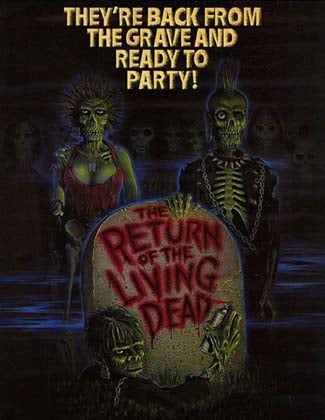
Normally tired cliches like Chuck trying to get with Casey are funny even when they shouldn't be. For my money the funniest bits go to Clu Gulagher, who gets to lampoon his tough-guy persona with all the bluster he can muster. When his Burt has to put a stop to the first zombie's running around with Freddy and Frank, he blows himself up like a puffer fish and begins screaming at Frank, who can't get up the courage to let the thing out of the closet. "Goddamn It Frank, Be A Man!" He really gets all the best lines. When he discovers that the only phone in the building is in the basement with the Tarman, he paces for a minute before picking up a board and bellowing, "Open the door. I'm gonna knock it's Goddamn Block Off!" Blustery older men are pretty much always funny to me, and when they so perfectly act the part, I can't help but laugh. So when a film can go from mercilessly making me gut laugh to wrenching those guts with some pretty terrifying stuff, I call it a success. 

Wednesday, September 10, 2008

2008: A Case Study

Recently if you've been to the pictures to see a horror/thriller, you'll have noticed a trend; everyone dies. I'd like to know when this trend started (I feel like I used to know). Anyway, what with torture porn running the game, apparently the kids are into everyone biting the dust by closing time. I found this sort of novel when the trend was new, now I feel like I can guess the ending before it starts. Two things made me challenge my assumptions this year. One was a gutsy little shocker whose entire budget went to it's stars, the other a claustrophobic tourists-beware film with twists to boot. It gives me a warm feeling to see a genre evolve in a few short months. It's a little like watching a robot learning how to love.

The Strangers
by Bryan Bertino

A couple having troubles get back to their summer house and after about an hour of unspoken resentment and half-finished sentences, someone knocks at the door. A blonde stands outside and she doesn't come close enough to the light of the house to show her. She wants to know if her friend is home. The couple are befuddled and lock the door. The boyfriend goes for a drive and the knocking resumes. Only now it's louder and it won't stop. The girlfriend panics, calls her boyfriend and then waits for him to come home. In the meantime things just get spookier and spookier. Noises and a horrible face appears at the window force her to hide under her bed before finally the boyfriend gets home. Now they need only get their phones and call the police. Except that the phones have been thrown in the fire and the chargers severed with a knife. Which means that someone was in the house. And that someone's just screwing with them. If they could come in at any minute, why don't they? Their move to the car is halted by the arrival of a big-ass diesel truck that lays waste to the small sedan. The boyfriend gets his gun; he figures he just has to wait for his friend to show up to give him the ride he was promised before any of this madness started. And there's always the radio in the garage. Shouldn't be too long, right?

The Strangers is easily the scariest and most ingenious horror film in...5 years? 10 years? The reason is that instead of spending money on effects, complicated traps or other torture-related set pieces, all that director Bryan Bertino puts on screen are three people in some of the cheapest masks I've ever seen and the noises they make. When Liv Tyler stands in her kitchen and the man in the smiley mask steps in, your heart just about stops. When she's alone in the yard trying to get to the garage, Bertino ingeniously turns the film into a game of expectations (Is she alone? Do they know where she is? When do they get her?). The masks are truly brilliant: a sack with a smiley face burned onto it, and two smiling clown faces. Why no one else has caught on to this is beyond me. You don't need elaborate scenario's or a vat of syringes, you need one guy with hulking shoulders and an enormous smile. Kip Weeks, who plays the gentleman in the mask, has perfect posture for the role. Gemma Ward and Laura Margolis, who play his female accomplices are just as frightening. Gemma Ward especially; she is one odd looking women normally, but here, with just brief glimpses of her face and hers being the only voice you hear, she in essence speaks for the trio of psychotic killers and she does a terrific job. Liv Tyler and Scott Speedman do convincing work as terrified nobodies, though I sometimes wonder what gets Liv Tyler into a film like this.

What really makes it hard to watch is the ending. It's slightly ambiguous, but it isn't good news for our concerned parties as the killers take off in urban legendy fashion. The Strangers is terrifying, but, what troubles me is that the ending is something of a copout. Bertino is clearly a smart guy because he's managed to cut all the mangy personality out of what could have been a more boring version of High Tension, but makes two irritating choices. In the first act when Scott Speedman and Liv Tyler show up at their house, they are clearly troubled by something. I was so excited because I thought he might do the audience the favor of not telling them what happens, but, sadly he doesn't. Had he never flashed back to the wedding party they'd just come from and explained where there problems spring from, he would be a genius on the level of George A. Romero or Roman Polanski. He still comes close, but, had he just moved forward this would have been even more terrifying. And it's even more pointless because the ending obviates all character developments anyway. When you have a bleak ending, it feels like the easy way out of what is otherwise a terrifying, simple, and smart film. Were it not for those two little things, I'd have no complaints. Though I do like the sort of last wound they deliver when a frightened Liv Tyler asks why the killers chose them of all people; harrowing stuff. This movie is excellent and leaves it's competition in the dust.

If you found yourself looking for intrigue of a similar nature, but maybe wanted a little joy with your tension, might I suggest something colder...

Transsiberian
by Brad Anderson

A russian drug enforcement officer called Ilya Grinko investigates a crime. Seems a man's had his drugs stolen and gotten a knife in the back of his head for his troubles. Grinko doesn't seem all that concerned, tells the other detective present he's going on vacation. We then see an American couple, Roy and Jessie, getting on the Transsiberian express train from their church-organized humanitarian trip in Beijing to a hotel in Moscow to go sight-seeing. Things seem to be going ok for them; they argue a little, have dinner, flirt, don't have sex as they've differing views on raising a family (something Brad Anderson does pretty well at first), then go to bed, both slightly annoyed. When the wife wakes up, they've got two new cabinmates, a couple. Carlos, the man, (pretty hilariously referred to as a Spaniard whenever he's not around to hear it) is a flirtatious, hard-drinking, asshole, while Abby, his American girlfriend seems nervous and shady. Carlos clearly has dirty things in mind for Jessie, as evidenced by his attempts to get her alone, showing her a bunch of wooden matryoshka dolls in private, telling her to keep it a secret. At the next stop, the four get out and split up. Roy and Carlos talk about Jessie's checkered past, as do Abby and Jessie; this doesn't really further the plot so much as it does set up that Carlos is really turned on by Jessie and he's a bit of a creepy bastard.

About five minutes after the train gets moving again, Jessie notices Roy isn't on the train. She, Abby, and Carlos get off at the next stop to wait for Roy to arrive on the next train. It comes out during dinner that Carlos has been keeping his dolls a secret from Abby, as she marches off to bed in a huff at the very mention of them. The next morning Carlos decides to ramp up his seduction as he's clearly not sleeping with Abby. He gives Jessie a story about his shower being broken so he can get naked in her hotel room, and then insists she go out walking with him so she can photograph an old church. After he's brought her to a secluded spot and she's taken his picture, he lays on the charm and they almost have sex right there in the abandoned church. Complications ensue and Jessie winds up coming back to the hotel by herself. When Roy's train gets in, Jessie has a whole new set of problems to worry about. First is that people are bound to ask what happened to the horny spaniard she's been witnessed alone with. Maybe his girlfriend who she left in town by herself for example? Maybe Roy's new cabinmate, who turns out to be none other than Ilya Grinko on his way to that vacation he mentioned. Then there's all those dolls that Carlos slipped into Jessie's suitcase while she was out of the room. Things start coming together (while coming apart just as quickly) for poor Jessie and her husband convinces her to come clean to Grinko. Grinko and his terrifying partner confirm her fears - the dolls are made of heroin. She lies a little more about her trip into town and goes to sleep, the weight on her shoulders all but lifted. Things change in the morning, though, in a big, bad way.Transsiberian, whatever else may be said of it, works as a perfect foil for Bertino's film. We have an ordinary couple being thrust into a harrowing encounter with another small group of people and there lives are soon on the line. The difference is in the handling of the problem. Jessie and Roy are just as bourgeois and helpless as anybody, in fact Woody Harrelson puts in one of the best performances of his career as loving hayseed Roy, but they manage to use what little savvy they have to get out of their predicament. Rather than succumbing to the grimness of their tormentor's punishment fully, they merely glimpse it. Now the way in which Roy and Jessie slide past their troubles is a little much to stomach, but after some of the shit I've seen this year I'm willing to bend the rules this one time. I'm especially willing because it follows Brad Anderson's greatest trick in the movie. Right after the two hand the drugs over to Grinko in an effort to come clean and all seems well Anderson pulls the rug out from under us. I won't reveal what it is because it's the best moment of the film, but look out for it; it's Anderson's shining moment. The creator of such cinematic gut punches as Session 9 and The Machinist probably had more in him than this, but he has a few effective scares here. I personally would have liked to see the train take on a more central role, rather than merely remaining the setting throughout. For a film in which 3/4 of the running time occurs between walls about 5 feet apart, things could have gotten a lot more claustrophobic. I also would have preferred if Anderson didn't explain everything so clearly at the start of the third act. He reveals in no uncertain terms how the drugs were placed in Jessie's bag, something that anyone who was paying even the slightest attention to would have figured out anyway. When will writers start taking the audience's intelligence for granted?

Back to the performances for a moment. Ben Kingsley does an amazing job with the Russian Grinko (his Russian is just as good as his English and as his character is slowly revealed his menace just gets heavier and heavier. He's not an oscar winner for nothing, I suppose). Thomas Kretschmann, who plays his colleague does a pretty remarkable job as well. It's funny, after seeing him play elegant evil, and more cartoonish evil, to see him play a role that ordinarily would have gone to Vincent Cassel. Eduardo Noriega and Kate Mara are competent as the shady couple, but their characters aren't really interesting enough for them to do much with. Harrelson does a very good job as the clueless American, but the real star is Emily Mortimer. Her Jessie is all-too tiresome for most of the film's second act, but when she discovers the heroin dolls in her bag, that's when she comes alive. Watch her eyes as she listens to Grinko discuss drug traffickers and then later when she's questioned about the holes in her story; she's on the verge of collapsing the whole time. The film's tension lies inside her eyes. When she runs to her room during a search of the train with drug-sniffing dogs and finds Roy waiting for her staring at the dolls, she loses it in the best way possible; I've never seen so honest a collapse since Gena Rowlands in Opening Night.

So we have a couple who doesn't deserve it being stalked by three sociopathic killers for no real reason, and we have a couple who find themselves at the mercy of a number of psychopaths, only one of whom comes close to deserving it. Given the endings of each film, which do I like better? Well, The Strangers is ten times as frightening as anything else released in the last five years, and Transsiberian is smarter than your average thriller. It's a difficult decision; a pessimistic ending for a superior film, or optimism in favor of a more rudimentary one. I enjoyed watching both of them; how's that for a cop-out?

Thursday, September 4, 2008

Back on the Horse

After a summer’s hiatus from my writings on the world of the living dead, filled with complicated movie shoots, recording an album, sitting on my first zombie literature panel as an expert, getting several of my friends arrested, spending a small period as a jobless lout, the odd obligatory networking stint, parties, weird social encounters, and the watching of an awful lot of bad movies. There were some good films I suppose, but god and my friend Sarah know that this is not the point of this here website. The point, my avid students, is the bad ones…

The Living Dead Girl
by Jean Rollin

Three average Italian men (tight pants, receding hairlines, one of them’s overweight, faded pastel colors) roll barrels of toxic waste into a mine that leads to a mausoleum with two coffins in it. One of the men seems to think this is a bad idea; his portly friend puts his mind at rest. Then what the DVD sleeve tells me is an earthquake shakes one of the two coffins open and the toxic waste spills out, burning one of the guys’ face off. The other wakes up after the rubble slide and looks in the open coffin lid. He gets his eyes gouged out for his trouble. The gouger steps out of her coffin and reveals herself to a blonde in a white gown with bangs. She gets out, wanders around, is spotted by our other heroes, an American and his foreign wife, and finds the house she used to live in. She returns home to discover that the house is now on the market. How’s this for a sales pitch? “They say the family’s still buried in the basement…Have you seen the piano?” Verbatim, friends, verbatim. So the girl, her name is Catherine Valmont, begins flashing back to her childhood. These flashbacks mostly consist of sitting alone with a brown-haired girl named Hélène. The two girls promised to be friends forever and engaged in one of those blood-pacts the kids are so crazy about, which gives Catherine the idea that maybe Hélène is the one person who will understand her predicament. What predicament, you ask? Well Rollin never makes it clear, but we can assume it has something to do with Catherine's thirst for viscera. It’s just sort of one of those unspoken things in zombie films of any type. I guess Rollin took for granted that the audience assumed that this was a zombie film like any other.

What’s left? Well Catherine kills the realtor and her boyfriend when they return that night to fool around in the big empty manse. Hélène shows up just in time to clean up the bodies and piece the whole mess together. “Why didn’t they tell me you were alive?” So Hélène decides, without telling anyone, that she’ll help lure unsuspecting meat back to the castle so that Catherine can feast on the flesh of the living. Then the American and his wife quarrel about whether the eerie girl in the picture is alive or dead. In the end the wife does a lot of pissing and moaning about her investigation and shows up unannounced at the castle to take Catherine’s picture. She has, for no real reason, decided to take it upon herself to play detective. Her obnoxious interactions with her husband are thus half of what we will be treated to in this film. Their scenes are probably my favorite, as they have a Franco-esque contempt for second takes, but before my evaluation, a few words.

I’ve tangoed with Jean Rollin, the “director” of such shambling schlockfests as The Grapes of Death and Zombie Lake before, and each time I’ve just gotten angry. Why did I decide now was the time for round 3? While in one of my favorite independent bookstores a few weeks back, I picked one of those horror film guides that are so in vogue these days and flipped to the section the authors called “Art Horror”. (since my dad’s novel has been accepted for publication, I’ve been given a whole new perspective on the way books get published, and so it makes sense that so many horror books should be promoted and published at the same time. one of these books, Zombie CSU by Jonathan Maberry, I may have to review here, despite it’s obvious dissonance with the usual fare on this here site. Maberry, like myself, is a horror addict. The man’s something of a minor miracle in the horror world, someone who knows as many facts as he does films. His book Vampire Universe is a blast. I met him through my dad and sister, and he agreed to help with my film, the one that got put on hold after the arrests. Anyway, this is all more than you need to know to understand The Living Dead Girl, which is of course, a night’s worth of drinking or someone with as sick a sense of humour as me to watch it with). The book in question, Horror Films by Colin Odell and Michelle Le Blanc, touches on some of my favorite horror films (Georges Franju’s Eyes Without A Face, The Evil Dead and Hideo Nakata’s Ringu) and there in the midst of those masterpieces we have Rollin’s Living Dead Girl. “Bullshit!” I thought, “There’s no way there’s some hidden work of genius hiding in this fuckhead’s canon.” Yet they spoke so highly of it; it worried me. They seemed to have decent taste otherwise, but then again, even geniuses have guilty pleasures. Soon, paranoia got the better of me, and there I was watching Living Dead Girl. Don’t ever let peer pressure get to your netflix queue, I assure you, you’re gonna regret it real soon. I can't tell you how many times I've followed the recommendation of horror guys and found myself staring at 90 minutes of excruciating torture.
What we have here is a disregard for logic that is almost sublime. Rollin’s screenplay suggests nothing more than his writing down ideas as they came to his head and then refusing to look at them again after he’d written them. His direction is much the same; we nearly have a repeat of Lina Romay’s stumbling into the camera from Female Vampire. Facts mean nothing to this guy. Take the opening. An earthquake is supposed to shift enough earth to move the toxic waste barrels in the mine, yet the van outside is intact and the coffins don’t tumble to the floor. There on the coffin is a plaque with the internee’s name on it. The kind you’d find in a school gymnasium with VIP’s names on it. Then once Catherine Valmont gets out of her tomb she traipses around the countryside only to come back to the basement she just left. Rollin seems to have taken for granted that we wouldn’t recognize the fact that the mausoleum she leaves is in the basement of the house she enters later that day. WHY WOULDN’T SHE JUST CLIMB THE STAIRS TO THE HOUSE? And why are the torches in the mausoleum already lit? Because she needed to be seen by the photographer and her husband, of course. The husband and wife’s dialogue, nay, their existence, is a testament to Rollin’s detachment from reality. Their lines are, best as I can figure, an amalgamations of sayings strung together haphazardly.
A real snatch of Dialogue:
The husband puts a camera around his wife’s neck

“There. A Perfect fit.”
“I’m an actress.”
….?

There’s a scene where the two of them are pouring over the wife’s photographs and talking about the living dead girl. Midway through their conversation the wind kicks up and knocks their food off the table and blows their photographs around. Take 2 not an option, Jean?

Then there are other wonderful things like when Hélène tries to figure out Catherine’s damage after cleaning up two dead bodies from the night before. When Catherine doesn’t speak, Hélène goes into the barn and comes back with a dead pigeon in her hands, which she refuses. I guess this is how Hélène figures out that Catherine needs people and not animals. How did she catch and kill a pigeon? She a fucking ninja all of a sudden? Weirdly, Marina Pierro who plays Hélène is a decent enough actress. I say this because in a Rollin film, she still puts in a decent enough performance. And next to Françoise Blanchard’s mute hero, and Carina Barone’s high-strung journalist, she could be Gena Rowlands. Rollin’s complete lack of logic aside, what really mars this whole affair is the fact that the cinematography and gore effects are about as lifeless as possible. The whole thing is lit too well. It’s the failing of many early 80s horror film and it looks like it might have been shot on video; things move too fluidly, all the colors are too bright, the look of the film elicits no tension whatsoever. The gore is really the bare minimum they could have done; the first (and only) victim Hélène and Catherine lure to the castle is killed with a sword. Hélène rubs the sword against the girl’s stomach and blood is smeared on it. Brilliant work, Jean. In fact, all around, Brilliant work. What anyone sees in you, I just don’t know.

I find it interesting that Redemption video proudly distributes a good many of Rollin's films and yet the works of Larisa Shepitko, Kaneto Shindo, and Marcel Camus are all but unavailable on DVD in the United States. I don't think I need to explain why this is unfair. If this film's wretchedness hadn't provided an evening's entertainment I'd be extremely pissed.

Monday, July 7, 2008

George A. Romero's Finest Achievement: His Legacy

While unfortunately I was on vacation when this happened, I wanted to point out that the 21st of June was officially the 40th anniversary of the events depicted in Night of the Living Dead. Yes, I suppose actually mentioning this during the month of June would have had twice the impact, but, I've been busy...doing...well...nothing. I've been writing music with my friend Sebastian's effects pedal and trying to record my band's debut, so, you know, cut me some slack. Anyway, I thought a fitting close to my tribute to George A. Romero would have to be the best example of his influence translated to modern times. A film that pays tribute to all of his films while rewriting the book on zombies. A revisionist zombie film that has colored all of my creative habits since I saw it in 2002. It's one of my favorite movies of all time and I think it's proof that not only is there still gold to be mined in the zombie genre, but also proof that everyone who thinks that all the good ideas have been used isn't paying attention. In late 2002 I was at a casting call when the woman across from me started talking about movies. One of her sons had auditioned to be in the remake of Sleepaway Camp (production delays and the fact this is a shitty idea have since prevented the film from ever being made). We then got onto the subject of 28 Days Later, which she felt was a rehash of Night of the Living Dead. This is a habit of stupid people, when they mistake the occurrence of a common theme for a lack of ideas. "I felt like I was watching the same movie." She explained. I wanted so desperately to harm this woman in front of her children, but, as I was all of 13, I didn't do that. When people insult good ideas, most especially good movies, I get angry and fantasize about taking revenge on behalf of artists and intellectuals everywhere. When good ideas fall into the wrong hands, they become powerless and are made cheap. This offends me as much as when bad ideas fall into the wrong hands and out comes The Gingerbread Man starring Gary Busey. Anyway, my leftist rage aside, I present to you one of my 100 favorite movies and the close of my loving look into the life and work of George A. Romero, a film that has both spawned a remake of one of Romero's own films and a pretty decent sequel. Thanks for everything, George, we won't soon forget everything you've done for us.

28 Days Later
by Danny Boyle

Horror films as a whole have a bad reputation; I’ve never understood this, because they’ve always been the things that have spellbound me since childhood. It is for this reason that I’ve become the harshest critic of horror movies that I know. Whereas others will let the majority of today’s horror output get away with artless depictions of graphic violence and torture, I remain the one pretentious aesthete among all my b-horror friends and the one deviant among my art-film friends. The route of this divide comes from one film that straddled the line between beauty and filth like nothing I had ever seen before. The tradition of art horror, specifically the potential of making a revisionist zombie movie as much Terrence Malick as George A. Romero, has since been the major driving force in much of my writing and viewing. The majority of my creative output in the years since 2002 has been the direct result of watching Danny Boyle’s sensational 28 Days Later.

Most legendary horror films are marked by their sucker-punch openings; this film boasts two. First we see eco-terrorists arriving at a lab performing experiment involving the exposure of monkeys to violent images; they want to set the animals free and get their wish. They do not believe the lab tech’s warning that the creatures have been infected with rage; would you? One of them is bitten, and then she vomits blood into her partner’s eyes, soon they’re all infected. We are forced into the future where a bicycle courier named Jim wakes alone in a hospital. Not only does it seem that he’s the only man in the building, he seems to be the only man left in all of London. When he meets the others, things take a turn for the worse. The only people he meets who don’t appear to have mentally deteriorated to the functionality of bloodthirsty zombies are the cynical Mark and Celina, who are much the worse for having survived the ordeal. It seems that the virus spread from those four people in the laboratory to perhaps the rest of the world. Jim has a lot to come to terms with; the death of his parents, the end of civilization, and the possibility that the only thing resembling help lies in a military unit stationed outside the ruins of Manchester.

28 Days Later was an unprecedented event in my life when it was released. I watched it once and then snuck back into the theatre and watched it again with my best friend. It typified everything that frightened me and that I would come to love in films. There were frightening images, character arcs that had been missing from most post-apocalyptic films, enthralling soundtrack, then-ground-breaking digital cinematography, break-neck editing together with breathtaking long takes, and it’s all driven by Danny Boyle’s hyper-hip direction.

First of the film’s many excellent qualities are the performances by the leads. Newcomers Cillian Murphy and Naomie Harries, as well as supporting players Brendan Gleeson and Christopher Eccleston are profoundly understated and believable as the last men on earth. Absent are one-dimensional action heroes that mark most films of the genre, present are the kind of people you might actually meet, neighbors, bicycle couriers, and the dim of wit. Jim, headstrong and full of empty bravado, flounders in crisis, eventually learning to put his pride away and behave for the common good, something crucial to his survival. Learning from error and changing for the better are not character traits you often find in horror films and to see the subtle change in Jim is flooring.

Equally as flooring was Jon Murphy’s score; an amalgam of haunting arpeggios and brooding, thunderous post-rock. Despite the brilliant use of outside sources (Godspeed! You Black Emperor’s "East Hastings" playing over the opening crawl through London may be the best use of non-diagetic music in a horror picture. Grandaddy’s casio-laden "AM 180" is both expertly used, but also part of Boyle’s tribute to Romero’s Dawn of the Dead. His nod to Day of the Dead is present in his use of treacherous military force. It can be said the whole film is a nod to Night of the Living Dead and the timeless quality of his work). Murphy’s music provides heavy atmosphere, without which the film’s awesome conclusion would be utterly without power. The urgency of watching a shirtless, bloody Cillian Murphy running from room to room trying to recover Celina from the arms of the brutish soldiers, all the while being pursued by the sprinting undead was absolutely mesmerizing. This scene has influenced everything I’ve ever written.

The color scheme was as vivid as I’d ever seen; between Mark Digby’s art direction and Anthony Dod Mantle’s cinematography, audiences expecting a genre film were blindly led into a stunning hybrid. The footage of the endless flower gardens and windmills that flank Jim, Frank, Hannah, and Celina on their way to Manchester are as beautiful as the sea of deep green that surrounds the soldier’s commandeered mansion. The differences between the indoor and outdoor, the daytime and nighttime photography are staggering. Boyle has a very keen sense of how to disorient as in his opening and use of repeated montage editing. In one particularly effective scene, we see the London skyline in dusk and a sliver of something darker in the top of the screen. He pans upward and shows us Jim, Mark, And Celina resting in Jim’s living room. Not even a minute later, they are attacked. Just afterwards Celina sees a bitemark on Mark’s hand and cuts him down right in front of Jim. Though the sequence is beautiful, the dulled orange color scheme followed by the unannounced assault coated in red, masterfully accented by the editing and sound design, shows that the dusk, when man’s lights cannot protect any longer and the city becomes a dangerous place, is a time to be feared. It is man’s discoveries that have led to its demise. Like George A. Romero, Boyle and screenwriter Alex Garland are interested in the many implications of a man-created disaster. As the many characters muse, the problem is strictly human and never leaves the realm of a human-dominated world. It also elaborates on the difference between positive ecological/humanistic thought and negative. As a counter to the windmills is the unreasonable behavior of the animal liberation cell. Construction and deconstruction in practice make all the difference and Dod Mantle’s camera paints the picture as well as Garland’s script. This kind of appreciation for nature and man’s futile eco-consciousness wrapped in an elegy for mankind isn’t the sort of somber wake-up call a young film fan gets handed everyday. It is the remarkably pragmatic nature of 28 Days Later that will allow it to live on for generations.

It is the descriptions of the after-civilization by each of the people Jim meets, and the immediate commoditization of any and all limited resources that raises this beyond the level of suburban horror that dominated cinema during the 80s and 90s. It is the boldness of a film that introduces us to it’s villain in a church, in the form of an undead priest and the words “Repent Now The End Is Extremely Fucking Nigh” scrawled in black on the wall that makes it’s peers seem inferior in ways never previously considered. One such way is the sheer practicality of this, a film about the end of the world. To put it bluntly 28 Days Later does everything right. With the absence of any higher power (government, religion), we have ordinary people trying desperately to save themselves with human nature as both their primary tool and undoing. Frank and Hannah, who have been surviving in an empty tenement building, have been collecting rainwater in dozens of brightly colored plastic buckets as the plumbing has long since stopped. Even little things like Jim lingering over the bulletin board near Churchill’s Corner where the pictures and ‘Have You Seen’s are posted haphazardly by the hundreds go a long way toward making this a complete portrait of a world-wide condition, even if we only see it’s affect on a stretch of about 300 miles worth of decimated land. Despite the small scale of the impact, the film is so well-handled, the performances so convincing, the 113 minutes of its running time so brilliantly colored and bursting with interesting sounds and figures, that there is never a doubt that the world is being irrevocably changed.

Tuesday, July 1, 2008

George A. Romero Month, Films 12-16

This summary is not available. Please click here to view the post.