Monday, March 10, 2008

The Middle of the Road 1960s Zombie Film

Today's double feature is one of epically shitty proportions. I have a movie that Mystery Science Theatre tackled and one that they wouldn't know what to do with. Recently I found one of these films and it looks to be so forgotten that the title on the dvd doesn't match any of the titles on the IMDB. The only name in the cast is John Drew Barrymore (yes, those Barrymores) and he spends most of his time talking to a giant stone head. It's an Italian production about voodoo type zombies, but it takes place in Turkey, I think. It features some of the greatest b-stock ham acting and genre cliches I've ever seen. Both of these films have a hackneyed romance sub-plot, hypnotism, 'exotic' women who are just hideous, tarted-up 50-somethings. Like Barrymore towards the end of his life both films are in wretched condition after years of neglect (can't say it's unwarranted) and make less sense every second they continue to run.

War of the Zombies
by Giuseppe Vari
War of the Zombies underwent some strange name changes and I rather suspect that's because it underwent some serious content changes as well. The name Rome Against Rome was never an official title of this film, it was simply up to the distributors of the no-budget DVD package to translate it's original italian title Roma contro Roma into English. It originally ran in the united states under the name War Of The Zombies, but it wouldn't surprise me to learn that audiences were so disappointed that they insisted the name be changed to stop trying to fool people into seeing the thing. It also ran on American television years later as Night Star: Goddess of Electra. Now before I say that this particular title has nothing to do with the story, it may well have when it was still in Italian. The film makes just enough sense in English to make me think there wasn't some serious changes when it came time to dub this thing. Anyway...

Our story begins in Rome as the big red title card will tell us a few more times before closing time. After we witness a battle in which apparently everyone was killed, somebody comes around and starts collecting the bodies. Senators or some such official wants to know what happened at the massacre and so send an emissary called Gaius to investigate. Gaius is played by Ettorre Manni and I'm tempted to start making old-timey teen-heart throb posters that say Ettorre Manly because this guy is incontrovertibly masculine. Apparently he traded brains for braun because neither Gaius nor his escort know the first thing about war. They're caught almost instantly by a priest called Aderbad (this is John Drew Barrymore doing an Ivan The Terrible impression). Gaius is in luck however because the villains are right in the middle of a power struggle and one of his men has become unsatisfied with Aderbad's way of doing things and is about to desert. Gaius sees just enough of Aderbad's operation to know there's some bad mojo afoot. Gaius is convinced of this when one of Aderbad's servant girls Rhama refuses his advances. He wouldn't be a card carrying B movie man-of-action if he didn't try and screw someone who can't afford to refuse his advances. She says she is under the spell of the goddess they're all serving and insists verbally that she has no free will of her own (the oldest trick in the book, by the way). The deserter catches Gaius on his way out and lets him and his escort go. When asked about the nature of this encounter his escort tells him "This is Asia, Gaius." I guess technically it is, but the filmmakers never bothered to say whether or not they're in Thrace or Anatolia, so this could just be intentional ignorance or actual ignorance on the part of the screenwriters.

Anyway, Aderbad has been collecting the bodies of the dead Roman soldiers to revive for the sake of combatting the Romans to gain freedom. Gaius has that, a hypnotized girlfriend, corrupt politicians, his own unassailable manliness, and a glittery witch to contend with. This movie was something of a challenge for me because it showed me once and for all that I have respect for a film that so believes in its own horse's ass mentality that it never shies away even for a second. It's got Ivano Staccioli and Susy Anderson (among other former and future porn, nazi, cannibal, zombie, sword-and-sandel, mafia and assorted other rip-off genre film space-fillers) and John Drew Barrymore looking like he's on so many pills that he's possibly the only one who finds any of the movie scary. The scene where the zombie romans attack the regular romans is a real treat. They introduce it by having the legionnaires say something about the darkness that rides with them. Then they are seen with the film stock tinted blue. It's like selective day-for-night photography and it's truly astonishing. The colors here are akin to something Mario Bava might have opened one of his films with in the 60s.
I think what may have happened here is someone got hold of a straight sword-and-sandals film and then did some creative shading work and presto....a zombie movie. The film is essentially shot from one angle, making it look like the world's most expensive high school play. They must have blown their production load on statues and pyrotechnics and didn't have a dime to spend on film stock, cameras, or name actors. All of these things stacked on top of each other may account for why the world got together and like the characters in Sphere, agreed to forget about it. When all is said and done, however, I just can't find fault in it. It believes itself far too much for me to hate it. It was a festival of cliche and I still found it kind of charming. Listen to this snatch of dialogue between mad priest (scientist) and manly hero:

"You're a madman Aderbad, but you'll be destroyed by your madness..."
"...I'd like to demonstrate how stupid you are."

If that doesn't say classic...

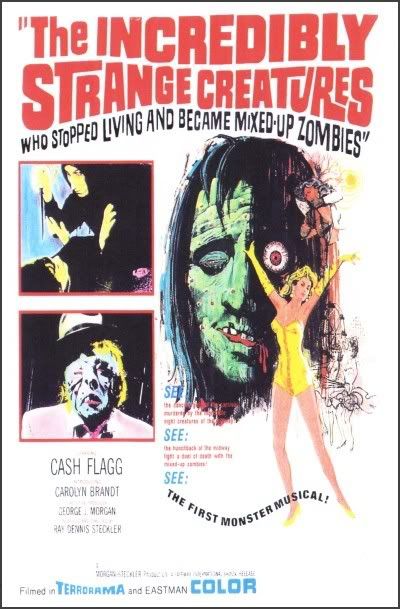
The Incredibly Strange Creatures Who Stopped Living And Became Mixed-Up Zombies
by Ray Dennis Steckler
How do I begin to talk about Ray Dennis Steckler? Ray Dennis Steckler was a writer, producer, director, assistant, editor, actor and cinematographer of some of the worst (and consequently most fun) schlock movies ever made. Whenever Ray Dennis appeared in movies it was under the conspicuous nom de plume Cash Flagg. He wrote, edited, and photographed under varied other ridiculous names including Cindy Lou Sutters, Michel J Rogers, Christopher Edwards, Sven Christian, Sherwood Strickle, Wolfgang Schmidt, Harry Nixon, Conrad Denke, Max Miller, & Sven Hellstrom. (Incidentally Steckler clearly wasn't the only interested in preserving his anonymity as other preposterous names appear in the cast list of The Incredibly Strange Creatures Who Stopped Living And Became Mixed-Up Zombies. To name but two: Atlas King and Son Hooker) The conspicuous number of women's names on this list and the fact that Ray's directed himself in a part in Incredibly Strange Creatures that called for a good deal of dancing, prancing, and spinning that I'm sure wasn't in the script leads me to wonder if Ray Dennis wasn't the first closeted homosexual b-horror director. It certainly wouldn't have been out of place given the character of the kinds of people who made these movies. Ed Wood was a transvestite, Coleman Francis was pretty much sexless, Doris Wishman had to have some kind of perverse nature because she just started making movies about naked people one day, Michael & Roberta Finlay were a married couple who practically invented the genre known as the Roughie, which consisted of pornography punctuated by scenes of graphic violence. These were not normal people when it came to sex and so it seems only natural that Steckler might join the ranks of sexual deviants behind the camera.

Incredibly Strange Creatures has two plotlines, both listless and lazy. One follows a female hypnotist who tells fortunes to make a living. On the side she bewitches men to do her bidding, which includes killing people who ruin the nightclub she runs by performing drunk. When she's finished with them she pours acid on their face and locks them in a closet. The other concerns a 30 year old teenage girl named Angela who's upset her mother by going steady with Jerry the ugliest hood in town. Jerry has a car and he's played by Ray Dennis Steckler. He's supposed to be a young man, but he looks like Max Schrek in Nosferatu. Jerry and his friend Harold drive Angela to a carnival where we'll watch them ride a rollercoaster for 10 minutes and not do much else. I get the feeling Steckler was trying to make a John Cassavettes type realistic beatnik film, but half-way through realized that horror sells better. The film mostly consists of dancing routines at Estrella's night club and footage of Jerry, Angela, and Harold doing absolutely nothing. Jerry eventually gets hypnotized into killing one of the nightclub gals and then accidentally strangles Angela at a family barbecue when he has a relapse looking at a spinning umbrella. Along the way there are a dozen or more full song-and-dance numbers, some of the most elaborately kooky Kenneth Anger-type dream sequences ever imagined for no budget in which our tortured hero sees a giant stone head talking to him (not unlike the kind Aderbad worships) and does a few twirls and ballet leaps through the air while being confronted with go-go dancers from the nightclub.

The film is comprised almost entirely of filler; so much so that when the zombies actually make an appearance I was truly excited to see the hokey bastards. Considering that Cash clearly didn't have enough forethought to write a script that amounted to more than 12 minutes of plot, the zombies look a lot better than they have any right to. There a number of pleasant, stupid surprises awaiting the viewer of this film; watching the camera zooming in and out on Cash's eyes whenever he's being hypnotized by Madame Estrella; seeing the plot get more and more muddied and then seeing Steckler handle it by shooting another dance sequence; watching Steckler run scared from the waves on a beach during the climax. It's likely that Dennis Ray had a partnership of some of kind with this nudie bar because if he couldn't afford real actors or sets there's no way he was going to spring for all those costumes or the rights to any of the music. the fact that one of these performers is listed in the credits as "Bill Ward as Himself" leads me to believe these people took their fourth-rate showbiz work as seriously as Steckler did his film career. The tagline of this movie makes it look like the music was intentional, that Steckler set out to make a movie that made equal use of night club performances and the hypnosis subplot, but it just seems so secondarily considered and has no connection to the plot. More likely is that like in most of these movies, they ran out of A roll and started using B roll as fast as they could. It's the only possible explanation for the lengthy dance sequences in Skydivers, The Horror of Party Beach, and The Astro Zombies. This is a trick Steckler used in almost everyone of his movies.
I look at movies like this and think: you had the money, a bunch of people willing to do anything you said, effects, a night club, props, permits...why didn't you just make a movie about a nightclub? Why not make a Killing of a Chinsese Bookie-type deal? People might have believed Steckler as a hapless pervert, whereas he falls flat on his face as someone that anyone could find attractive. Steckler could have made any film he wanted to, and he chose this. Directors of the 60s are the most troubling examples of men with vision. Ray Dennis, Coleman Francis, Ted Mikels, Herk Harvey, Del Tenney, Harold Warren, Roger Corman...They could have made ANY movie in the world and they gave us The Terror, Manos: The Hands Of Fate, Carnival of Souls, The Living Corpse, The Beast Of Yucca Flats and dozens of other shitty movies that are so completely devoid of anything resembling the trends of a Hollywood film. It's almost touching when you think of the things they were trying to do and that they wouldn't let anything (plotholes, lucidity, reason) get in their way. The only thing dictating their movies was the market and that's why we have so many horror films to view today. I guess I can't complain.

Tuesday, January 29, 2008

Don't See Teeth!!!!

Yeah, forget what I may have said before now, I saw Teeth and it was terrible. It is a movie about the biggest wasted opportunities in life. Every possible point of interest they establish in the first half is completely destroyed by the stupid humour in the second. Ok, when one hears of a plot so outlandish as this - a toothed vagina - the mind races. 'OH, THE POSSIBILITIES' it says. Well when I saw Teeth by Mitchell Lichtenstein, 'ARE YOU KIDDING?' is how my mind replied. It starts well enough: a creepy chastity-vow girl lives in a town where giant computer generated smoke stacks run at all hours of the day and night (this by the way is supposed to be our explanation for said teeth). She meets her dream boy, who turns out to be a sleaze bag and introduces her to the real reason she's been subconsciously celibate all these years. Then it's frat-boy, black-humour all the way to the sickening, stupid, powerless conclusion.

Teeth
by Mitchell Lichtenstein

I don't often draw lines, but when a films attempt at subtlety is an anal sex joke, I just can't help but feel like I've been cheated. Look up the plot elsewhere, I'm too mad to fucking recount this dumber-than-hell story. This movie could have been incredible. It could have been the first smart, feminist, atheist horror movie of the new millennium. Instead it turns out to be a riff on a really stupid sex-as-a-weapon theme filled with severed dick jokes. Oh I never tire of the dawning-realization set-piece! Or how about all those severed penises, right? HAHA! This movie isn't in favor of women, it stands before them and shouts "I'm still afraid of you and don't know a thing about you! Hope you like dick jokes!" The big mistake it makes is to play every second of it's second half time for laughs. This has the effect of making every dramatic element set up in the first half fall flat on its face. You can't tell us its a comedy and then ask to feel anything but contempt for it. Laughing at a woman being tricked into sleeping with someone is not only tired, stupid and painfully unfunny, it's pretty fucking appallingly insensitive. I'm sorry I don't find tricking someone into losing their virginity all that funny, especially when we were shown a rape scene not 10 minutes ago. Make up your mind, cause this in limbo nonsense isn't working. What's especially galling is that Lichtenstein seems to think he can get away with laughing at women's misfortune by piling even more misfortune on top of an already unjustifiable awful story and that it's all going to even out. Sorry, not having it. I don't see how any movie that hinges on a tattooed ape-man finding his sister attractive as the basis for a dramatic climax could be anything but unwatchable shit. You want to make a movie that supports women? Fine. Don't waste my time and money on unbelievable character development and personality changes that wouldn't fool an 8 year old. Just because you found something in a history book while studying for midterms and you and the kids on your floor thought it was funny, doesn't mean it warrants a movie. America and its black humour! Give it a rest, already! I haven't been this disappointed by 'jokes' ruining a good premise since Eight Legged Freaks. If I wanted David Arquette interacting with spiders, I'd feed him to a pack of them! I want to be SCARED, you hapless dipshits! Stop trying to be so clever! You are not that funny! It's like the 40s all over again. When a horror movie of this gravity is predicated upon humour, it condescends its subject matter. When that subject matter is currently the subject of torture and violence as we speak, those who joke about it deserve to be shot into space where their ignorance can't do any harm.

(Added several days later) A brief addition to my notes on teeth. Firstly, women have been mistreated in ways that outstrip the atrocities of the last century for the last two millennia. To make light of that is tasteless and cheap. Here's a tip, think about the fact that girls were and continue to be raped by men who don't understand how HIV works every day for years and years. Second, I've seen my fair share of rape revenge movies (I hope never to have to pull that piece of information out again) and none of them have been this dumb and mean. I've seen I Spit On Your Grave, Irreversible, Ms. 45, Thriller: A Cruel Picture and all of them manage to stick with their original message; Women are mistreated by big, stupid yahoos and the only fitting way to deal with them is to castrate them, pull their heads off or gun them down. Don't misunderstand me, watching rape is never easy, nor do I ever recommend making it the subject of a film where it has to be shown. It happens, it is real, women fear it, so inevitably, it will end up on movie screens. For the most part, these films tread the fine line between horror and just plain tastelessness, but next to this horny piece of shit, even Last House On The Left has more sensitivity. Rape in the movies has been around since 1929 (Alfred Hitchcock's Blackmail is incidentally one of the boldest movies ever made for this reason, and did a much better job than most films on the subject) and so to have people resurrect a myth that has caused so much suffering for women everywhere and then have a female character embrace it, embrace the kind of bullshit that's been responsible for mass rape and death and ruined lives...well that's just the ugliest thing I've ever heard.

Saturday, January 26, 2008

The Not-Too-Distant Future

Here’s a riddle for you: How do you get twenty somethings into a movie theatre? It’s something Roger Corman’s dedicated himself to constantly solving and resolving every day. The answer, more or less, hasn’t changed much in 50 years (thanks mostly to Tom Graeff), but the nature of the solution has changed quite a bit. J.J. Abrams knows the answer and his film Cloverfield proves it. It’s making millions internationally and in about a month, Corman and dozens like him will start making their own Cloverfield. This movie’s success makes me kind of nervous as to what to expect in the future. It’s not that it wasn’t a decent film, it just felt more like I was watching an FPS (and getting sicker and sicker with every passing minute) than the future of horror movies. And, as I’m sure many of it’s viewers can attest to, I didn’t have a good feeling about much after the lights came up. I bet Roger Corman wishes he had his name on this one, because I get the feeling this will be what teens talk about in favor of Saw or 300…at least for awhile. The answer to the riddle: put them on the screen.

Cloverfield
by Matt Reeves

Cloverfield (the arbitrariness of the name is a little maddening) follows an ever-dwindling group of twenty somethings as they go from unenlightened party guests to unenlightened monster victims. Their actions on the night of an undersea/outerspace monster attack are captured on a handheld digital camera wielded by the movie’s comic relief. This film, believe it or not, is pretty misanthropic. First of all, the motivations of the protagonist are predicated upon some vicious thing he says to someone he slept with before she leaves his party. He’s leaving to take some job he’s clearly not qualified for, professionally, mentally, or socially, and doesn’t want to leave without her knowing how he feels about her, so, of course he goes back into monster-infested midtown Manhattan to rescue her. I’ve seen this plot handled with much more tact and charm than it is here and with characters I actually sympathized with. Second, the use of digital footage and the one-take only style filmmaking means that no one’s death can be treated with anything other than passivity; the emotions follow, kind of. We see literally hundreds of people (or just one character we’ve been asked to attach significance to) killed and then we listen to emotionally stunted twenty-three year old babies talk out their feelings. In the end, it won’t make any difference (not only because the death of thousands of innocent people is just scenery to a really, really lame romantic subplot. In this regard, it’s kind of like The English Patient; ‘our love is more important than all of this noise.’ I won’t ruin the ending, but when you see it, you’ll see why this is even more trite than it sounds). Put yourself in their shoes for a second and tell me if they don’t sound a little cold: you’ve just seen your friend explode. Need a minute? No? You’re cool? Ok. And scene! That’s what I thought.

The sound design was very well done as others have already observed, and the creature was ok, but I couldn’t help feeling like somebody had just seen The Mist. The tentacled monster with small spider parts wasn’t exactly the reinvented wheel everyone claims it is. And I’m also kind of miffed that they managed to sneak in product placement too. As if this didn’t feel like a big decision already, they had to add new music (not just current, but NEW) and fancy electronics. Oh and the other thing, how the hell do these jackasses afford such nice Manhattan apartments? The hero doesn’t look like he could be the vice president of his shoelaces, so explain how he and his brother and his girlfriend all live in the biggest lofts I’ve ever seen. I mean, I know some people come from money, but, Christmas! Also, at what point during the motherfucking apocalypse do you stop being a smart-ass. After seeing the gaping hole in somebody’s chest after some kind of monster attack, I think that’s when you stop impersonating Dane Cook. These are things that probably only impeded my sympathizing with the characters, but, if someone’s going to split hairs, it’s this guy.

The motivation behind the digital camera set piece are explained in one sentence, and I’m not the only one who has issues with it. Critics have cited “people are gonna know how it all went down…” as the films biggest misstep. The reasons for filming people being bitten by subterranean bug creatures, confessing to sexual misconduct, or a forced introduction before your blown to pieces, or one case your own death, are all equally gross, and it’s supposed to be the message of this million dollar movie. Kids film stuff, so why wouldn’t they film everybody getting eaten by monsters. Sadly, given today’s youtube climate, I can’t offer any argument. If it was me, the camera goes off when the big fucking tentacles shows up, but others might not be easily dissuaded. “it’d make a killer viral vid, man!” I don’t get this, and so the movie loses a lot of its appeal. So, in the face of such adversity, like the true film nerd I am, I just spent most of the running time questioning the mise en scene. How much could we actually see if the camera operator was legitimately running for his life. And let’s talk about that. I had eaten before seeing this movie…turns out that was a mistake. For the hour following Cloverfield I just felt sick. I hope that horror movies don’t all end up like this one; I don’t think my stomach can handle it.

It’s not unreasonable to assume that this Gonzo-type horror film is going to be en vogue for a little while. George Romero’s Diary Of The Dead uses the same trick and Zach Snyder played with it in his Dawn Of The Dead, so clearly Abrams is on to something. Mark my words, Dandelionfield and Weedfield to follow and Roger Corman will get his fingers in this pie if it’s the last thing he does. People are comparing this to Blair Witch. I get it, but the important difference is I could see searching for the three kids from that film when they go missing. Also, love it or hate it, people couldn’t get enough of that movie. I think it’s still the highest grossing movie of all time or very nearly. Let’s see if Cloverfield pulls off that trick.

Sunday, January 20, 2008

Japanese Screams - Volume 6

1968 was a pretty incredible time for horror films. Films in general were going through a rennaisance, John Cassavettes with Faces, The Maysles Brothers, William Grieves, but in horror, there was something really remarkable going on. Night Of The Living Dead destroyed all genre conventions (while borrowing from a few others). Peter Bogdonavich used Roger Corman’s money to prove how stupid Roger Corman and his cronies were being with Targets. Rosemary’s Baby was the perfect use of the horror talkie and the new sex & the devil sensibility. Tigon had just made Witchfinder General which would inform every satan worshipper movie for the next 20 years. The films explored in this series were by no means as influential, but they were certainly more unique. Going into a forgotten (understatement) late 60s Japanese ghost story, you don’t expect to find something so completely fascinating as this. What I’m about to claim is 100% speculative, so don’t do anything rash, like take any of it to heart, but in 1968 Nobuo Nakagawa made a cautionary socialist ghost story that may have influenced The Exorcist and Kurosawa. Bold of me? Just the beginning.

Snake Woman’s Curse
by Nobuo Nakagawa
We start and end with some perfect Heaven and Hell Nakagawa imagery (a barrel breaking to reveal a ghastly green woman, snakes thrown onto glass like a sack of viscera), we are given the rundown in voiceover. In early Meiji period Japan, (no later than 1890) a brutal landlord essentially brings about the demise of a small dirt-farming family. When the husband dies of a lung deficiency, he orders the wife, Sue and daughter, Asa out of their house and into his to do manual labor, so that their house can be destroyed to make room for god knows what. After a few days of living under the Dickensianly-heinous rule of the landlord’s wife and his overseer, Sue is killed, leaving Asa alone. Her only comfort comes in the form of her hopeful boyfriend who promises to marry her when the time comes. She doesn’t even really have time to dream in starry-eyed wonderment of what life without the landlord would be like because his son comes home to get married to the police commissioner’s daughter and instead takes a shining to Asa, in the worst way possible. After the landlord’s son violates the girl a few times, and her boyfriend finds her dead, he discovers the bad luck that comes from seeing his bride in her dress before the ceremony. Soon he and his father are plagued with visions of the dead family and are in no mood to atone.

Ok, where to begin. First I guess we can start with the history. Japanese films, more so than just about any other country’s output, have had a focus on historical accuracy. Kenji Mizoguchi, Akira Kurosawa, Masaki Kobayashi, Kaneto Shindo, Masahiro Shinoda and the dozens of filmmakers had all by 1968 made rich and fascinating narrative films with little to no anachronisms or careless mistakes. Nakagawa, from what I can tell, hadn’t really concerned himself with the kind of period-specific storytelling that his peers did, but here he shows he was no less capable of raising the same issues without detracting from (indeed enhancing) the movie’s effectiveness. Here we see the clashing of the old-world Japan clashing with modern Japan. Of the old we have the unquestioned rule of a brutal landlord, unspeakable working conditions, an old man known for hypnosis, a séance performed by a mystic, and no medicine or psychological theory to speak of. Where this movie first caught my attention was the appearance of a horse-drawn carriage, and if Val Lewton has taught me anything, it’s that the appearance of such a carriage means the appearance of a wealthy bastard is soon to follow (the angle here made me think Joe D’Amato watched this before making Death Smiles On A Murderer). The carriage also meant we were on the cusp of modernization; Meiji meant ‘enlightened rule’ after all. Seeing the emergence of justice in the form of the Police Commissioner and the landlord’s complete disregard for their authority was really something. We see that in the long run, the appearance of the law doesn’t make a lot of difference in the events of the story, but it does serve to frustrate both protagonist and antagonist. The commissioner doesn’t act in time to do anything about the murderous stupidity of the richest family in town while their wealth could make him happy; when it no longer makes a difference he wants answers. Nakagawa has a point; nothing much has changed in a hundred years. But it is a good foil to the ignorant, powermadness of the landlord when he has to consider the thought of someone standing up for the tenant farmers who serve him. In his mind, they are lower than dirt, so why should it matter when they are killed, or who kills them. The law means less to him than the mockery that his son’s wake becomes. The peasants show up to the séance, but make such a racquet while the medium tries to communicate with the spirits. The belief in the spirit world is waning here. The landlord himself doesn’t seem to give a damn about the whole mess, he does it merely because he doesn’t want to seem heartless and possibly to get some clue as to where the visions of snakes and dead farmers are coming from.

Incidentally, the use of a snake seems to have a cosmetic choice more than anything. They are relatively spooky, live in rural Japan and many exist that pose no threat to humans, and that I believe is where the choice came from; Scales are also easily mimicked. Nakagawa avoids the usual snake-pitfalls, medusa mythos or anything else remotely serpentine, which could be seen as laziness or caution, depending on your mood. Ultimately it feels almost unmotivated. Scorpion Woman’s Curse or Lamprey Woman’s Curse would have made for much scarier dream sequences, but I guess seeing your spouse covered in scales would be just as scary as anything else. The landlord’s son’s fear is made twice as understandable when put in the context of the marriage of convenience he so willingly takes part in. Being unhappy with his wife means discord between his family and the commissioner, and it also means he’ll have no one to take his sexual frustration out on, and so we see him actually considering sleeping with a lizard after a few run-ins with his conscious. This is pretty well done; we obviously feel no sympathy for the man, but putting ourselves in his shoes is not exactly comfortable. It is also a perverse comment on feminism. We both fear the scaly woman, but understand that her appearance is the orchestration of the angry ghost of a wronged woman. It does speak to the complete and utter helplessness of women in Japanese society. On the one hand we have a woman beaten by her employer and sexually abused by his equally wealthy and twice as piggish son. On the other we have the young bride, equally terrified of ruining her chances in marriage and of her brutish husband who continually tries to strangle her because of his lame mind. Even the tyrannical wife of the landlord winds up a victim of her husband’s insanity. There’s more worth uncovering, but, I don’t know nearly enough about feminist theory and manipulation to take any larger a stab than I already have. My guess is Nakagawa didn’t really care, but that’s ok.

The technical aspects of this movie are splendid. I think in the gap between Jigoku and Snake Woman, Nakagawa picked up a thing or two. The movie is shot pretty much entirely on real sets, outdoors as opposed to the back lot that most of Jigoku takes place in. His camera is also much grander. Shots and angles are longer; he feels more comfortable setting up at a comfortable distance from the action and just letting things happen, a far cry from the splice happy rhythm of his earlier work. I have a feeling that this came from watching Kwaidan, but most interesting is that this is the same kind of impersonal camera Kurosawa would adopt after his suicide attempt. Kagemusha, Dersu Uzala and Ran all had the same withdrawn view (and lush green color). He still used the same make-up and juxtaposition of ghastly apparition types as he did in Jigoku, but this time, he has a more grounded reality to contrast them with. This works greatly to his advantage. This is where my Exorcist claim comes in. it is in these scenes of sudden change and mixing of moods that the films influence is most felt. Take for example the scene at the séance. The landlord pulls himself out of the séance (a scene not unlike the exorcism itself) and the turns and sees the congregation of peasants has been replaced by a group of white-clad figures. This had exactly the same effect as watching Reagan MacNeil turn into Father Karas’ mother. Granted Nakagawa didn’t have the same sense of careful composition that William Friedkin did, but Friedkin wasn’t churning out B pictures for Toei, either. This isn’t the only crib I could spy either. The scenes of the carriage riding past the farmers, the nonchalant introduction of our male protagonist, the children running just before the wedding ceremony; they are all composed in ways not unlike the scenes in Northern Iraq.
The final aspect of this movie I want to draw upon is the storytelling. It is much less manic a story than his earlier works and makes sense from start to finish, which is always a plus. It’s story of woman thrust into unfair circumstances, despite the efforts of their friends draws heavily on another B film. Snake Woman’s Curse could almost be said to be an American version of Carnival Of Souls. We follow a woman’s descent into madness, brought on by an oppressive reality that results in a harsh fantasy world. The difference being that in Snake Woman, Nakagawa’s heroine isn’t the one who gets saddled with supernatural horror; this time the oppressors get their just deserts. Akemi Negishi certainly makes a better showing of herself than Candace Hilligoss did, but their mood is the same, a sort of reigned-in horror. At no point does either woman let their emotional state better them, they never scream or cry gratuitously. They have a lack of control, but unending dignity. For other parallels see the scores of both films. Gene Moore’s organ and Shunsuke Kikuchi’s Theremin sound eerily similar, in that you wish for both of them to stop the second they start. Jesus, nothing kills a mood quicker than inappropriate musical choices. Also, of course there are the recurring motifs, Snakes and Herk Harvey’s face, respectively.

So while he seems to have taken a fair amount from Val Lewton, Herk Harvey, and Masaki Kobayashi, Nakagawa proved that even on a B budget, he could make a film just as interesting as any of his heroes that could inspire generations of directors.

Thursday, January 17, 2008

Japanese Screams - Volume 5

Ok, so, yeah, I lied, but who's paying attention. When you run into really excellent (not to mention) original horror films, you just kind of have to tell people (even if only technically) so that the unknown can be visited by others. So, this edition follows a film that I admit I wasn't nearly the first to discover; it made two rounds on TCM before I was able to catch the thing and Tarentino had already stolen from it by this time. But it is just as wild as anything and so deserves as much time in the sun as it can be given. This is a film after all that pays homage to American Alien films from the 50s and preempts Italian gross-out films by a few years. It's also got a head on it's shoulders that is a little more self-aware than Mario Bava's. In any case it knows enough to know that is its going to introduce plot elements like a frat-boy vomiting, it has to do so at the same pace. If we have time to catch our breathe, we would reel in the stupidity of some of these elements, but because they jump out at the audience like spring-loaded snakes, they make us smile with amazement, rather than shake our heads.

Goke, Body Snatcher From Hell
by Hajime Sato

After an offscreen assassination of the British Prime minister, a plane full of crazies flying in a blood red sky are told in very quick succession that the assassin is on the plane, and so is a bomb, and the plane is going to crash into a UFO. Crash it does, leaving only a handful of people alive. The Co-Pilot and a stewardess from the plane, an American woman, two business men, the guy with the bomb, a psychiatrist, and the assassin are all alive on what I take to be a deserted island (Now, I say this because there appears to be only a beach and rain forest surrounding them. In hindsight, my assumption was really just that, as their whereabouts are never discussed until the ending, when I found myself flabbergasted by the truth. In all fairness, if I was right and this is a deserted island, than the ending would be ten times as big a kick in the pants). Soon after they land, the assassin tries to make off with a hostage, but is stopped when they encounter the UFO, now parked and glowing red on the other side of the beach. The aliens dispatch a slimy, worm-like ambassador which burrows into the assassin's face and possesses him. After the initial panic, the survivors realize that they are in a hell of a jam and need to try and work together to overcome A. The well-dressed alien stalking them, B. the possibility that there they may be more where he came from, C. the thought of never being rescued, D. the fact that everyone but the co-pilot, stewardess and psychiatrist are either crazy or so prickish and self-involved that they could get everyone killed.

I like these movies because we are made painfully aware from the start that absolutely no one is on the level. It's a blast watching everybody trying to look out for themselves in Japanese films (for me this never carried over into Spanish or Italian movies, because they never present me with anyone worth liking). Hajime Sato took the frantic pace of his contemporaries' Yakuza pictures, the gore and character types from the Italian horror films of the time, and the plot devices from American flying saucer films (and a little from 40s crime films, too) and blended them together in bolder-than-reality Fujiscope; The colors could give anyone a heart-attack.

This is a very professional film: It never meanders, never slacks off, never shies away from itself, makes its 3 or 4 trick endings seem logical and is an absolute blast. Pay close attention, because this is definitely a blink-and-miss-it type film. Every second of craziness works and amounts to a truely bizarre ride, and to be left out of any of it is silly. The art and effects are really cool (and as if it needed to be said, ahead of their time). Some of them are like pulp comic drawings come to life. The images here are striking and this seems an important steppingstone in horror pictures. 

Tuesday, January 8, 2008

"GIVE ME THE BLOOD, LORD!"


Masterpiece is a word people throw around a lot. (The Greatest is Cat Power's masterpiece. Once is a masterpiece etc.) These uses get to me because either people really love mediocrity or they've just been living in their basement for 10 years and the first thing they saw when they came out was so radically different from the sounds of spider's fornicating that it struck them in such a profound way. Masterpiece is a word that belongs next to very few works of art. Paul Thomas Anderson's There Will Be Blood is one of them. I've seen more movies than I can count and I'm still lucky enough to be surprised by something completely unique once in a blue moon. I had a feeling this was going to be my favorite movie of the last year, so strongly did I feel this that I drove an hour and a half to a city I hate to see it. It is in unqeustionably one of the best narrative movies ever made.

I thought that No Country For Old Men was going to be the high point of art films this year, but this film beats it. The look is much more of the kind of thing the Coen Brothers were going for, but in much more monumental terms. Take for example the scene in which the oil derricks finally break through and the thing catches fire. The colors he uses, the oil filled skies, the burning tower, the sunset, the fire reflecting in Daniel Day-Lewis's eyes. It all plays up the intensity which is made palpable by Daniel Day-Lewis himself, who seems to embody the word seething. He is perfect; as is the score by Jonny Greenwood. Everybody here is just living up to their potential in ways never previously imagined. PT Anderson makes up for Magnolia in a big way and together with his stars, composer, editor, cinematographer and the rest of his crew, he has created a beautiful, unprecedented, remarkably original, creative movie, the best of the last 2 or 3 years. It rivals Inland Empire, Zodiac, No Country and all other films this year in it's sheer audacity. Each scene is just more insane than the next and in the end still manages to makes sense. This is one of the most atheistic, misanthropic films ever made (the fact that it was made today, in the midst of the most religious government this country has ever seen is amazing). In what other film would a hateful, disgusting creep like Daniel Plainview get away with all the terrible things he does and not find anything close to redemption. The one kind thing he does is alienate his son so he is motivated to distance himself from him and his horrible lifestyle. I like to think that his last conversation with his son is a conscious decision, especially after the thing that follows. The ending is the most bizarre violent outburst an American has attempted that I've seen. It's pace, look, color and tone reminds me of a Seijun Suzuki film (like Youth Of The Beast, Story Of A Prostitute and Branded To Kill). Run, friends, don't walk.

Sunday, January 6, 2008

Day For Knight

Now here's a curio the world seems to have forgotten, and it's a good one. How's this for potential: a civil war voodoo movie. Watching this movie makes me think that Hollywood comes together every now and again, sees a movie like this and agrees to bury it and pilfer its more creative moments for better funded projects. For a movie that clearly no one saw, one can draw some parallels to Ravenous, Sleepy Hollow, & Pirates Of The Caribbean that are just clear enough to make me wonder if there wasn't someone paying attention.

Grey Knight
by George Hickenlooper


Morphine addicted union captain John Harling is told that before he can be discharged he has to track down a group of rogue confederate soldiers who have been killing and crucifying whole regiments at a time. The only trace they have left so far is a belt buckle from a Kentucky regiment that his old friend and former professor Col. Strayn used to run. It just so happens that Strayn is in a union prison where he's been for as long as his regiment has been missing. Harling pulls some strings and gets his commanding officers to agree to let Strayn accompany them on their mission as he is familiar with both the territory and the regiment they will be tracking. Also along for the ride are aborted comic relief English photographer and a mute black girl who seems to know more than she lets on. You see she was a witness to an attack by the evil brigade and managed to escape by using fire to scare her attacker. So Harling, Strayn, Mute Girl, annoying Brit, a very humourless Ray Wise and a group of soldiers head into confederate territory. Eventually we'll that the evil soldiers stumbled upon a curse that been condemned to a small cave that Mute Girl's ancestors forced it into. The cave was broken into when the war started and the curse began possessing soldiers who now kill without prejudice, making more zombies for their army. So what happens when Strayn's regiment catches up with him?

Grey Knight or The Killing Box was about as odd a film as could be imagined in 1993; a film led by a string of B actors with little to no production value that combines a lot of elements that would show up in much bigger films in the next 15 years. It's a shoddy affair to be sure, but you can see some flares of originality in this movie, even if it does labor over dreams and voice over a lot more than it can get away with. It was, as far as I can see, a fairly unique premise, even the title is fairly creative. It also relies heavily on pretty silly behavioral ploys; the villains do a lot more menacing than they do killing. The movie looks like it was shot pretty much completely in day for night photography (this gets old pretty quickly) and the footage of the silhouetted soldiers owes an awful lot to The Fog. It has the same kind of energy as The Fog, though Hickenlooper tried to build a little more out of the nothing he was given than John Carpenter did. In that regard it's a little more like Escape From New York (I'm surpirsed Tom Atkins didn't put in an appearance).

What bugs me most is the little things they do to set up intrigue among characters that they just abandon. Harling's morphine addiction for one is ignored almost completely. While they find it necessary to say how anti-slavery Strayn would become after the battle, it never bothers exploring how the soldiers would explain that a group of Zombies had been killing soldiers from both sides of the army. George Hickenlooper did his best, but there just wasn't enough to make it work in the end. He didn't care at all about the anachronisms that seemed to fill every second of the movie (I guess if execs blew their load getting name actors you could give a damn about, you wouldn't care much either, granted I don't know how they convinced Martin Sheen to appear for his 15 seconds at the beginning or whose idea it was). Corbin Bernson, Ray Wise and Adrian Pasdar are professional enough; shortly after this movie, minor players David Arquette, Matt Leblanc and Billy Bob Thornton would explode in a big way. There are too many little coincidences here that suggest someone with deep pockets paid attention to this movie, even if audiences didn't. For my money it's better than all of the direct to video zombie films released ever since. Seeing Grey Knight has reminded me just how little creativity is left in the movie making world. A movie like this, cheap as it is, had enough going for it to spark a fair amount of rip offs. Whens the last time a horror movie, studio picture or straight to video, made use of a wholly original concept, enough that the lowliest of filmmaker sought to rip it off. The days of unique rip-off culture are long dead I fear. Oh sure, there's still a When A Killer Calls every month, but dammit, the heart and soul of this business is long dead. What happened to the Dan O'Bannons and J.R. Bookwalters of the world? Zombie movies have seen much better days than these.