Friday, November 28, 2008

The Big World of Little Films

In the world of independent horror film there is a group of filmmakers, competent and imaginative, who work in a team akin to the Coppola, Lucas, and Spielbergs of yesterday and the Cuarón, Del Toro, Iñárritu, and Almodovars of today. Not that Cuarón and those guys aren’t in a sense independent, but they have the budget and mainstream precedents that will carry them as far as they’ll ever need (in fact Del Toro’s latest job, pinch-hitting for Peter Jackson on the Hobbit, should guarantee that they can all make whatever incendiary films they want until there as old as Alfonso Arau). This small collective of filmmakers can, together, do just about anything that needs to be done. Graham Reznick, Glenn McQuaid, Ti West, and Larry Fessenden (and David Gordon Green, kind of; he’s in there with them, but he doesn’t make horror films), together with regulars John Speredakos, Kevin Corrigan, and Ron Perlman have crafted many effective, moody, and creepy horror films made for next to no money through their production company Glass Eye Pix. Fessenden, being the senior of the group, obviously has something of an edge where quantity is concerned; his work extends back to the short films he started making in 1978 when he was only 15; I don't know about you, but I think it's pretty funny that his first film was called Jaws three years after Spielberg released his film. He started off the rash of no budget shockers with his film No Telling in the early 90s. His films spend a lot of time on character development, spend a bit of time establishing moody atmospheric scare scenes and then the creature arrives at the end. Incidentally, Fessendan really likes the Wendigo story, cause he's used it twice now in the films of his I've seen. The conclusion to Wendigo is one of the more inventive and spooky cheap film endings I've yet to see; it's worth the price of admission. Glenn McQuaid typically does visual effects for the other guys, but his film is the one I’m most looking forward to; it’s called I Sell The Dead and it looks like a blast; it looks like a continuation of a short film he made with Fessendan called The Resurrection Apprentice. Graham Reznick does sound design for these films and he has a feature-length thriller under his belt called I Can See You. Ti West, however, is the man we’ll be concerning ourselves with today. His most impressive entry into this delightfully amateurish crew’s oeuvre is called The Roost and its the one film that fits in with my mission statement. The Roost, is a sort of zombie film, and a great, unpretentious Evil Dead tribute that was a lot of damned fun.

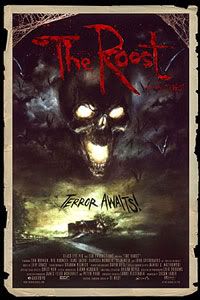
The Roost
by Ti West
Ti West lets us know what sort of film this is right away in the framing story. We meet a TV host (Tom Noonan, the big creepy guy from Manhunter and a few other Michael Mann films and Charlie Kaufman’s Synecdoche, NY) who tells us we’re in for a sppoky story. There is no sound design to speak of, his dialogue is clearly being read off a cue card, is full of bad puns, and he wears a Dracula costume. Noonan does a laconic, 60-year-old Criswell impersonation for a few minutes before we enter the story proper. Four kids who clearly have some ties to each other that we don’t need to understand to enjoy the film are driving home when their car careens off the road and they’re forced to find a phone; as is common in horror films, cell phones are not an option. They go to the nearest house to ask to use their phone and surprise, surprise, no one answers. A quick inspection of the barn behind the house reveals no signs of life that they want any part of; where should I start? The bats or the zombies? Well, let’s go with the bats. The four twenty-something interchangeable protagonists will intermittently encounter a horde of almost convincing front-projection bats; The bats’ bite cause ordinary folk to turn into bloodthirsty zombie-type things that make our heroes’ stay at the barn all the more difficult. The sheriff arrives and does about as much good as the one in The Last House On The Left, Night Of The Living Dead, or Marcus Nispel’s Texas Chainsaw Massacre. These kids are going to need a lot of luck to get out of this one alive. Meanwhile, back in the framing story, we’re treated to the identity of the ‘master’ that Noonan keeps referring us to.

Like a lot of the Glass Eye Pix stuff and other recent independent horror films (Soft For Digging, Ils, Cool Air) The Roost is set in a desolate location, has refreshingly believable protagonists, and gets major points for atmosphere. Unlike those films, The Roost spends most of its running time giving you Sam Raimi style jump scares heightened with extremely gory flourishes. Like its most obvious influence, The Evil Dead, The Roost has its major stylistic device down pat. Every time West lulls us into a quiet spot he and his undead boogie men burst out of nowhere and scare us stupid. Like other backwoods films (Raimi’s films or grimmer fare like Axe or Just Before Dawn) it spends its time with a tiny group of people and makes with the fright quickly and cheaply.

The cheapness of The Roost adds to its charm in a big, big way. We have Glenn McQuaid’s awesome visual effects (the bats are what they are, but at least they don’t dance on the end of a string). Whenever someone gets their face bit, we know it. West doesn’t flinch when its time to show what his make-up guys are capable of. The Roost has its moments where it achieves scares just as good as many of the ones Raimi got in his heyday. Ti West knows exactly what he’s trying to do and can carry out incredibly effective budget effects like no one I’ve seen in the last 20 years. The gore looks better than even George Romero’s latest efforts. It’s funny how much technology gets in the way of good story-telling. Take for example the switch from miniatures to computer generated effects in the sci-fi genre. With a movie like Aliens, for example, it’s nearly impossible to tell what sets are miniatures and which aren’t, and I for one think we should never have abandoned it. It’s a little like the black hole basement in Sweden or wherever; hey, we have this technology, let’s use it. Does no one think to ask why? We have computers that can simulate blood flowing out of someone’s head like they’ve been shot. Didn’t we just spend the better part of 70 years trying to get this right using real effects? Why would we abandon it when something more expensive comes along? I don’t know, but I do know that Ti West’s The Roost proves you don’t need money to scare people. In fact, the one point in which animation was used (those bats, again) is the one thing I have to complain about. The Roost is a great little film; it feels like a little film but it scares like a big one.

Glasseye Pix recently produced a film called Wendy & Lucy whose musicless trailer actually unsettled me more than most horror films released today. It just goes to show you that less is more in most cases. Sometimes, however, an imbalance in elements can make for a frustrating hour and a half. Which brings me to another independent near-zombie film made by a group of friends. This time, the personalities of each contributor is out in the open; you needn't look to their other work to see who brings what to the table.

The Signal
by Dan Bush, David Bruckner, and Jacob Gentry

The film's opening is deceptively disorienting. A woman screams alone in a concrete shack in the middle of the woods covered in blood as a retro title sequence plays out over her pained expressions. We'll never return to this, because it's a clip from one of Gentry's other films. Lame. Just when I thought I was being taken into a shockingly original and gory nightmare world that was both a throwback and unique, like The Roost, the story proper begins and its a dubious melodramatic affair. Chapter one, directed by Bruckner, is called Mad Love. Well, this just wouldn't be a revisionist zombie film without some doomed lovers, so lets bring them out. Meet Ben and Mya, a pair of homely lovers who meet in secret so as to avoid confronting Mya's abusive jagoff husband Lewis. Ben's convinced, as these types generally are, that they can make a go of an ordinary life away from Lewis. Mya, with visions of living of sin in her head, leaves the rendezvous and finds a Let Sleeping Corpses Lie-esque societal chaos waiting for her. People are violent, sick, and ill-mannered everywhere she looks. Why? It has something to do with the signal that's on every TV in town. The icing on the crazy cake comes when her husband, fueled by what at first appears to be jealousy, beats one of his two drinking buddies literally to death. Strangest of all though is the fact that Lewis doesn't show the slightest sign that he is at all phased by his own actions. Mya flees with Lewis' surviving friend Rod and just misses Ben as he storms her apartment building looking to make good on all his "let's leave this place" bravado. He finds more people turned insane by the signal that's all over town.
Chapter 2 starts when Mya leaves her apartment and crashes her car outside a condominium populated by recently crazed buffoons. There's Anna, whose new years party preparations got put on hold when she killed her husband, but doesn't realize she has. There's Clark, her landlord, whose only slightly more with it. There's Jim Parsons, their neighbor, who, with Kramer-like clumsiness walks into a death trap. This is the funny part, in case you were wondering. The second chapter is the most aimless of the three in that Jacob Gentry, who directs, tries to squeeze every last ounce of humour out of the idea that there's bad shit going on outside but no one inside knows it. It's funny at first, but...this isn't really a comedy last time I checked. The film then screws around for 45 minutes establishing what we already know: that Lewis is a jealous asshole who'd kill people to keep them away from his wife. Things end badly for everyone but Clark, who is saved by the last minute intervention of Ben.

Chapter three finds Ben trying to jog Clark's memory about Mya's whereabouts while Lewis tries to hunt them down. Clark decides that the best way for him to regain control of his thoughts is to take Rod's displaced head and attach electrodes to it a la The Brain That Wouldn't Die. Clark finally remembers that a certain blond mentioned going to a train station to leave town with her lover; the two men are off at once. They reach the train station and this segment's director Dan Bush confirms that we're in the psychological horror part of the evening. Instead of the sweaty, grimy, bloody climax we were promised in chapter one, we get 15 minutes of Lewis and Ben trying to out-think each other through voice over and flashes of the signal on a bunch of TVs nearby. Need I say who wins? In the end, however, I can't say I really have any clue what happens.

The Signal was fun while I was watching it, but, as soon as it ended I felt cheated. The performances are all great especially coming from relative nobodies and the editing, production design, and cinematography are extremely well executed. So what we have is a problem of direction and writing, the curse of the anthology movie. Where were all the zombies? Where did all that madness go? Now, my main issue with this movie stems from the fact that a review told me this was a zombie movie. It's not, and so I should just get over it, but that's not this films biggest failing. The first act sets up a perfectly serviceable plot with acceptably trite cliches in a new kind of situation and then acts two and three drop the ball pretty spectacularly. Bruckner put so much time in setting up a great, paranoid first act and his two collaborators were not the least bit interested in picking up where he left off. Here's what chapter one sets up; the signal, whatever it may be, is turning people into violent sociopaths who act on their every impulse. Where does the signal come from? How does Ben keep control of his thoughts? What about the music in Mya's headphones keeps her from going as crazy as everyone else? Why was Rod spared? What is the Signal actually doing to people's brains? What does the rest of the city, or the world look like? Well Gentry and Bush could care less and we'll never learn the answers to any of those questions, save one; Ben's immunity is explained pretty pretentiously by Bush. I wouldn't have found the last two thirds of the movie so disappointing if a much better conclusion wasn't demanded of the first act.

We basically move from [rec]-like intensity to black comedy with no answers to sub-Tarkovskian philosophy with no emotion or violence and vague answers. Bruckner had everything more or less in check, but that balance disappears when his segment ends. Where did the Signal come from? TV signals are exclusively man-made and thus must be controlled by human means or something more intelligent. With the production cost of both acts II and III, they could have explained the origin with a scene. Both Gentry and Bush ladled their styles so heavily onto their segments its like we're watching three different films, which shouldn't be the case. I'm not opposed to being left in the dark, but I'd like a little story with my mayhem and psycho-babble. The urgency is dropped; I for one would have liked to see Ben's bravado take the same form as Jim's in 28 Days Later.

Props must be given to David Wingo, sometime composer for David Gordon Green, whose cover of Joy Division's Atmosphere is the recurring musical theme in The Signal. It is a shimmering, pure, and beautiful piece of music that fittingly accompanies the few positive surviving human values in a world gone mad. Wingo is a wizard with layers, textures, and his soulful voice is fittingly haunting and fits his arrangement like a glove. A beautiful song and he was kind enough to give it to me when he discovered iTunes wasn't selling it as a single. Less is more.

Tuesday, November 18, 2008

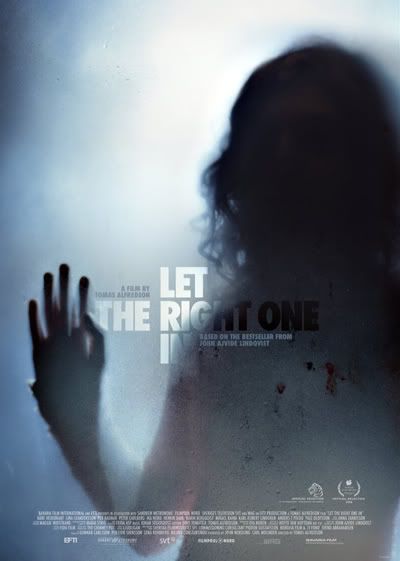
My 100 Favorite Films Volume 7: Let The Right One In

Occasionally you’ll know right off the bat that what you’re looking at is a work of art; sometimes it takes a while, sometimes it’s during a backward glance appraisal. Let The Right One In, a Swedish vampire film I read a tiny review of in some magazine or other, was quite clearly an overwhelming artistic achievement from the word go. I was made totally aware of this fact at one moment in particular: our hero, a 12 year old boy, is hit in the cheek with a stick by a bully and for a split second the sound goes in favor of the high-pitched ringing that accompanies unexpected bursts of pain. No one had ever done that before so boldly and clearly and from then on I knew unquestionably that this was bound to be one of the best films I'd ever seen. With all the mishigas being raised over Twilight and the disappointing sting of 30 Days of Night still fresh in my mind, I’d like to choose my words carefully so that readers will understand that this movie is special in ways few horror films ever manage to be; I’d also like to sit the makers of both Twilight and 30 Days of Night down and make them watch this and then smack their noses with a newspaper. I will say though that rather than read my analysis and take my word for it, you should stop now, drive the two hours to the nearest arthouse that’s showing it and see for yourself that there are still brilliant movies being made, and for the most part, if this and Joachim Von Trier's Reprise are any indication, they're being made in Scandinavia. Would you believe me if I told you it was about a cute 12 year old girl who was also a vampire?

Let The Right One In
by Tomas Alfredson
Open on a hopelessly beautiful, hopelessly middle class tenement building in a village outside Stockholm, Sweden. As 12-year-old child of divorce Oskar stands in his underwear practices his tough guy speech to a window, an old man and his young daughter unpack their belongings from a taxi cab and move into the apartment next door. Oskar is the victim of bullying and it’s not hard to see what makes him easy prey: he is pale, gangly even for a 12 year old, has long blonde hair his mother has clearly not looked at in sometime, he walks as if one leg were longer than the other, and his social weirdness manifests itself whenever he’s called on to talk in class. Clean cut bully Conny and his two not-so-brave cohorts Martin and Andreas make Oskar’s life as miserable as possible whenever they can fit it in. It isn’t until Oskar meets his new neighbor that things start to turn around for our young hero.

We know things aren’t right when, in what might be the most beautifully composed evisceration ever filmed, the elder of Oskar’s two neighbors drugs a passerby, strings him up on a lamppost and cuts his throat. This might be an ordinary killing save for one thing; he catches the blood in a plastic jug. The old man’s plan, whatever it may be, is ruined when a runaway dog brings its owners to the scene forcing him to flee. This doesn’t make his ‘daughter’ too happy, who after a stern talking to issues what sounds like a hypothetical warning “Do I have to do this myself?” Shortly after this botched incident, Oskar is outside after dark threatening a tree at knife point when he catches the young girl spying on him. It will take a lot of coaxing before he learns her name (Eli), but she wants to make one thing clear; she may be the same age as Oskar, but that doesn’t mean they’re going to be friends. This changes after they meet a few times and Eli develops a soft spot for Oskar; perhaps because she has a very adult secret that youthful playtime helps her forget. One night one of the neighborhood drunks stumbles home and Eli lures him under a bridge and savagely murders him with her teeth. Two significant developments then unfold; firstly is that after Eli does her victim in fully, she cries, clearly unhappy about her fate; secondly an old eccentric with a house full of cats happens to witness the murder. Eli’s father hides the body, but clearly things are about to change for the family.

Oskar starts seeing more and more of Eli; she teaches him to stand up for himself and soon he has a crush on her that takes up most of his attention whenever they’re apart. Eli is initially reluctant until the night her dad slips up and gets himself caught while trying to milk a neighborhood boy of his life essence; the old man chooses an incredibly painful method of concealing his identity and covering his tracks so that Eli is left unmolested by authorities. When she visits him in the hospital that night, he says farewell to her and gives her what he was unable to provide while they lived together. Eli visits Oskar that night and agrees to ‘go steady’ as he puts it. Because Eli has to do her own hunting and as she isn’t be as careful as her dad was, she leaves behind a calling card one night when she doesn’t finish off one of her victims; the poor woman’s drunkard boyfriend is understandably a little shocked when she becomes sensitive to daylight, is nearly eaten alive by cats and won’t shut up about a little girl infecting her with something. Time to do some investigating, eh? This guy isn’t any Van Helsing, but he has a pretty good idea who’s behind the whole mess. As if that weren’t enough problems for our heroes, Oskar manages to make yet another enemy. When Oskar takes Eli’s advice about not letting kids bully him anymore and lashes out at Conny with a stick at recess, the little terror’s older brother gets involved; I guess exceedingly stupid and violent behavior runs in the family.

If this movie has one clear precedent, it wouldn’t be Bram Stoker’s Dracula, Nosferatu or its excellent remake, any of Bela Lugosi or Christopher Lee’s takes on the subject, nor that oft-referenced teenage vampire trainwreck The Lost Boys. It wouldn’t even be some of the more recent child-horror films: your 6th Senses, The Rings, or any of Guillermo Del Toro’s three elegiac fairy tales, The Devil’s Backbone, Cronos, or Pan’s Labyrinth. No, if I could point to one film most likely to have been an influence on this film, I’d guess it would be Lasse Hallström’s My Life As A Dog. Another famous Swedish export (in fact perhaps the most famous non-Bergman Swedish film yet made; notice I didn’t say infamous; that honor would go to Alf Sjoberg’s I Am Curious) My Life As A Dog has many thematic similarities including a weak-willed boy infatuated with a much stronger female, pubescent growing pains, a lovely romantic story between two youths of starkly different types, a town full of characters on the fringe of the lead's lives who play important roles in the story proper, parents incapable of understanding their children, and adults in general being powerless to put themselves in the mindset of that thing they’re now least like and most afraid of in the world – a child. The film's theme of childhood being as mysterious as supernatural behavior reminds one of Robert Wise's great Curse of the Cat People, only with roles reversed and modernized. The same shimmering innocence pervades both films and Alfredson has Wise's respect for the extraordinary power of the imagination.

Let me digress for a moment and say that if I had an inner child, she would look and act something like Lina Leandersson does here; this 12 year old first-time actress is my hero. Her Eli, on top of scoring points for being an unrelentingly cute murderer, is one of the greatest characters in film history. Oskar and Eli spend most of their time together asking questions typical of 12 year olds, and its clear that they both suffer from arrested development, albeit for two different reasons. Oskar has his absent parents to thank for his naivete (Oskar has ten times more fun with his dad, but dad still hasn’t come clean about his homosexuality and is clearly ashamed of it, which puts a strain on their relationship), Eli has the fact that her life stopped being that of 12 year old years ago. Between Eli’s lack of friends her own age or any other relationships beyond her male caregiver, she is just as clueless about socialization as Oskar. This is most whimsically demonstrated when Oskar buys Eli a bag of candy in a misguided attempt to be kind. Eli, not wanting to seem rude, eats one and promptly vomits behind the vender’s stand; Oskar panics and hugs Eli, something, I gather from her ridged posture, that no one has done in quite some time. Both Oskar's frightened expectations and Eli's confused detachment ring as true as anything I've ever seen on film. Moments like this are what separates Let The Right One In from all of its contemporaries. Alfredson proves himself capable of providing every facet of John Ajvide Lindqvist‘s source novel and screenplay with equal amounts of care and grace. Incidentally, Lindqvist should receive accolade for both staying remarkably true to vampire lore, while still delivering a unique scenario in which to play with it (for every Martin there's a Dracula 2000 waiting to make it irrelevant). I knew that this movie was not simply good but transcendent just after Eli says goodbye to her father. She comes back to Oskar’s room, her mouth still coated in her guardian’s dried blood, disrobes and climbs into bed with him (Maria Strid's costumes really make Eli's malaise all the more palpable). She has never known loss before and thus her turning to Oskar for comfort in her time of greatest need is beyond touching. They never face each other and Oskar is clearly out of his depth, but the two are completely in the moment and this scene’s tenderness is nearly unparalleled; rarely have child actors seemed so unapologetically, wonderfully childish. When Eli slowly takes Oskar’s hand, I thought I was going to cry.

Oh, and those of you who’re reading this going “it’s a love story, pfft! I’ll just see Saw V, thank you very much. We don’t need another Twilight!” shame on you. Please don’t misunderstand me, the movie works just as well as a horror film; Alfredson is just as at home melting a heart as he ripping one out. And oh, the horror! Let The Right One In is like the There Will Be Blood of horror films. It is quiet, unpredictable, wildly visual, gut-wrenchingly tense, and absolutely mesmerizing. So little actually happens, and what does is so masterfully understated that you can’t help but wait with bated breath from scene to scene. Hoyte Van Hoytema’s cinematography makes for one of the moodiest portrayals of cold weather in recent memory. As enthralled as I was by the awesomely beautiful story of pre-adolescent love and the search for understanding, I was absolutely spellbound by the scenes where the horror elements come into play. Watching Conny observe Oskar and plan his downfall internally is ten times as frightening because this is a film completely unafraid to put its heroes in danger. His classmates put Oskar in very real peril and it almost rivals the gruesome murders committed by his sunlight-fearing dream girl. Another point Let has in common with There Will Be Blood is it’s truly awesome and orgasmically violent climax. This and 28 Days Later now share the prize for greatest conclusion in any film. No other filmmaker has yet been brave enough to make its romantic peak coincide with harm to children under 12 without losing any of his or the movie's integrity.
It’s funny to note how effortlessly a country enters a discourse and makes the homogenized major players seem like the big, monomaniacal teenagers they truly are. Go to netflix and look at their foreign horror; they have two categories: Italian and Japanese. You’ll find a French film and the odd Spanish production, but the point is that America’s scope is so narrow that it’s a wonder Let The Right One In got…well, let in (to use [rec] as an example, that film’s remake is currently making the rounds of multiplexes across the country, but it’s superior source film has yet to find an American distributor [note: it found a barebones DVD release mid-2009]). Seeing as how Let The Right One In has exactly one historical precedent (Ingmar Bergman’s haunting and hallucinogenic Hour Of The Wolf), it could have been anything less than perfect and I would have been satisfied. In fact I probably would have sung its praises anyway seeing as how America’s idea of a good independent horror film is Teeth and its idea of a revisionist vampire movie ranges from the bad (Underworld, Interview With A Vampire, Lost Boys) to the absolutely unwatchable (Van Helsing, Bordello of Blood, From Dusk Till Dawn). However, not since Near Dark has there been so brilliant a vampire film; not ever has there been a better film about childhood. Let The Right One In is nothing short of perfect and will remain one of my favorite films for a long time.

Tuesday, November 11, 2008

[truly goddamn terrifying]

You know sometimes you see something that frightens you so badly you're not even embarassed about the girlish noises you've been making for the last hour 30?

[rec]
by Jaume Balagueró & Paco Plaza

That's all the intro this film gets because it scared me so fucking bad that I need to just get to it. This is that rare film where no place is secure, no one is safe, and absolutely everything is out to get you. A woman and her camera man are recording segments for a show about the nocturnal work forces in their town and tonight has taken them to a fire house. They're introduced to Manu and Alex, the two fireman who they'll be making the rounds with, they play basketball, see the mess hall, the sleeping quarters...Alex makes it pretty clear that the life of a firefighter is not one of constant heroics. No sooner has their routine of nothingness begun to sink in for the amateur reporter that the alarm finally sounds. Angela and Pablo, reporter and cameraman respectively, ride along to an apartment where an elderly woman was heard screaming; her door is locked and so no one is able to get her out. Manu, Alex, and two cops everyone has a hard time taking seriously bust the door down and find the old woman in a bad way. She is hunched over at the end of the hallway, speaks only in sickening barks, and is covered in blood. When the elder of the two cops tries to put a hand to her, she bites him in the throat. Anyone with a passing familiarity with the subject matter tackled on these pages knows the score; the poor bastards in the four story apartment building don't.

When Manu and rent-a-cop #2 bring their injured quarry downstairs, a couple of sobering reality checks are waiting for them. The first is that the authorities have locked everyone in the building; voices on megaphones assure them that decisions are being made for the best outside and that they should stay put. Next, Alex's body falls three stories and slams face first in the middle of the floor. When Guillem, a medical intern and possibly the landlord, gets the two injured men in stable conditions, Manu and the remaining cop go back upstairs. The old woman has gotten right the hell back up and it takes a gunshot to put her back down. Still don't know what's going on? Well here's a man in a yellow haz-mat to clear the air. Seems there's some kind of infection scare going on and priority one is, you guessed it, containment! So, what does that mean for the 15 people still inside. Well they're just fucked aren't they?

I love zombie films and one of the things that really makes a zombie film for me is when they're I don't know...scary. So many zombie films, in fact I'd go so far as to say most of them, simply think they can exist on nominal horror: i.e. there are zombies, it must be scary. Not so. The success of most zombies films is, admittedly, in the stories they tell, but I call a zombie film great when it scares me. 28 Days Later, scary. Dawn of the Dead, scary. Zombies are endlessly entertaining as the endless blog reel can tell you. As horror writer Jonathan Maberry put it when explaining why the Dawn remake was his favorite zombie film, these films were great because they 'made zombies scary again'. So, what does [rec] bring to the table? Quite frankly the best use of shaky-cam (and unlike the American remake, the film stock is actually the sort favored by local news stations) and the most claustrophobic nightmare ever committed to film. Jaume Balagueró was in the red with me after his laughably boring Darkness, but he's more than redeemed himself here. Just after I'd gotten over the shock of a reality based horror film with believable performances from EVERY actor, then came the horror. Aside about the acting; everyone is great. Everyone who is annoying is annoying in a completely truthful real-world fashion. The eccentric racist, the protective mother, the agitating junior reporter, the monomaniacal cameraman; all people I've encountered before and their behavior is precisely as it would be in this situation. At 89 minutes long, [rec] doesn't have time to fuck around, and it knows it. After the obligatory-yet-reasonable character development scene (SCENE. Singular, take a page J.J. Abrams! We don't care who these people are dating because it has, surprise, surprise, nothing to do with the plot!) we're treated to shock after squeal-inducing shock. Zombies are frightening only when you know you can't get away from them, and writers Balagueró, Plaza, and Luis Berdejo give our heroes less and less ground to feel safe in; for a few blistering minutes they are completely without shelter (the fact that they lose floors of a building when they lose ground reminded me increasingly of It! The Terror From Beyond Space). These guys know how to draw screams as well as any Japanese director of the last 15 years. And like the best Japanese directors, their gore is never obscene; rather it is always well-played and even-handed, if incredibly intense. The production design is flawless; the real apartment interior adds to the truly horrendous nature of the terror. You are never drawn out of the film by some short-coming; in short everything works.

The film is not without it's influences, those two new school runner flicks foremost among them (there's a scene with a little girl that had my head sideways for a few seconds, but it recovered soon after). But where Balagueró and Plaza really leave the ranks of the average and enter the realm of those most gifted of horror craftsmen (Friedkin, Boyle, Carpenter) is the ending. The way they explain zombies is not only wholly original (not that some d grade Italian productions haven't tried it before with horrid results, but boy does that ever not count), but its fascinating given Spain's cultural obsessions. Its also one of the single scariest things I've seen in my life (this combines a number of my greatest fears and they win points for this, even if the last shot, the one that the American remake insists on showing you in all the adverts, is completely uninspired). I'll go no further in the details, but suffice it to say that it's brilliant, and so is [rec].


Addendum:
It couldn’t be clearer that foreign countries know how to make horror movies that make American films look like vomit on a canvas. Funniest to me is that new countries keep emerging from the woodworks with tiny films that show up every American horror film in the year of its release. [rec] has been remade as Quarantine, as those of you who’ve seen the truly stupid advertising campaigns know, and it looks like Let The Right One In is next for a bastardized American clone. Let me first explain that the Swedish film hasn’t even been out a month…usually these things take time. No, so quickly is Hollywood running out of ideas that Matt Reeves, director of this year’s realist Grand Guignol Cloverfield, has already been attached to direct. This is deeply saddening and pathetic and no one knows this better than Tomas Alfredson, the film' director. As he explained to Nyheter, a Swedish film website, "Remakes should be made of movies that aren’t very good, that gives you the chance to fix whatever has gone wrong, “I’m very proud of my movie and think it’s great, but the Americans might be of another opinion. The saddest thing for me would be to see that beautiful story made into something mainstream….if you’d spent years on painting a picture, you’d hate to hear buzz about a copy even before your version…Why can’t you just read the subtitles…?” Too right. [rec] didn't need to be retold; Let The Right One In shouldn't be retold.

The American remake culture is not, however born out of artistic necessity, but out of artistic poverty. If American studios would hire real minds with real ideas, they wouldn’t need to sink all their money into reproducing, shot for shot in many cases, subtle, cultural-specific fright films. I don’t know about you, but I don’t think that The Day The Earth Stood Still, Ju-On, The Omen, or Psycho called out for repairs. Look at the last bout of remakes and you tell me if they were needed: Mirrors, The Eye, Bangkok Dangerous, Shutter, Prom Night, One Missed Call need I go on? My point is if they were arrogant enough to think that The Hills Have Eyes and Dawn of the Dead needed reinterpretation (two of the kinder ones, mind you) then where does it all end? The Thing*? The Exorcist? Alien?

Addendum Addendum
*Remake to hit theatres later this year

Thursday, October 9, 2008

October Shall Be Voodoo Month!

Ok, now it’s time for a history lesson. Not a very in depth one, and nothing below the surface, but it’s still important, damn you. A little while ago I sat in on a zombie panel at the release of Jonathan Maberry’s Zombie CSU and the question of the first zombie movie we’d seen came up. Fantasy author Gregory Frost's answer was I Walked With A Zombie, which he thought might have been the first zombie movie ever made. I, the upstart of the group, told him otherwise. So the inevitable next question was, “Just what was the first zombie film?” The answer in a moment, but first a digression. It’s no secret to anyone with an interest in ethnobotany or more than a passing familiarity with zombies that zombies are in fact a real thing. They aren’t the George A. Romero-created horror paradigm that so many of us are obsessed with but rather laborers who ingest one drug that stops their hearts so they can be revived later by another drug (Maberry and the other panel members knew more about the actual cocktail you have to take to get undead). This practice is not new and there are a few books on the subject (Harlem Renaissance pariah Zore Neale Hurston’s 1937 account of her trip to Haiti, Tell My Horse, and Wade Davis’ 1985 expose on the subject, The Serpent and the Rainbow, to name a few), but we’re here for the cinematic side of things. Before those books were published, there was exactly one account of zombies as we know them in American culture until 1932; a 1926 short story by H.P. Lovecraft called Cool Air was really all there was. In 1932 the first [voodoo] zombie movie was directed by Victor Halperin and produced by his brother Edward. Bela Lugosi plays the ring leader of the zombies and the story is not unlike many of his other post-Dracula roles.

White Zombie
by Victor Halperin
A young couple, not unlike the one from The Black Cat, The Raven, or The Old Dark House, ride through the night in a horse drawn carriage. The two lovebirds, Neil and Madeline, are in Haiti and they’re to be married that night. Why have they come here of all places? Well, they’re seeing an old acquaintance of the young woman named Charles Beaumont. He’s graciously offered his hacienda as the site of their nuptials, but what the husband in this equation doesn’t realize is that this acquaintance has a different marriage in mind. Seems Beaumont and Madeline used to have a bit of a thing and Beaumont isn’t really over the young lass. Seems he brought her here to win her back and he’s got an ace up his sleeve if she says no. As if it needed to be said, she does, which sends Beaumont for his lifeboat, an old man by the name of Murder Legendre. We know this man is evil because he’s played by Bela Lugosi, and also because he runs a sugar mill staffed entirely by zombies. Beaumont and Murder (well I'll never be able to type those names together again) have come to a little agreement; Beaumont wants some of Murder’s zombie powder - the stuff that made his staff so efficient - so he can administer it to his former lover and have her all to himself. You know how this goes: she gets drugged, seems to die, the body gets stolen, revived in private. Now both Neil and Beaumont have pretty awful prospects staring at them. Neil and Dr. Bruner, the missionary who was to wed the young lovers set about trying to find the body after Neil spies Murder’s zombie minions making off with it. Once Madeline gets her second wind she acts not like the lively young lass Beaumont envisioned, but as catatonic as the workers in the mill; the White Zombie of the title. Careful what you wish for, eh?

White Zombie, as many others have noted, is one of the best American horror films of the early sound era. It's straight-faced, unlike Dracula or The Invisible Man, engaging, unlike The Mummy, and not too wierd like The Black Cat. It does, however lose a bit of it's frightening quality after the first act, not unlike Island of Lost Souls. It is however nicely paced, has a few decent shocks, and a mostly reigned in performance by Bela Lugosi. His supporting cast are really just that (all competent, no one exceptional. Madge Bellamy does a fine job as a vegetable, Robert Frazer the same as a jilted eccentric). The 1932 release date explains a lot (the scripts reliance on a christian in Haiti to do all of the spiritual and physical legwork, the attitude towards the natives). There are, as I said, many fine moments, the introduction the sugar mill being the very best. There's also the Matte painting that stands in for Murder's lair that looks sufficiently spooky. The ending is a bit romantic (even by 30s standards), but I can't really expect much else. Thoroughly confusing is why the only black person in the film is Neil and Madeleine's chauffeur and why Victor Halperin made no effort whatsoever to make the natives appear as anything but porky white guys. Perhaps it was this ethic that brought about the ruin of his career four years later when he and his brother attempted to cash in on their success. The simple and haunting White Zombie gave way to the dull and wrongheaded Revolt of the Zombies, a movie with no connection to this except for some recycled footage of Bela Lugosi in close-up and the same men behind the lens. All in all, at an hour and 5 minutes, you could do a right sight worse.

It would be a while before anyone got the voodoo zombie formula right again, so viewers with a taste for the islands had to mire in thoughtless crap like King of the Zombies and Ouanga or Drums of the Jungle. It was in 1943, a full decade after the first zombie film that we have the second great one. Incidentally, it's the first one Gregory Frost ever saw.

I Walked With A Zombie
by Jacques Tourneur
Curt Siodmak's screenplay begins (as his often do) in transit. Betsy Connell is a nurse headed to the West Indies to care for a woman named Jessica in a vegetative state (sound familiar). She is part of the wealthy, but incredibly petty Holland family. Paul Holland, the husband of said patient-to-be, is a reserved man who is himself in something of a catatonic state. He's become incredibly reserved since his wife's coma struck and rarely leaves his house. Wesley is Paul's half-brother and he is a drunk who clearly harbours more than a little resentment towards Paul. Wesley it seems, is the one who really cares enough about Jessica to get her help, not her husband. And then there's Wesley's mom who oversees the whole thing like a Tennessee Williams character. She discovers this in a series of rather awkward encounters with both men, and once those are out of the way, Tourneur starts turning on the creep.

One night shortly after arriving, Betsy hears a strange crying coming from an empty stone tower on the Holland's property. When she sneaks out to discover its origin, she comes face to face with Jessica in ghastly white robes. Paul calms the frightened nurse while Wesley grabs Jessica and carries her back to the house. Talk about priorities. And as for that, Betsy finds herself tragically falling love with Paul (Christ the 40s were a melodramatic time). Anyway, so Betsy realizes she and Paul can't be together, but she wants to make him happy, and gets it into her head that the only way to do this is to take Jessica, in secret, to a voodoo ceremony to see if someone can't magic all the coma out of her. So, in the middle of the night, nurse guides patient through a dead field to the ceremony where they come face to face with....A Zombie! And a scary bastard he is. The ceremony doesn't go as expected, it just has the effect of making the voodoo worshippers interested in kidnapping Jessica to add to their zombie collection. A whole slew of starcrossed lovers, an antsy voodoo cult, and a zombie wandering about. Sounds like fun to me.

A precursor to both Bernardo Bertolucci and David Cronenberg, Jacques Tourneur was able to make very effective films that dripped with sexual overtones. He was at his best, strangely, with his first few films working for notorious noirror film producer Val Lewton. Tourneur's three films for Lewton (Zombie, Cat People, and The Leopard Man) are standouts in Lewton's RKO output and as horror films that stand the test of time. Cat People is quite simply one of the finest movies ever made, genre aside. After parting ways with horror he made a good many movies in the 40s and 50s, the most famous of which, Out Of The Past, is a delicious bit of noir filmmaking; many of Lewton's lessons clearly paid off. He would make one last masterpiece - 1957's Curse of the Demon - before fading into the limbo state of Italian no-budget filmmaking and bad TV, poor Jacques. But what he was able to accomplish before the art world turned cold and shut him out is enough to make any filmmaker green with envy.

I Walked With A Zombie gets mixed reviews from the zombie loving crowd. Some find it tedious and boring, others calculated and chilling. Everyone however agrees about the power of the films best scenes. The first, the discovery of Mrs. Holland in the bell tower and the second, the first appearance of the zombie. Personally I don't think there's been a better cinematic zombie than the one Darby Jones portrays here. Rigid posture, bugging eyes, Jones has some real cosmic menace. His performance is about the one thing everyone finds to like about I Walked With A Zombie. There are some other decent performances here, but I for one don't really get Tom Conway as a romantic lead. Depressed husband I get, but not future prospect. He did better playing stodgy men of science and perverted psychiatrists. That voice and his mad appearance lend themselves to characters, not leads, if you get my meaning. Frances Dee is wholly uninspiring, but Edith Barrett as Mrs. Rand and James Ellison as Wesley make up for it. Ellison's finest moment comes when he spies Jessica leaving the premises, headed for the voodoo priest bidding her with spiritual finger come hither. His wordless response is perfect and the movie closes on a simultaneous up and down beat. It's one of my favorite ending shots of all time. The film has a sort of sun-drenched look to it that Tourneur delivers flawlessly and it makes me love I Walked With A Zombie all the more. I really like this film and I think it's one of those rare works of art that lends weight to the horror genre's transcendent power. It is very thoughtfully composed, a little heavy-handed, legitimately scary at times, and quite beautiful to watch.
Incidentally, if you happen upon the Val Lewton Collection of this, it's worth it to watch again with Kim Newman's commentary. The man is brilliant and knows everything there is to know about this film. Plus who doesn't like the sound of a British film critic's voice?

Wednesday, October 1, 2008

Children of the 80s

The 80s saw the last hurrah of the real horror film (it wouldn't see it's renaissance until 2002). Horror movies really got going at the end of the 60s, held their gory, gnarled fingers on the pulse of audiences all throughout the 60s and finally flatlined somewhere around 1986. Gone were bawdy exploitation fright films worth watching, even for a laugh; gone were creatures that gave us nightmares; gone were shameless but fun cribbing from the writings of Richard Matheson and H.P. Lovecraft, gone, gone all of them gone right around 1986. Granted there was horror between then and 2002, but my god, talk about slim pickens. You'd have better luck getting scared watching an Abel Ferrera film than if you picked up anything Wes Craven or Dario Argento put their name on in the 1990s. I think what really killed horror films (but conversely we're also some of the most entertaining films in the genre) was the invention of the horror comedy. Specifically, the zombie comedy. This started out as something truly awesome to behold; smart, funny, esoteric romps through the land of the living dead with madder than mad science, excellent performances, genre conventions turned gleefully on their heads, and a nice balance of gore and character. This may have given birth to some of the most wretched films I've yet to see (I'm alone in the world of horror reviewers, but I fucking hated Dead Alive and Cemetary Man, and I can't stand the recent crop of them, either; Dead & Breakfast for example). The archetypes, however, the films by which all the rest would be judged (dis-favorably) were quite marvelous (and I don't mean Zombies on Broadway either). With the exception of Frank Hennenlotter's Basket Case, I can't think of two 80s horror films so highly praised for their charming weirdness (well, maybe I can, but that's a story for another day....)

Re-Animator
by Stuart Gordon

Reaminator is based on a pulpy H.P. Lovecraft serial from the mid 1920s that people love to tell you is nothing like the film. The opening is one my favorite moments of camp ever filmed. A group of professors gathers around a locked door; there is some kind of commotion going on behind it. When they finally get it open they find a young man with spectacles wrestling with a much larger man in a suit. The young man breaks free of the elder man's stranglehold and then kills him in front of the horrified audience he's just gathered. As the perfect 80s synth score chugs away behind them, one of the assembled spectators gasps "You've Killed Him!" to which the young man replies as he's dragged from the room "No! I Gave Him Life!" How much more perfect can you get? This air of tarring and feathering the horror tradition pervades the rest of the film, which is excellent, because if this movie took itself too seriously, there's no way it'd be as fun.

Next we see a similar life and death struggle as Dan Cain, a medical student, tries in vain to revive a corpse with a pair of defibrillators. This is apparently not the first time this has happened to the doomed young doctor, because his punishment is to be confined to the morgue where he can do no more damage to the living (or so you'd think). He meets three people during his first visit that are going to be very important to him very soon. Halsey, the dean of the medical school, Hill, the resident brain specialist, and Herbert West, the gentleman who was dragged kicking and screaming from the prologue. Now, what exactly is he doing here? Shouldn't he have been locked away. If you're Dan Cain, you'd agree one hundred percent, because West is about to cause him more trouble than Mogwai after midnight.

West sees an ad placed by Cain for a spare apartment and answers it just in time to spy Cain and the Dean's daughter, Megan indisposed on the couch, something the Halsey doesn't know about. With that piece of blackmail in place, West takes the basement apartment and then the weirdness begins in earnest. First is when Dan's cat goes missing and Megan finds him chilling in West's freezer, very much dead. This is upsetting enough, but not half as bad as when Dan hears screaming in the middle of the night and finds West and the cat battling it out in the basement. Dan helps West rekill the animal and then demands an explanation. Herbert West it seems, is no ordinary mortuary attendant. He took the job at the big freezer so he could have access to dead bodies and continue his research. The nature of that research, as we've seen, is bringing the dead back to life with a phosphorescent green liquid he's created himself. Dan's intrigued; wouldn't you be?

They go next to the morgue to try the now successful serum on a slightly bigger host. They manage to bring a hulking corpse back to life, but, what neither considers is how Rufus the cat behaved just after found life again; the result is the same, except instead of a cat, they have to contend with someone much bigger than either Cain or West. Neither can get their hands on the body in time and it kills Dean Halsey, who has the misfortune to run into it before West can take a bonesaw to its chest. West, as it turns out, is less than reasonable, and sees only another opportunity to try out his serum when the dean drops dead in front of him. The results are, once again, less than impressive. The dean's ravenous lunacy lands him in an asylum, puts Megan into a state of pretty understandable grief, and gives West a new rival. Hill, it seems, is just as keen to know the secret of life after death as West is, but he's just a little less insidious a character. Hill will stoop to blackmail, just like West, but he doesn't realize that West isn't above murder to keep his secret safe, at least until he gets proper recognition for it. What does he do? Well he cuts off Hill's head with a shovel and reanimates it in an aluminum pan and his body, which lies a few feet away on the floor. Gordon's a real charmer. Those of you who have seen The Brain That Wouldn't Die will already have a pretty good idea of what this looks like; For the rest of you:

The best part of the film occurs jut after Hill's body and head work together to steal West's reagent, kidnap Megan, and invite all manner of zany rescue attempt. West, the reanimated Dean Halsey, and Cain all swarm in to stop Hill, and the resulting chaos is about the craziest fucking thing you'll ever see. Picture a morgue coming to life, being really angry, really confused, and hopped up on Red Bull. Then add exploding intestines and you come close to imagining the conclusion of Reanimator. Of course, as this is a Lovecraft adaptation, there must be some indication of evil ever lurking somewhere nearby, so we're treated to the hint that there might be a new reanimator in town.

Stuart Gordon, I've always felt, is the Herschell Gordon Lewis of his time. He started making low-budget, gory, campy fun, and he makes it to this day. His films are full of life and are in general a blast, even if they occasionally suck worse than a post-Cujo Stephen King adaptation. Today's film is hotly debated because it's based on an H.P. Lovecraft story (Lovecraft fans are some touchy people). Lovecraft's fans always get their tentacles in a bunch whenever anyone takes on the master's work, and never more so than when The Reanimator is brought up; for the record, the film is actually not a bad adaptation until the third act. Gordon was a man of his time, and so couldn't very well not deliver on the elements that kids of the era craved when they went to see an 80s zombie film. So what we have is the story "Herbert West - Reanimator" brought to the 1980s in every aspect (clothes, styles, gore, nudity, sex, and the blackest of humour). And it's so much fun you occasionally forget you're being scared by a few things. The ending for example is a re-imagining of every zombie holocaust scene from every bad Italian zombie film before or since. Hill and West make for interesting Nemeses, because, in an exaggerated spin on the Hammer style, they're just two different evil bastards pitted against each other. Bruce Abbott as Cain isn't much of a hero for most of the film, and only half comes through at the end when we expect him to be a bit more assertive. The real hero is Jeffrey Combs as the charismatic, deranged Herbert West. His deranged swagger makes him endlessly watch-able as he slips further and further from reality and into Vincent Price-esque depths of madness. If Cain had been pitted against him, this could have been a rehash of any of Price's films at AIP in the 1960s, where countless, lumpy, vaguely handsome good guys were shuffled in front of him to take their turn acting as a sponge to his eloquently delivered, tortured apostrophizing.
The zombies themselves are mostly comic set pieces until the orgiastic third act comes to a close and West is confronted with the horrible result of his work. Watching a naked corpse run down a hallway to strangle a collegiate girl was not something I thought I needed to see at age 13, but now I don't know where I'd be if I hadn't seen it. I never saw any of the sequels, simply because I hold this film in such high-esteem that a purely comic riff on the carefully balanced themes and story devices of Reanimator would just feel half-done. Reanimator was at least partially a horror film and a damn good one at that, and when films forego craft for an overhaul of absurd elements, I feel cheated. See the original and die happy so we can fill you full of neon reagent.

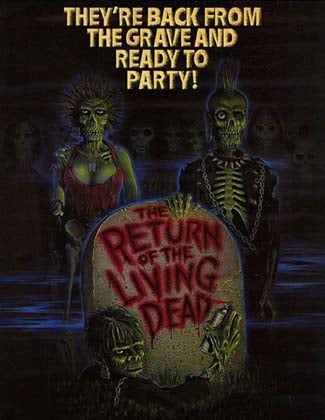
Return of the Living Dead
by Dan O'Bannon

Dan O'Bannon may be the most underrated man in the horror game. John Carpenter's made a few good films (and one masterpiece), but he's shown nowhere near the creativity of just one of O'Bannon's films. Wes Craven lost his touch years ago, yet studios paid him to write the sequel to a remake of one his films, something he proved incapable of doing when the original was released. Sam Raimi hasn't made a great film since Evil Dead 2, yet year after year we see Spiderman sequel after Spiderman sequel, and they never get any better. Yet everyone seemed more than willing to let O'Bannon slide right out of the public eye. What happened? The man was the reason we have some of our greatest horror movies? He gave us the script for Alien, perhaps the most thoroughly creepy and thoughtfully composed monster movie of all time. He gave us Lifeforce, a super fun, zany zombie-alien mash-up, a formula no one seems to get right these days. And he gave us Return of the Living Dead, a wonderful send up of Romero's famous living dead pictures, the same year as his own disappointing Day Of The Dead hit theatres. This film, unlike Day, lived up to its full potential and is jammed with blistering comic moments, as well as some legitimate scares. A film that proves not only through it's genius script, but in it's expert staging that O'Bannon was twice as handy a writer, and just as capable a director as anyone else.

Interesting to note that, like Reanimator, this film was steeped in controversy, as many were a little miffed about the use of the words Living Dead in the title, lawyers and fans alike, if you get me. This film isn't exactly a sequel, and legally it certainly isn't one.

Our story concerns a myriad of disaffected 80s youth; punks you might call them. There are a half-dozen of them hanging out at a graveyard, and boy do they look the part. We have capes, leather, zebra stripes, chains, and buckles, and everything else Hot Topic would sell fifteen years later. And if the clothes don't say it all, how about these names (Spider, Scuz, Trash, Suicide...and then there's Casey and Chuck, but, nevermind that). We'll be focusing on the two members of the group who don't quite look the part. One of them, Freddy, is not with the group because he's just finishing his shift at the mortuary (a good sign in any horror film) while his friends wait outside for him. He and Frank, his considerably older coworker, are shifting some barrels around inside the large building's storage facility. Frank tells his young friend that the barrels are full of some secret government corpses, and that in fact the events of the movie Night of the Living Dead are not fiction, but fact. The only evidence lies right within the very canister they're rolling around. No sooner has Frank explained to Freddy that there's no way to break open the canisters does Frank's comforting tap accidentally crack open the crate and expose the two rubes to whatever chemical affected the corpse. When they wake up they have a bigger problem than what to tell their boss about the cracked canister. There's a nude, yellow body running around like an idiot. They manage to lock him up and then they get their supervisor, Burt to help them with the body. Because he's played by Clu Gulagher, I just get the feeling he'll get the job done. After a comical couple of minutes where they struggle with the best way to kill something that by rights should already be dead, they finally dismember the thing with a hacksaw (they have to as cutting off it's head does nothing but give them a just as crazy, headless corpse to catch up with).

Meanwhile, Tina, the only one of the gang of kids not dressed for a Dead Boys concert, wanders away to find Freddy. Freddy is her boyfriend and this is the only reason she's come along with the punks in the first place. Well she happens upon an empty warehouse and goes into the basement (I have to assume she's been here to pick her boyfriend up before). She discovers something even more unnerving than the yellow-tinged naked body Freddy, Burt, and Frank tangoed with. A grungy, dripping, zombie with its flesh leaking off it's bones (referred to as the Tarman in the end credits) comes roaring out of another storage canister. With a throaty cry of "Brains" it chases Tina around the room, forcing her to seek shelter in the same canister the thing escaped from.

After getting their situation under wraps, Frank, Burt, and Freddy bring the writhing body parts to the mortuary where the kindly old mortician, Ernie, is also working late. Understanding that Ernie would be a little wigged out about the sight of legs, hands, and bits of chest squirming around in little plastic bags, Burt tells him the bags are full of rabid weasels. Ernie agrees that the best thing to do is fire up his crematorium and send the things to hell. This doesn't go as smoothly as they might have liked however. The chemical that has revived the mangy corpse goes right up into the air with the smoke from the crematorium and the rain storm that has just kicked up brings it all right down into the soil of the graveyard nearby; the same graveyard Freddy's friends have decided to hang out in. You know what this means? Why it's that right of passage in the world of post-Plan 9 living dead films; the bodies of the dead burst out of their graves to stir up trouble. Trouble for six kids having stupid fun on top of some headstones.

Before the zombie invasion has reached the crematorium, Burt sees that the chemical has wreaked havoc on Freddy and Frank, and so paramedics are called. The ambulance arrives and the paramedics have just enough time to deliver their diagnosis ("You have no pulse, your blood pressure's zero-over-zero, you have no pupillary response, no reflexes and your temperature is 70 degrees") before they become food for the living dead. On the other half of the grounds, things aren't going too well for the malcontents. The first to go is Trash (notable for one reason only, because she's Linnea Quigly, and she dances around naked) who falls down in the mud and gets eaten soon after. Next is Suicide, the leader of the bunch, who runs afoul of the tarman, allowing Tina to escape with Spider and Scuz. They head for the crematorium, with zombies running after them (and yes I mean running. Though 28 Days Later revolutionized the zombie film, it wasn't the first to feature 'runners'. Chuck and Casey lock the door to the basement and stay in the warehouse, afraid to go outside again.

From here on out we have a new spin on the Night of the Living Dead board-up-the-windows scenario. The zombies, super smart and marathon-runner-fast, take more and more ground in the mortuary as Freddy and Frank's condition worsens. And to cap it all off, we have a race against time before nuclear weapons are used to erase the whole mess. Miles away in some official building, a higher up called Colonel Glover moves ahead with the plan to use whatever means necessary to contain the potential zombie epidemic he's got on his hands.

Enjoying this movie immensely was not a surprise when I first saw it in 4th grade. The emotional kick I got watching it, then and everytime I've watched it since, is a surprise. For whatever reason (and this is true of Reanimator, too) this movie manages to make me care about the characters in ways that most serious dramatic pieces can't. Maybe it was some ingrained sympathy for radical lifestyles, but, I paid rapt attention when the punks in this film were in danger. I saw this movie before I saw Night of the Living Dead, and so this was the first time I'd seen the board yourself up set-piece before. This had a pretty huge influence on me; most of the things I wrote between first watching it at age 8 and then actually starting to write in screenplay format all had some element of Return Of The Living Dead in it.

The reason this film is (rightly) remembered so fondly is its humour. I may be the only person who found this film scary, but I more than sympathize with the people who laughed their asses off while watching Return. O'Bannon's script is just plain funny. The interactions between the feuding twenty somethings is a hoot, as it becomes clearer and clearer that these guys hang out with each other simply because they've got no one else to hang out with.

Suicide: How come you guys only come around when you need a ride someplace?
Spider: Cause you're one spooky motherfucker, man!
Normally tired cliches like Chuck trying to get with Casey are funny even when they shouldn't be. For my money the funniest bits go to Clu Gulagher, who gets to lampoon his tough-guy persona with all the bluster he can muster. When his Burt has to put a stop to the first zombie's running around with Freddy and Frank, he blows himself up like a puffer fish and begins screaming at Frank, who can't get up the courage to let the thing out of the closet. "Goddamn It Frank, Be A Man!" He really gets all the best lines. When he discovers that the only phone in the building is in the basement with the Tarman, he paces for a minute before picking up a board and bellowing, "Open the door. I'm gonna knock it's Goddamn Block Off!" Blustery older men are pretty much always funny to me, and when they so perfectly act the part, I can't help but laugh. So when a film can go from mercilessly making me gut laugh to wrenching those guts with some pretty terrifying stuff, I call it a success. 

Wednesday, September 10, 2008

2008: A Case Study

Recently if you've been to the pictures to see a horror/thriller, you'll have noticed a trend; everyone dies. I'd like to know when this trend started (I feel like I used to know). Anyway, what with torture porn running the game, apparently the kids are into everyone biting the dust by closing time. I found this sort of novel when the trend was new, now I feel like I can guess the ending before it starts. Two things made me challenge my assumptions this year. One was a gutsy little shocker whose entire budget went to it's stars, the other a claustrophobic tourists-beware film with twists to boot. It gives me a warm feeling to see a genre evolve in a few short months. It's a little like watching a robot learning how to love.

The Strangers
by Bryan Bertino

A couple having troubles get back to their summer house and after about an hour of unspoken resentment and half-finished sentences, someone knocks at the door. A blonde stands outside and she doesn't come close enough to the light of the house to show her. She wants to know if her friend is home. The couple are befuddled and lock the door. The boyfriend goes for a drive and the knocking resumes. Only now it's louder and it won't stop. The girlfriend panics, calls her boyfriend and then waits for him to come home. In the meantime things just get spookier and spookier. Noises and a horrible face appears at the window force her to hide under her bed before finally the boyfriend gets home. Now they need only get their phones and call the police. Except that the phones have been thrown in the fire and the chargers severed with a knife. Which means that someone was in the house. And that someone's just screwing with them. If they could come in at any minute, why don't they? Their move to the car is halted by the arrival of a big-ass diesel truck that lays waste to the small sedan. The boyfriend gets his gun; he figures he just has to wait for his friend to show up to give him the ride he was promised before any of this madness started. And there's always the radio in the garage. Shouldn't be too long, right?

The Strangers is easily the scariest and most ingenious horror film in...5 years? 10 years? The reason is that instead of spending money on effects, complicated traps or other torture-related set pieces, all that director Bryan Bertino puts on screen are three people in some of the cheapest masks I've ever seen and the noises they make. When Liv Tyler stands in her kitchen and the man in the smiley mask steps in, your heart just about stops. When she's alone in the yard trying to get to the garage, Bertino ingeniously turns the film into a game of expectations (Is she alone? Do they know where she is? When do they get her?). The masks are truly brilliant: a sack with a smiley face burned onto it, and two smiling clown faces. Why no one else has caught on to this is beyond me. You don't need elaborate scenario's or a vat of syringes, you need one guy with hulking shoulders and an enormous smile. Kip Weeks, who plays the gentleman in the mask, has perfect posture for the role. Gemma Ward and Laura Margolis, who play his female accomplices are just as frightening. Gemma Ward especially; she is one odd looking women normally, but here, with just brief glimpses of her face and hers being the only voice you hear, she in essence speaks for the trio of psychotic killers and she does a terrific job. Liv Tyler and Scott Speedman do convincing work as terrified nobodies, though I sometimes wonder what gets Liv Tyler into a film like this.

What really makes it hard to watch is the ending. It's slightly ambiguous, but it isn't good news for our concerned parties as the killers take off in urban legendy fashion. The Strangers is terrifying, but, what troubles me is that the ending is something of a copout. Bertino is clearly a smart guy because he's managed to cut all the mangy personality out of what could have been a more boring version of High Tension, but makes two irritating choices. In the first act when Scott Speedman and Liv Tyler show up at their house, they are clearly troubled by something. I was so excited because I thought he might do the audience the favor of not telling them what happens, but, sadly he doesn't. Had he never flashed back to the wedding party they'd just come from and explained where there problems spring from, he would be a genius on the level of George A. Romero or Roman Polanski. He still comes close, but, had he just moved forward this would have been even more terrifying. And it's even more pointless because the ending obviates all character developments anyway. When you have a bleak ending, it feels like the easy way out of what is otherwise a terrifying, simple, and smart film. Were it not for those two little things, I'd have no complaints. Though I do like the sort of last wound they deliver when a frightened Liv Tyler asks why the killers chose them of all people; harrowing stuff. This movie is excellent and leaves it's competition in the dust.

If you found yourself looking for intrigue of a similar nature, but maybe wanted a little joy with your tension, might I suggest something colder...

Transsiberian
by Brad Anderson

A russian drug enforcement officer called Ilya Grinko investigates a crime. Seems a man's had his drugs stolen and gotten a knife in the back of his head for his troubles. Grinko doesn't seem all that concerned, tells the other detective present he's going on vacation. We then see an American couple, Roy and Jessie, getting on the Transsiberian express train from their church-organized humanitarian trip in Beijing to a hotel in Moscow to go sight-seeing. Things seem to be going ok for them; they argue a little, have dinner, flirt, don't have sex as they've differing views on raising a family (something Brad Anderson does pretty well at first), then go to bed, both slightly annoyed. When the wife wakes up, they've got two new cabinmates, a couple. Carlos, the man, (pretty hilariously referred to as a Spaniard whenever he's not around to hear it) is a flirtatious, hard-drinking, asshole, while Abby, his American girlfriend seems nervous and shady. Carlos clearly has dirty things in mind for Jessie, as evidenced by his attempts to get her alone, showing her a bunch of wooden matryoshka dolls in private, telling her to keep it a secret. At the next stop, the four get out and split up. Roy and Carlos talk about Jessie's checkered past, as do Abby and Jessie; this doesn't really further the plot so much as it does set up that Carlos is really turned on by Jessie and he's a bit of a creepy bastard.

About five minutes after the train gets moving again, Jessie notices Roy isn't on the train. She, Abby, and Carlos get off at the next stop to wait for Roy to arrive on the next train. It comes out during dinner that Carlos has been keeping his dolls a secret from Abby, as she marches off to bed in a huff at the very mention of them. The next morning Carlos decides to ramp up his seduction as he's clearly not sleeping with Abby. He gives Jessie a story about his shower being broken so he can get naked in her hotel room, and then insists she go out walking with him so she can photograph an old church. After he's brought her to a secluded spot and she's taken his picture, he lays on the charm and they almost have sex right there in the abandoned church. Complications ensue and Jessie winds up coming back to the hotel by herself. When Roy's train gets in, Jessie has a whole new set of problems to worry about. First is that people are bound to ask what happened to the horny spaniard she's been witnessed alone with. Maybe his girlfriend who she left in town by herself for example? Maybe Roy's new cabinmate, who turns out to be none other than Ilya Grinko on his way to that vacation he mentioned. Then there's all those dolls that Carlos slipped into Jessie's suitcase while she was out of the room. Things start coming together (while coming apart just as quickly) for poor Jessie and her husband convinces her to come clean to Grinko. Grinko and his terrifying partner confirm her fears - the dolls are made of heroin. She lies a little more about her trip into town and goes to sleep, the weight on her shoulders all but lifted. Things change in the morning, though, in a big, bad way.Transsiberian, whatever else may be said of it, works as a perfect foil for Bertino's film. We have an ordinary couple being thrust into a harrowing encounter with another small group of people and there lives are soon on the line. The difference is in the handling of the problem. Jessie and Roy are just as bourgeois and helpless as anybody, in fact Woody Harrelson puts in one of the best performances of his career as loving hayseed Roy, but they manage to use what little savvy they have to get out of their predicament. Rather than succumbing to the grimness of their tormentor's punishment fully, they merely glimpse it. Now the way in which Roy and Jessie slide past their troubles is a little much to stomach, but after some of the shit I've seen this year I'm willing to bend the rules this one time. I'm especially willing because it follows Brad Anderson's greatest trick in the movie. Right after the two hand the drugs over to Grinko in an effort to come clean and all seems well Anderson pulls the rug out from under us. I won't reveal what it is because it's the best moment of the film, but look out for it; it's Anderson's shining moment. The creator of such cinematic gut punches as Session 9 and The Machinist probably had more in him than this, but he has a few effective scares here. I personally would have liked to see the train take on a more central role, rather than merely remaining the setting throughout. For a film in which 3/4 of the running time occurs between walls about 5 feet apart, things could have gotten a lot more claustrophobic. I also would have preferred if Anderson didn't explain everything so clearly at the start of the third act. He reveals in no uncertain terms how the drugs were placed in Jessie's bag, something that anyone who was paying even the slightest attention to would have figured out anyway. When will writers start taking the audience's intelligence for granted?

Back to the performances for a moment. Ben Kingsley does an amazing job with the Russian Grinko (his Russian is just as good as his English and as his character is slowly revealed his menace just gets heavier and heavier. He's not an oscar winner for nothing, I suppose). Thomas Kretschmann, who plays his colleague does a pretty remarkable job as well. It's funny, after seeing him play elegant evil, and more cartoonish evil, to see him play a role that ordinarily would have gone to Vincent Cassel. Eduardo Noriega and Kate Mara are competent as the shady couple, but their characters aren't really interesting enough for them to do much with. Harrelson does a very good job as the clueless American, but the real star is Emily Mortimer. Her Jessie is all-too tiresome for most of the film's second act, but when she discovers the heroin dolls in her bag, that's when she comes alive. Watch her eyes as she listens to Grinko discuss drug traffickers and then later when she's questioned about the holes in her story; she's on the verge of collapsing the whole time. The film's tension lies inside her eyes. When she runs to her room during a search of the train with drug-sniffing dogs and finds Roy waiting for her staring at the dolls, she loses it in the best way possible; I've never seen so honest a collapse since Gena Rowlands in Opening Night.

So we have a couple who doesn't deserve it being stalked by three sociopathic killers for no real reason, and we have a couple who find themselves at the mercy of a number of psychopaths, only one of whom comes close to deserving it. Given the endings of each film, which do I like better? Well, The Strangers is ten times as frightening as anything else released in the last five years, and Transsiberian is smarter than your average thriller. It's a difficult decision; a pessimistic ending for a superior film, or optimism in favor of a more rudimentary one. I enjoyed watching both of them; how's that for a cop-out?