Sunday, May 24, 2009

Cannibals: Petty and Disingenuous

When last we left Umberto Lenzi, he had turned down the chance to direct Jungle Holocaust because they weren't going to pay him enough money, as if he deserved it. So Ruggero Deodato took the project, made a much better film than Lenzi ever could have or has. Then he made the mother of all horror films. Where did that leave Lenzi? Crying in his room I hope. I wonder if he was actually on the set of Eaten Alive when he got the news that people thought Cannibal Holocaust was real, or if he was in his living room sitting with a cup of coffee. If so, I imagine he spit it out and then ran to the phone, "What the fuck is this? Get me to the Jungle! I have millions of dollars to make!"

Eaten Alive
By Umberto Lenzi
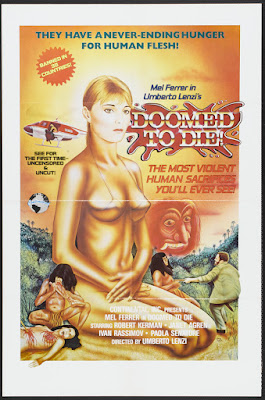
Sheila Morris is a young American (yeah, ok!) looking for her sister Diana who disappeared in New Guinea a few months ago. We find this out when a native starts killin' folks with a blow gun and when he dies, all he has on him is some 8mm footage of a native ritual. And who should be one of the only white extras in this grainy movie but Diana Morris! Sheila hires surly mercenary Mark Butler to take her to where Diana is supposed to be. You’re just gonna have to take Lenzi’s word when this guy tells you how manly he is, because Robert Kerman (fresh off his strikingly similar turn in Cannibal Holocaust) who plays Butler is about as rugged as Oscar the Grouch. He’s more of an abrasive jagoff than Indiana Jones. Anyway, so they go deep into the jungle, get attacked by a loony white guy, almost eaten by crocodiles, and watch some stolen footage of animals being killed and then find Diana in the midst of a Jim Jones style cult run by a tall fellow named Jonas (Jones....Jonas....Get it? My, how clever). Lenzi raises the stakes a bit by making the commune smack-dab in the middle of Cannibal country. So Bulter and Sheila have to get Diana out of the commune (with the help of Me Me Lai, hired because she'll work with her shirt off and because she's in some footage Lenzi stole from Jungle Holocaust) while not getting killed by Jonas' guards, cannibals, or falling prey to Jonas' jedi mind tricks, which include covering Sheila in gold body paint for some reason. In the end, Sheila and Mark are not only completely unsuccessful, they probably caused a lot more death than they would have if they'd stayed the hell home.

Here’s the problem with the internet, anyone can say whatever the fuck they please whenever the fuck they please. Allow me to be completely condescending while still talking about movies that insult the intelligence of just about everybody as if they were works of art. Take a look at this sample review of Eaten Alive from a nameless site:

This is Lenzi’s second cannibal film (the first being Cannibal Ferox aka Make Them Die Slowly) and it does rather pale in comparison. It’s violent, exploitative, and gory, as one should expect from this genre, but unfortunately, Lenzi went the Cannibal Holocaust route of cheapening the film with needless real animal deaths (much of said footage was borrowed from other cannibal films). That being said, it’s still a decent outing and worth including in any horror fan’s collection.

If anyone can tell me what the fuck that means, I'll give you a hug. How can you roundly chastise something, get simple facts about it incorrect that a trip to the IMDB could have told you, and then say we all need to buy it? There's seems to be a checklist with bloggers and such when talking about old sleaze, and I admit to using it at the start of Honors Zombie: you say something historically accurate about the film, make fun of it for something easy, and then say something catchy you may or may not believe. Eaten Alive and Make Them Die Slowly are not decent outings, they're trash, and the worst kind of trash because they actively pursues their trashiness; you can't just sit there and enjoy some dated sleaze, you have to pick a side.
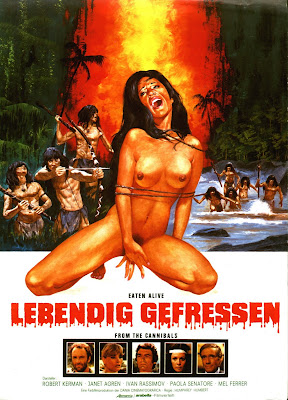
Eaten Alive is actually pretty ambitious considering what sort of film it is. And I do realize that I've already encountered a film called Eaten Alive; that was Tobe Hooper's sophomore effort about the veteran who feeds people to his crocodile, which, while not exactly Rosemary's Baby or anything, was a right sight better than this film. Though, weirdly, both films have Mel Ferrer in inconsequential bit parts. Consider that to make his cannibal cash-in, Lenzi didn't settle for his neighbor's yard like so many other directors would have. He actually went to the jungle, granted he went to Sri Lanka rather than actually going to New Guinea, but still; actually he didn't even have to say the film was in New Guinea, come to think of it. He stole footage from Mountain of the Cannibal God which took place in New Guinea but was also filmed in Sri Lanka because he was either too lazy to learn where else cannibalism is practiced or he was just a big old copycat. His initial ambition aside this is a terrible movie with few redeeming features. Eaten Alive isn't nearly so disgusting as his next 'movie' Make Them Die Slowly, but its pretty gross in all aspects. Ok, so lets talk origins. Though it's tempting to say that this film came out in response to Cannibal Holocaust, it was actually more likely in answer to Jungle Holocaust and at best rumours of Cannibal Holocaust's production. It's clearly a Jungle Holocaust rip-off because as I said a good deal of the effect footage (that is to say all the actual cannibalizing) is lifted from that film. Lenzi was clearly in "let me show you how it's done" mood because he went and got his old cast from The Man From Deep River, Me Me Lai and Ivan Rassimov. They sell their parts well enough, but Lenzi is just not as talented as Deodato. Me Me Lai goes from mute native in Jungle Holocaust, to scheming maid in Eaten Alive; Ivan Rassimov is always kind of interesting to watch, so it doesn't matter that he gets a less dynamic character than he did in either preceding cannibal film. Clearly this was a knee-jerk film and so the resulting problems can be blamed on that; all things considered it could have been worse. Lenzi was out to make something quickly so he might have the last word on the cannibal genre before the upstart Jungle Holocaust made him look dated and soft; funny that this film just proved how out-of-step he was with audiences.

Also funny that in order to make a film that would out-match Jungle Holocaust he chose subject matter as tasteless as the Jim Jones incident. Jones, for those scratching their heads, was a communist who was so out of his mind trying to make the world a better place that he started his own 'socialist paradise' in Guyana, refused to let anyone of his 900 plus converts leave, and then had them all commit suicide by drinking poison when he lost hope in humanity. Jones, for his part, had a number of progressive ideas regarding race relations, but he was also probably mentally ill and routinely denied a lot of personal things like his drug addiction and homosexuality. But during the 60s and 70s when people who were caught in the maelstrom of racist America had someone like Jones, who tried really did love the black community and devoted much of his time to integrating society and who used religion as a jumping off point to talk about progress really charismatically, they listened because a lot was at stake. People were being killed over the color of their skin so someone like Jones was like a beacon of hope for a little while, at least until he started Jonestown, his Guyana-based commune where he and his followers killed themselves. At the time there had never been a single greater loss of American lives as a result of one incident. This was in 1978. In 1979, Lenzi went into production. Any argument he might make about relevancy is, in my mind, completely forfeit. In an interview, Lenzi compared Eaten Alive to Bernardo Bertolucci's Last Tango In Paris because both films were banned. For this, I'd like to smack him. He can't even see why he's so oafish and pigheaded. On an interview he gave for the The Man From Deep River DVD, he was furious at the suggestion that people credit Ruggero Deodato with the creation of the cannibal genre. WHO CARES, MAN?!? What do you think people will be comparing your movies like El Grecos and Rembrandts? Grow up! Deodato at least has the good sense to regret his choices, Lenzi is completely clueless and Eaten Alive is proof positive. Lenzi has earned his reputation.

Eaten Alive is a movie in which, though clearly a lot of effort went into it (by people other than Umberto Lenzi), everything is stolen. This movie literally cannibalized other movies. The cannibal thing, second hand; the Jonestown cult thing, obviously cribbed; the structure (guy and girl trying to survive), stolen; Robert Kerman in fatigues; stolen; real animals being killed; that's actually like three generations stolen; the effects, stolen; Janet Agren covered in gold; stolen from Goldfinger. There's not a unique bone in this film's body. There's footage stolen from Mountain of the Cannibal God floating around as well, some of which was actually already stock footage; if that's not lame, I simply don't know what is. Eaten Alive is not good for a scare or for excitement; it got banned simply because Jungle Holocaust got banned. I guess thats one way for your movie to be condemned for publicity's sake, just fill it with footage from other condemned movies. The trailer has more tension than the film itself. Lenzi, I think, realized that this movie was no good, despite his senile ravings about how groundbreaking it was. Not even a year after he finished this movie, he went back to the jungle with a younger cast in one final effort to have the last word on cannibalism.
Sadder than the fact that Lenzi was outmatched in every way by his young colleague, was the fact that Eaten Alive seems to have been the inspiration for movies like Zombi Holocaust and Cannibal Terror more so than Cannibal Holocaust. Almost as if lowlifes like Marino Girolami knew they couldn't best Cannibal Holocaust they just stole from less ambitious films because ultimately a film like Eaten Alive is dumb and dumb is easy to copy (Zombi Holocaust plays like a hybrid of both of Lenzi's later cannibal films, with a dash of Zombie and Mountain of the Cannibal God thrown in for good measure). That puts me in mind of one of the film's many delightfully stupid quotes "People need to know that the stone age still exists, not everybody's living in the space age." No, they don't, and hundreds of years of anthropological study proves that that is a stupid way of looking at things; what people really need to know is facts and compassion; then not only would there be no Eaten Alive, there would be no group of people who say they like it.

Thursday, May 21, 2009

Cannibals: Infamous And Unforgiving

There are a few examples of films being more than just raw stock projected on screens for the enjoyment of viewers. Pasolini's Salò is one such film, as is Nabuo Nakagawa's Jigoku. These are films not intended to simply horrify or anyway they do so much more. In their short running times they raise questions about life and death that many of our greatest works of literature don't have the deftness to propose. Steve Mcqueen's Hunger comes to mind as a more recent example of a film having the power to do more than provoke happiness or sorrow from its viewer. He makes death and hardship beautiful and tragic in a way I had never encountered before. The film today isn't beautiful, but it does at times appear to be more than just a film. Like Salò, it stems the tide of modern cinema by bombarding the viewer with images of vileness, torture, and rape in service of eschewing western beliefs and the safety of films and ends in a smorgasbord of sexualized violence. It is a film so lifelike, grim and ghastly that chanting "it's only a movie" simply doesn't cut it.

Cannibal Holocaust
by Ruggero Deodato
The film starts, weirdly, with an Emanuelle And The Last Cannibals crib; I don't know if Deodato had watched Joe D'Amato's film, but it does seem rather conspicuous that both films start in pretty much exactly the same way. Robert Monroe of NYU's anthropology department is the subject of a news segment because of his planned trip to Brazil. He's going down there to find out what happened to filmmaker Alan Yates and his crew who went there to make a documentary about warring cannibal tribes and haven't been heard from for weeks. Once in the jungle he hires two guides from the military garrison monitoring the conflict who happen to have an ace up their sleeve: they have one of the natives captive. Using their injured native as something like a bloodhound, they are taken on a tour of the home turf of the Yakumo, a neutral tribe. After a few days being coddled by the Yakumo, Monroe and his guides go further down river to find the tribes that Yates was after. The three men save one of the tribes, the Yanamamo, from a war party of Shamatari, the other tribe. Monroe takes care to try and integrate himself into the Yanamamo society so that they might give him the cans of Yates' footage. After Monroe dines with him on a Shamatari captive, the chief agrees to let him take the film back with him.

Once back in New York, Monroe views the footage before allowing the news executives who paid for Yates’ expedition to see so much as a foot of film. The network did foot the bill after all, the least they might expect is some ratings in exchange for their losses. Monroe, having seen it, knows what a bad idea that is and insists they watch it first before they make any decisions (wouldn’t they anyway?). So Monroe sits down with the crew and together they watch The Green Inferno. On top of showing what became of Yates and his crew (his girlfriend Faye, two cameramen Mark and Jack, and one guide) it also becomes immediately clear that Yates got what was coming to him. If Yates had even a slight understanding of the region (that is to say the truth about the so-called cannibals) he would know that they wouldn’t be putting on the flesh-and-blood show he came down there for. So what did he do? He decided to invent a little savagery himself and force the hands of the tribes. Yates effectively became a one man colonial power; he and his crew burn down villages, murder and rape natives, kill animals for no reasons, he cuts off his guide’s leg after a snake bite resulting in the man’s death, and then shoots Jack when he gets injured so that when the natives find and kill him he can film it – that the natives attack and kill Yates and the others on camera should come as a shocker to no one. The executives finally see that running on this primetime would be the biggest mistakes of their careers and order the footage burned (which I don’t think news executives actually do; they aren’t the ministers of propaganda for a 40s fascist state). Reading about these things and seeing them happen in front of your face in one of the most convincing pieces of mock Cinéma vérité in history are vastly different things.

If you think I'm kidding about this being realer-than-reel listen to this. The film premiered in Rome in 1979 and was doing pretty well in its opening week until the proper authorities got involved. Ten days into the film's run, the police confiscated it, and Ruggero Deodato was hauled off to prison. He was about to be convicted of murder because to the police and the censors it appeared as though Alan Yates and co were actually raped, killed, and eaten by cannibals (Hey, they weren't the only ones who worried that Deodato was a murderer. Carl Gabriel York who played Yates was worried he was going to get killed for the sake of the film and was half-convinced it was a snuff film while he was down there. Robert Kerman who played Monroe thought Deodato was a cold son of a bitch, too. Perry Kirkanen who played Mark is supposed to have cried and wretched at the sight of a lot of the director's choice of setpieces). They gave Deodato 30 days to produce the actors as proof he hadn't fed them to the Yanamamo. Clearly not thinking that this was going to happen, Deodato had instructed his leads to lie low for a year, they’d even signed contracts to that effect. Finding and presenting them may have crushed one of the best laid publicity schemes in history, but it made way for quite another. The murder charges were dropped, but the obscenity charges stuck for four more years until he was able to argue his way into a heavily edited home video release. Japan, incidentally got it for a theatrical run and the film made thousands of dollars; it was the second largest grossing film that year after E.T. He was in point of fact, trying to make the harshest film ever made, so all things considered, Deodato made out ok in that now not only has he got the most fiercely manipulative movie on his resume, but also one of the more infamous. Try counting the countries in which Cannibal Holocaust was banned, you’ll get somewhere around 30 before the proof runs out. And while at first that might seem like a stroke of particularly bad luck, isn’t that just the thing that 42nd street freaks eat for breakfast? Can you think of a better possible way to get people into grindhouse seats (today it would be foreign video hosting websites) than to say your movie was banned by more than two dozen countries? I didn’t think so.
There are many comparisons to be made here, most of which other, smarter people have already pointed out, so I'll stick with my impressions and the facts. Deodato had in the years immediately following Jungle Holocaust, made other films; Cannibalism is not his one trick as many have suggested. His films Last Feelings (1978) and The Concorde Affair (1979) are both well regarded, which proves my point that Deodato was an actual moviemaker, not just a machine like Joe D'Amato or Jesús Franco. He had learned from an apprenticeship with Roberto Rosselini and knew quite a bit about making a convincing and involving story. That's why, when the opportunity arose to make another cannibal film, he said yes. Deodato had been fascinated with the stories of the Red Brigade, a terrorist group in Italy known for political assassinations. He watched a good deal of the media coverage and began wondering why no one thought to look into the media coverage. He thought that much of the footage seemed to be staged for the sake of the media, which struck him as being uncouth and just about the furthest thing from journalist integrity (he was also a fan of Mondo films like those made by Prosperi and Jacopetti, who I always like to point out, bribed a judge to delay an illegal execution so they could film it!!!! for their movie Africa Addio, so I leave it to him to tell the difference). Mix intensity, anger and deftness and some frightening shit is going to result, no two ways.

The reason for all the controversy comes from the last half of the film, the Green Inferno. Deodato went out of his way to make the first half, the framing segments look glossy and polished, which led me to believe that 1984 was the film's actual release date (the cinematography on the whole is years ahead of its time). This means that there are things that go pretty terribly awry in part 1. When Monroe arrives in the jungle, he and his guides witness a native man punishing his cheating wife. There's a lot not to like about this scene like the fact that the men could easily stop it, but don't, which I guess is a touch of the Red Brigade influence seeping in, but still...Fuck! The man molests her with a big stone phallus and then kills her with it, I didn't need to see that. From a logical standpoint, the scene looks preposterous because though the crew did their best to cover the girl in mud, she's clearly white. Her name is Lucia Costantini and she's the head of wardrobe; they had to have her in the scene because Surprise! Surprise! none of the actresses wanted to get raped with a stone in the mud. The change in cinematography also helps change the depiction of natives. In part 1, you see their faces up close, and they are not nearly so frightening as all that, in part 2, you can't see anything but menacing faceless bodies writhing around in the jungle. Finally, the real difference in part 1 and 2 is that in the found footage with the Green Inferno segment on it, the footage itself is thoughtfully and carefully degraded so that it looks like it was left in the jungle. Scratched, overexposed, shaky, and consisting of long takes edited with a hatchet, it perfectly mimics uncut documentary footage (evidently, the rest of the world thought so, too, hence Deodato's murder trial).

Which brings me to why this movie is so difficult to watch. The tedious first half is riddled with holes through which Deodato’s realism falls fast. The adulteress punishment, Monroe’s integration into the Yanamamo, the behavior of the Yakumo (who, like the natives in Jungle Holocaust, play with his penis for an uncomfortable amount of time. That Kerman was a pornstar (you could find him in Debbie Does Dallas if you cared to) and the girls were on loan from a brothel might explain why he doesn’t seem as bothered by it as Massimo Foschi in Deodato’s previous film), the helpful asides from our guide and the lazy not-quite-charming acting from Kerman makes the framing parts feel like the work of a lesser director. It makes sense that Deodato would try being a little less grim so that when the Green Inferno is shown, it is a total departure in tone, style, and everything else, but part 1 feels too boyishly naïve to be paired with the grizzly and cutthroat ending.
The Green Inferno is something that was so distressing and horrifying and confrontational that not too long after I had seen it, my brain had actually blocked a good deal of its content. I remembered vaguely that the murders were terrible and that the animal slaughter was repulsive, but after about a month or so, I couldn’t conjure up the images to go with the feelings of disgust or the order in which things happened. As I noted in my Goodbye, Uncle Tom review, the way he presents the bodies of the cannibals, as a thriving mass, less than human, almost alien, is monstrous and it really frightens me. All of them dancing about and participating in the murders, all of them painted very inhuman colours; they are made to look evil, but they're just people driven to do horrible things. We don't get that, we don't really get their side of things other than in the actions of Yates and his crew, which is disproportionate to say the least. Murder and rape on one hand and murder and rape on the other, that isn't exactly easy to stomach. Beyond the characters, there's also the actions of Deodato and his crew to consider. Let’s talk animals, shall we? I don’t like seeing animals die (I’ve had pets all my life) and seeing them killed for the sake of a film-within-a-film was just ugly. A monkey is hacked up, a coatamundi (rodent not unlike a muskrat, which is what I thought it was) is stabbed, lizards and spiders are killed, a pig is shot, and then there’s the turtle. Right around the time Yates and co. torch the Yakumo village, they catch and kill a turtle so they can eat it. As I watched them take it apart, that’s when I realized that this was not an ordinary film. I’d seen a lot of violence, but never like this, never completely free of artifice; Deodato and this film suddenly seemed evil. In hindsight I get that this is supposed to be a comment on journalism, but I can’t put myself in that position; I cannot see myself suggesting that an animal (and a fucking turtle, no less) needed to have its dignity stripped from it as it is murdered; I’m not in PETA or anything, but that’s what it is, it’s murder. Accounts of the shooting are about as scary as one would expect.

Carl Gabriel Yorke was a young actor's studio graduate with no film experience, which is perhaps why his acting is so good; he had no ego and everything to prove. He and the other four members of the expedition do such amazing jobs (especially when paired with the wooden actors of the framing story) that it's easy to believe everything they say. And they were doing such believable jobs in spite of (or perhaps because of) the horrible treatment they underwent. Perry Kinkanen is supposed to have wept after they killed the pig, though you wouldn't know it from watching that scene, so brutal and chilling is his acting. After the rape of the Yanamamo girl, Yates and Faye are supposed to have sex as the homes of the Yakumo burn behind them. Yorke was a little nervous about the scene so Francesca Ciardi who played Faye actually suggested that the two go off and have sex somewhere in the jungle; he declined. He and Robert Kerman have both stated that Deodato was an unfeeling bastard and that everything was subordinate to the film. At one point during filming, the father of one of his actors died. Deodato did let him leave for the funeral, but you can still see him crying on film. Who the fuck would do that?

Deodato was effectively conditioning everyone in the audience to expect the worst from his characters. So they murder animals, burn down villages and rape women and just revel in the carnage. He was purposely stacking up acts of violence and debauchery so that the third act would be so devastating and he was doing it in the most realistic way he could have, short of actually killing people. The script stacks the odds against Yates getting out alive, but you don’t hate his crew as much as you hate him and yet they’re the ones who get the brunt of the punishment. First is the guide; he gets bitten by a snake, and not even a poisonous one, and Yates hacks his leg off; he dies shortly after. He then coerces Jack and Mark into raping a Yanamamo girl with him and shortly after they find the girl dead, stuck on a pole (the image you’re probably familiar with even if you’ve never seen the film), clearly punishment for her being raped; Yates spouts some bullshit about it being a purely sexual ritual so, one would assume, he could edit it later. Then he all but murders Mark after the cannibals come looking for retribution for the girl. Mark is injured by a spear and so Yates shoots him so they can catch up to him; he films from a short distance away as they castrate, dismember, and eat him. Somehow it only clicks what an unforgivable mess he’s made of things when the cannibals take Faye. He insists that he and Jack go back for her, but when he runs out of bullets, his only recourse is to hide in the bushes as Jack films her being raped, beheaded, and eaten. We don’t see Yates being properly punished, we just see his face as the camera falls out of Jack’s hands onto the ground. The ending is horrifying and pitch black in tone. Riz Ortolani’s music perfectly fills rounds out the soundtrack as a series of entirely-too-convincing murders are carried out by the pulsing throng of natives who have stopped being human; they are monsters. We’re told we need to consider who the real cannibals are. This movie, its proponents, and all that it stands for is unforgivable.
This is a movie about victims, collateral damage, but I don’t think that was Deodato’s intent. He, like Yates, wanted to excite and disgust and had no concern about whom or what got in his way. So, he behaved abhorrently, killed animals, treated his actors like shit, lied about the lives of two actual tribes who never asked to be treated with such disrespect, fed into stereotypes, fell into exactly the traps he supposedly set out to condemn and then got off essentially scot-free (albeit after a lengthy fight, but that was in no way proportionate to the crimes he committed). He was even allowed to make a third cannibal film (Cut and Run in 1985) and he’s currently doing a fourth. He says he regrets the animal killings, he’s reportedly gone so far as to say the whole exercise was a mistake, but I don’t see that that makes up for it. The end didn’t justify the means and I don’t know how he could have thought they did, even as the intense realist he was 1979, desperate to prove he was an uncompromising genius. Well, he succeeded, I guess, he didn’t compromise and his film was so real looking that he was almost executed for it. So he’s clearly one of the most talented and meticulous filmmakers of our time, but no one’s ever going to recognize him; in fact if he had never made this film, he’d be just another Italian filmmaker. Deodato is sort of like a real-life Daniel Plainview from There Will Be Blood (and yes, I know that Plainview was based on the real-life Edward Doheny but stick with me); he has an ocean of oil under his feet but no way to profit from it; in order to do so he has to cut all his ties and betray his beliefs. We might see the ending cannibalistic orgy and Plainview's bowling pin cudgeling as the same tragic collapse; both men finally achieve what they want to, but it's the end of the line.

It makes sense then that the only person dumb enough to, in the wake of this controversy, try and achieve Deodato-style infamy is Umberto Lenzi. In crafting the ultimate cannibal film, Deodato also obfuscated the whole genre; no one was ever going to outdo him. Did that stop Lenzi? Hell no! When Cannibal films became the full-fledged genre that they are today, Lenzi was at the forefront, trying to beat Deodato at his own game, oblivious to the fact that he had no hope of succeeding and that Deodato wasn’t paying attention, he was too busy trying to get his film screened. It didn’t matter anyway because by the time Lenzi had made his final cannibal film (Make Them Die Slowly), people like Jesús Franco had gone in, churned out a dozen cheap-ass ripoffs and everyone stopped expecting things from the cannibal genre and graciously stopped in 1981. After Cut and Run a few more appeared, a few as supposed sequels, but they were largely ignored. On the night he saw Cannibal Holocaust, Sergio Leone, one of the great overrated directors of the 20th century, wrote Deodato a letter saying how much he liked his movie, but that it was going to get him in trouble and he was right for once in his life. The film earned something close to two million dollars before it was banned, so maybe its true that Italians get Italian films more than any outsider ever could. It does strike me that no one with any taste could ever pay money to see this movie more than once (or at all if you knew anything about it).
Recently the influence of Cannibal Holocaust has been felt all over the world; A Japanese film was released in 2003 that claimed to be a Cannibal Holocaust sequel; an independent Amercian film called Welcome to the Jungle was made, clearly in homage to Cannibal Holocaust, in 2007. Eli Roth has spoken of his debt to Cannibal Holocaust and even put Ruggero Deodato in Hostel Part II in a small role as…a Cannibal! There’s now a generation of young filmmakers and critics who completely missed the point and simply take the violence at face value no different from the violence in Zombie or Suspiria. If someone tells you that they like this film, they are either lying, trying to get you to think something about them or both. Cause if they actually do like it, like most people enjoy say Pulp Fiction or Raiders of the Lost Ark or Casablanca or whatever, think about what that means. They like the murder, the animal deaths, the exploitation of other cultures for profit and the rape. I don't think, but can't prove, that Deodato made this movie so people could enjoy it, but I do know he regrets it. So, you know where it came from, you know what happened, and you know what it did. I’ll let you decide whether the world would be better or worse without Cannibal Holocaust; you already know what I think.

Tuesday, May 19, 2009

Cannibals: Lurid and Sleazy

Cannibal Movies become less and less impressive when you watch them all one right after the other. Let me explain the trickle down effect of bad movies. Ruggero Deodato makes the successful and gory Jungle Holocaust as an effort to squeeze money out of people's lingering memories of The Man From Deep River at roughly the same time that Joe D'Amato makes Emanuelle & The Last Cannibals which shares a lot of the same elements but is ultimately its own film. The market demands further cashflow and ten times easier than hiring some kid to work a minor miracle by creating an original cannibal story (the same way Deodato did) was to get someone reliable to make the same movie twice (they already made a few bucks, why screw with success?), which is what happened with our next film. First, the powers that be wanted another cannibal film, so Sergio Martino gets called in basically to make Emanuelle and the Last Cannibal World. Then a few years down the line, after both Cannibal Holocaust and Zombie have made their respective splashes, Marino Girolami makes Zombi Holocaust which is really just this film with zombies. That's why incest among royalty is such a bad idea, because the people making decisions are just going to get dumber and dumber and dumber. Martino's film may be better than Zombi Holocaust, but its still a pretty terrible movie.

Mountain of the Cannibal God
by Sergio Martino

Sergio knows exactly what kind of movie he's making because while the credits roll we get about a dozen pieces of staged animal killings. The first thing we're told is that the following is all basically real, and that New Guinea still has primitive tribes and since we're "On the Dawn of the Space Age," whatever the fuck that means, you know, it pays to know about cannibals. This isn't true, but evidently Umberto Lenzi bought it, because he had Janet Agren deliver this same bullshit (almost verbatim) at the end of Eaten Alive, which, like this film, was a ripoff of Jungle Holocaust. Anyway, brother and sister Susan and Arthur have arrived in New Guinea looking for Susan's husband Henry, a scientist whose expedition vanished a few months ago. The authorities, as usual, are powerless, so they turn to Edward Foster, one of the few Americans left in the region and one of the only people who's been to the spot where Henry disappeared and lived to talk about it. They visit Foster's dilapidated mansion (?) and convince him to guide them. Together with a handful of servants, they head into the jungle.

The place their headed is off limits for some reason, so they have to sneak their way to the island where Henry disappeared. As the crew of servants thins (to a crocodile I take to be a Kruna prototype, an animal trap, a cudgel to the head, and some brainwashing poison respectively), Susan sees Edward talking to his cohorts in hushed tones and looks worried. After everyone but Susan, Arthur, and Edward have been knocked off, they locate the mission of Father Moses. The mission is the last bit of humanity before what the natives call the mountain of the cannibal god. Their proximity to cannibal gods probably accounts for the masked killers stalking the gringos throughout the jungle, and as we'll soon see, into the mission. The only other white guy in the village is Manolo and he's played by Martino favorite Claudio Cassinelli, so naturally we'll be spending a good deal of time with him. He came out to the jungle looking to test himself and Susan convinces him that going up the mountain will be the ultimate test (making out with him probably helps with the convincing). That night, they get their final bit of motivation when one of those masked fellows kills a girl midway through screwing Arthur; Edward gets a nasty leg wound from the man when he gives chase. Moses blames all the white folks for bringing sex into his mission (just how the hell does he expect to keep the damn thing afloat if no one has sex?) and demands that they all leave. I guess its up the waterfall and onto the mountain for everyone. I wonder what they'll find at the top?
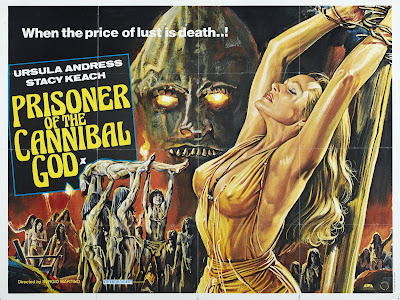
Mountain of the Cannibal God looks great and was clearly a lot of work. That's about all the complimenting I'm going to do in this review other than to say I could watch Claudio Cassinelli do just about anything and this counts (and the music's gonna get some lip-service a little later on). This film smells of desperation. Sergio was clearly given more money than either Joe D'Amato or Ruggero Deodato which is why its shot in widescreen and why the names Ursula Andress and Stacey Keach are on all the posters. Andress wasn't as big a name as she may once have been (like Sean Connery in Zardoz, she'd looked a lot better just a decade earlier in Dr. No) and Stacy Keach wasn't exactly Al Pacino, but those were still big enough names that they probably ate up a good deal of the budget, and yet there's a sense that Martino pulled a rabbit out of his moth-eaten hat. Lousy though this was, the allure of a very topless Ursula Andress probably filled a lot of seats even though her age was starting to show. And what is a cannibal movie but a series of gimmicks anyway (attendees of Cannibal Man screenings were given bags to puke in when they entered the theatre, Cannibal Ferox claimed to be the most violent movie ever made and wore its 31 banishments like merit badges, and Cannibal Holocaust had just about the biggest and best gimmick any horror director could have asked for, but that's another story).

The plot is, as I mentioned earlier, a combination of Jungle Holocaust and Emanuelle and the Last Cannibals; cannibal cave and animal killings in this corner and unmotivated sex, thinning search party, and a last minute money-driven switcharoo in this corner. That means we're privy to a whole lot of development in not a lot of time and though it's done a little more bawdily than either film, it has almost none of their strengths. Jungle Holocaust was egoless, claustrophobic and grim and so there was no chance that Martino's lurid treatment was going to be anywhere near as powerful or realistic as that film. The crazed sensibility of Emanuelle carries over a little bit (like the heroine's battle with a snake), but, that was porn and so didn't need to adhere to logic or anything else, it just needed to be fun and erotic. You really understand how dirty a film this is once we're in the cannibal cave. It takes its cues from the other films and shows us a parade of disgusting sexual images including Ursula getting naked, painted and raped by the natives, and unnecessary violence to animals and we, like Manolo, have to sit back and watch it all unfold. It's grimy and nasty and its all there just because its been done before. When you look at it like that, its even more gross. When Martino tries to put his own spin on Robert's escape in Jungle Holocaust by having a midget attack Manolo in his bonds, I just felt sad. When Ursula Andress gets naked, I got even sadder, and that shouldn't be so. I got sad when Stacy Keach disappeared towards the end because they'd spent so much energy padding out his character. There's too much that this film wants to do and can't pull any of it off correctly.

Mountain of the Cannibal God is supposed to be a 'real' film (wow, ok, so maybe real isn't the right word. Let's say more like Let Sleeping Corpses Lie than Mansion of the Living Dead. Good? Good!) and looks like one so the off-putting non sequiturs like when a native girl masturbates for twenty minutes or when one of the natives fucks a pig during Susan's drug fantasy (no, really!) don't seem at all like the continuation of the film's overall feeling they do in D'Amato's film; they feel like an hour long pit-stop in the ridiculous and uncomfortable. The pig thing and a few other bits (the animal trap, the masks and the geiger counter heart) were all that really distinguishes Martino's style from the films he was stealing from, so pay attention to those diversions in the formula and you'll get a good idea of what kind of director he was. He liked adventure, poorly executed gore, absolutely pointless sexual tangents, and crazy inappropriate music. The score to this film is so off the wall in that 70s way, in fact I dare a room full of guys to come up with anything so specifically bizarre; my guess is you couldn't do it; it's too weird and dated. If anybody's wondering what Italy's contribution to psych music was, watch a few Italian horror films and you'll have your answer.
Mountain was part of a cycle of adventure films with horror elements that Martino made with Cassinelli in the lead role over the course of two years. Mountain, The Great Alligator, and Island of the Fishmen appear to be roughly the same film with a few minor changes (Now I have to find and review Island of the Fishmen). Personally because The Great Alligator was so bad that I could sit back and laugh my ass off, I liked that better. Mountain of the Cannibal God is halfway legitimate and halfway incomprehensible sleaze and it was born out of a commercial need, so all in all, I'm glad I didn't pay money to see it and you might take a lesson from that.

Tuesday, May 12, 2009

Cannibals: Madcap and Sexy

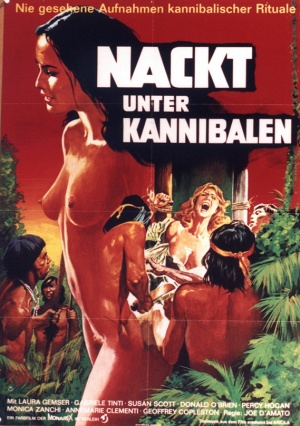
Let it be said that Joe D’Amato was no slouch. Sure, the director of Anthropophagous and Ator: The Flying Eagle was…well, special. He treated moviemaking like a business in the same way that William Beaudine and Jesús Franco did, but Joe had his own style of factory filmmaking and the one thing that carried over from one film to the next: craziness. Franco’s films were batshit crazy, but, in a more aimless, “Were these people aware that an audience would see this?” kind of way. Joe’s was a cinematic craziness: he got that people would see the end product so he filled his film with as many zany elements as possible. Death Smiles on a Murderer for example could have been any old Giallo but with Joe D’Amato at the helm it turned into a miasma of sexual violence and hairlighting. Almost immediately after Emmanuelle, France’s most infamous soft-core pornographic movie and its most profitable movie to date, debuted in Italy, Joe started making his own Italian Emanuelle films (how he avoided a lawsuit is beyond me), the first with Rosemarie Lindt in the title role but he soon switched to Laura Gemser. With Gemser in the lead, his series quickly became known as the Black Emanuelle movies. He was only four movies in when he or someone at Flora Film heard about Jungle Holocaust and some gears started turning. The result is the first film to out-and-out cash-in on the cannibal genre and pre-empt the cannibal rip-offs of the early 80s. Joe beat out Ruggero Deodato, Umberto Lenzi and Jesús Franco in the great Cannibal boom and his is easily the most fun and the easiest to watch of any of the cannibal movies I’ve seen so far.

Emanuelle and the Last Cannibals
by Joe D’Amato

I’m pretty unfamiliar with the plot of the preceding black Emanuelle films but I think they would probably explain how she got to be a journalist. As a journalist of the investigative variety, she’s Shock Corridored herself into an insane asylum to expose the maltreatment of the patients. While playing crazy, she witnesses an attack by one of the patients on a nurse; she bites her nipple off. The girl was found on the banks of a river deep in some jungle. This gives our reporter an idea. She gets in touch with Professor Mark Lester, an anthropologist, who can help her get down the jungle to see just how that girl got to be a cannibal. Lester and some others are a little unclear about the status of the tribe; some believe they’re extinct, others say they’re still around. You and I have an edge on all the characters in this film because we knew going into the movie that it’s called Emanuelle and the Last Cannibals. After Lester and Emanuelle have had sex, they head to the jungle.

In the encampment where they land, they exchange notes with Wilkes, a missionary who’d come down with his daughter Isabelle to help out. Emanuelle and Lester agree to take Isabelle and one of the nuns, Sister Angela, down to the mission further down river along with two native guides (after Isabelle spies on Mark and Emanuelle having sex in the middle of the night, of course). A few revelations await them down river like so many stock footage crocodiles. The mission appears to have been attacked and everyone – men, women, and children – slaughtered. They meet up with a hunter, Donald McKenzie, his wife Maggie, and their gorgeous, shirtless manservant Salvadore. Donald talks a big game and seems ok with the prospect of hunting the cannibals in lieu of having animals to hunt, but something seems off. That night when the gang beds down with the McKenzies, things start getting weird.

Maggie gets restless while sleeping and takes Salvadore into the jungle with her to screw while her husband spies on them. The next day one of the natives has been killed, his entrails taken, and all the boats are gone. The group doesn’t have much choice but to try and walk upstream to find help. Donald and Maggie start whispering sinister things to each other, which puts their motives even further into question. The other guide is killed by a booby-trap and that night Donald tries to feel Isabelle up while she sleeps. Mark would probably opt to leave the McKenzies behind if he weren’t so nice (he also loses the fistfight he starts after Isabelle screams bloody murder when she finds the old pervert standing over her). Sister Angela goes missing and presumably gets hers before the others can find her. The final day trekking we get the most amount of action we’ve seen so far: Donald and Maggie find a plane with stolen diamonds on board, the natives find them during their victory sex wounding Donald and abducting Maggie. The others give chase but Isabelle is soon in their clutches as well and it falls to Emanuelle to find a way to free her from the clutches of the bloodthirsty cannibals.
Before you say anything, yes, this was a porn movie and yes it was just as lousy as anything where its story and acting are concerned. The difference between this and say The Cheerleaders or Deep Throat is that the sex becomes secondary to D’Amato’s almost Agatha Christie-esque plotting. There are a lot more characters than actually get used for sex or that can be given dramatic death scenes (I was especially miffed about Salvadore's unceremonious treatment after his first tryst with Maggie) and the sex scenes that do get left in are actually fairly brief. And because it’s a porn film, the gore can’t be lingered over too long to gross out the raincoat crowds who would have been this movie’s target audience. So essentially you have a sex movie with not enough sex and a gore film with not enough gore. While that would certainly bother some sleaze hounds, I was actually pleasantly surprised. I wasn’t going into the film to look at Laura Gemser naked (her incredibly thin physique has always kept me from seeking out the other films in the series) nor was I looking to be bowled over by random acts of cruelty or particularly believable gore; I wanted something that walked the line. While Emanuelle and the Last Cannibals isn’t a great film or even a great example of either genre pie it had a finger in, it’s ten kinds of crazy fun.

Ordinarily on a film like this I pick a fight with waning morals, but I can find literally nothing to complain about here. Sure it’s very clearly a bad movie with terrible acting, no scruples and dubbing that seems to have been recorded off the fly (the dubbing actors all match the duration of time that someone’s mouth stays open when delivering their lines, regardless of how silly it sounds to preserve those silences. I can think of no other movie where this tactic is employed and I think I’d remember because the effect is like watching the whole cast do their best William Shatner impersonation) but its so kooky and engrossing that all of its faults just add to the goodtime. The whole film is tasteless, but harmlessly tasteless: no animals die, the sex is all tactful (the glaring exception being the ending ritual where Isabelle has about 30 men forced on her, on and off screen), the film is remarkably well edited and directed, and best of all there’s no bullshit commentary on modern life at closing time (actually the only attempt at moralizing we hear sounds a little like he was condemning Ruggero Deodato and Umberto Lenzi. Emanuelle’s last lines could be read as reproaching those filmmakers who think they need to kill animals to make an effective movie, but that’s only if you’re feeling generous. Actually Emanuelle’s last lines are truly bizarre: she laments the people who just died for the sake of her article and I believe she says “And the McKenzies, with their shabbiness.” I may have misheard that, but isn’t that just the craziest bit of dubbing? That’s why I love this movie). Interestingly enough, Joe also beat his contemporaries to the starting-in-New-York plot point that would kick off just about every bad Italian cannibal, zombie, and alien film until 1983 when Escape From The Bronx erased New York’s allure to foreign filmmakers.

Despite the fact that I watch a lot of inexcusably misogynistic and reprehensible movies, finding ones that I enjoy is a rare thing indeed. It takes a rare kind of filth to leave me wanting a return trip. Mark of the Devil, Axe and Twins of Evil are all undeniably sleazy films but I thoroughly enjoyed myself watching them as opposed to movies of equal character like Bay of Blood, Killer Nun or Bloodsucking Freaks which I alternately squirmed and yawned my way through. The difference is in the presentation. Emanuelle and the Last Cannibals is one of Joe’s most ecstatically grimy movies and he took much more time to make sure it was fun to watch than he did with most of his 80s films; these (his porn films) were the movies he clearly enjoyed making and was willing and able to exert a little more effort on and when Joe D’Amato goes all out, brace yourself. The Nino Fidenco music is absolutely insane, showering every action from violence to screwing in space age “Da-Da-Da” choruses and instrumental themes that would make Bruce Maderna jealous. Then there are bits like when Emanuelle and Isabelle are washing each other near a waterfall while a chimpanzee smokes a cigarette on the shore (never mind that chimps are not indigenous to the region, nor indeed even the same continent, in which the film is set). The crazy-ass tangent with the diamond plane was similarly completely unnecessary but Joe makes it work.

Joe D'Amato juggles all of his madcap elements expertly and though the film doesn’t work as either the nudie film Flora Film probably paid for or the cannibal film its most excellent rerelease title suggests (“Trap Them And Kill Them” which is one of my all time favorite horror movie names), it is a blast; a gory, debauched mess of one but I’d take sex over real animal deaths any day. I only wish Joe had pitted his Emanuelle against Zombies. Oh well... A man can dream....

Saturday, May 9, 2009

Cannibals: Dark and Masculine

Cannibal movies took their time getting started. Zombie movies went from interesting to unstoppable from 1966-1970. After The Man From Deep River got the ball rolling, the response was slow, but it was a wholly new kind of film so a sequel (or endorsed and endowed rip-off) was never far away. The people at the burgeoning production house Erre Cinematograsica saw a window and approached Umberto Lenzi to do a sequel of sorts to his film. He wanted more money (suffering from a bout of 'Serious Artist') than they could or wanted to pay him so he walked off. Ruggero Deodato, who’d made a string of decent films in the preceding 10 years, gladly stepped up, perhaps seeing a true test of his skills; he’d studied under famed Neo-Realist director Roberto Rossellini for a few years and was dying to prove that he wasn’t just anybody.

Jungle Holocaust
by Ruggero Deodato
Rolf, Robert and Swan are three field workers for an oil company, sent to check out a claim made by a team somewhere in the Philippines. Together with their hard-drinking pilot Charlie, they land their plane near the campsite of the claim team but soon discover that they’ve got bigger problems than moving pipeline to the middle of the jungle – the whole team is missing and probably dead. Were it not for the impending darkness, they’d pack up and leave now, but Charlie isn’t so good a pilot as to be able to navigate the jungle in his Cessna in pitch darkness so they hole up in the plane and wait for daylight. Swan goes outside in the middle of the night to pee (Deodato already proving he’s smarter than the average director by giving a legit reason for the only female in the party to split up from the group for a few seconds) and is abducted by the creepy tribesmen who’ve been leering at them from the shadows since they arrived.

Charlie, Rolf, and Robert agree to wait until morning to look for her (I won’t say that’s totally grounded and progressive, but, I guess I wouldn’t want to go out in the middle of the night with abductors about either; another point for Deodato) and suffice it to say their findings are less than thrilling. Charlie is killed in a booby-trap and soon after Robert and Rolf find the tribe munching on what looks to be Swan’s charred remains. Robert and Rolf - lost, hungry and tired – find a river that they think will lead them back to the plane. Rapids cut their triumphant escape (and their raft) in half sending Rolf downstream faster than his companion can save him. The bit where Robert looks around at the vast jungle realizing he's completely lost and alone is pretty excellent. The tribe finds him hours later.

If you’ve seen Man From Deep River, act 2 is going to seem familiar, yet much more intense and believable. First is the ‘prod-the-white-man’ scene where they try to figure out exactly what the hell Robert is. First they tie him up, strip him naked, and yank at his privates for what seems like hours (oh I should mention that everyone is either nude or nearly nude in the big cannibal cave) Robert explains in voice-over that they probably think he can fly just before they string him up with a complicated pulley system and drop him from great heights and watch him bounce. They then put him in a cage, throw scraps of food at him after they butcher animals in front of him (Deodato says he didn’t want to add scenes of animals killing each other, yet, I can’t help but notice that the film’s most disgusting scene is one clearly shot with all the actors in place, not edited in like most of the animal kingdom snuff footage. I’ll come back to this). His only respite is the cute native girl who seems to like touching him through the bars of his cage. Anyway, after Robert sees his captors remove the hawk they used as bait from the stomach of an crocodile he fears it won’t be long till they’re pulling him out of the belly of a croc. Unlike The Man from Deep River, Robert’s solitude is palpable and his escape is independent of anyone else. He plays dead during a big festival so when some kids come looking to hurl scraps at him, they have to go in his cage to do so; he brains them both and makes a run for it. When he sees a burly guy trying to rape the cute native girl, he kills him too and takes the cute girl with him into the jungle.
Robert and the cute girl slog through the jungle for days. She tries to escape more than once until he tires of her resistance and rapes her. Well apparently that got through to her because the next morning she’s prepared a breakfast for him and they seem to get along ok now (if this is a comment on western ideas of masculinity, point taken. If this is the producer’s idea of truth, I piss on your grave. This is Italy in the 1970s, so…Christ knows). They take off and later that day they actually have a near-fatal run-in with Rolf of all people who Robert mistakes for a cannibal and nearly kills. The two white men have changed a lot since their forced separation; Rolf has a nasty-looking knee wound and he can’t walk without a stick to help him and Robert seems to be going nuts, talking to himself and looking quite the worse for having been stuck in a cage without water for a number of days. They agree to get the hell back to the plane before the cannibals catch up to them and from the looks of things, the group isn’t but a little bit behind them, and the plane is at least a day's walk away.

Jungle Holocaust comes close to being a great film a few times. Its production design is terrific especially considering what appears to a modest budget. The cave that act 2 takes place in is put to excellent use and the performances by the natives are excellent (in that they are perfect depictions of what the west might expect to find in a cave in the Philippines, if that makes sense). The leads are all pretty excellent. Ivan Rassimov does a pretty excellent job as not only just a supporting player but a good guy (one of the few likeable characters in his vast canon). Me Me Lai actually does some acting this time around and even when she's just looking all puppy-eyed while given an editing-only handjob with her shirt off (it's off the whole film, those fans of Me Me Lai). Despite her being something for guys to look at, she's still great and she wouldn't be as good again until Lars Von Trier's The Element of Crime, her last role. Massimo Foschi plays Rolf with about as much gravity as any Italian lead has ever mustered. He does a tremendous job wearing his degradation and torment on his face and he and Rassimov both undergo believable physical transformations from clean-cut oilmen to unshaven survivalists. Also the fact that Foschi, like all the natives, spends all of act 2 with no clothing is actually a great idea and added to the oppressive atmosphere. That's really where the film and Deodato succeed: atmosphere. Aside from its antecessor, Cannibal Holocaust, and Salò, Jungle Holocaust may be the best atmospheric Italian film of its time. This may owe its existence to Man From Deep River but Jungle Holocaust is clearly the superior film. The only problem is that it went too far in the opposite direction with its native treatment.

The film was originally called The Last Cannibal World which does account for its mix reverence and brutality; Jungle Holocaust was a name tacked onto it in the wake of the success of Deodato's next film. While it does feel like it was probably the most realistic Italian horror film to date it’s not without flaws. The first, as I said, is the treatment that the natives get. Now it’s entirely possible that Deodato was light-years ahead of his peers and that he was simply playing into popular notions of the third world in his direction but it's also possible he was just a much better director and no different morally from anyone else. It's in places like the flying scene where the question mark appears. While it is undoubtedly an interesting idea and it’s done surprisingly well, it doesn’t really make any sense. Ok, let’s assume the natives think he can fly because they saw him land in the plane, why didn’t they try to make Swan fly? And why do they feel the need to repeat something they perfected themselves? They made that pulley system, after all. And why did they make the pulley system? And where is it suspended from? It’s just a creepy distraction more than anything because it falls apart under scrutiny. And then there’s the animal killing. Now Deodato maintains that the animal killings were the idea of the producer, something they added after shooting was done. This makes sense in a few scenes (Robert looks out his cage in pitch darkness, sees a snake eating an iguana in daylight in a different film stock) but the croc death…that was quite obviously Deodato’s. It’s in the cave set with the actors actually doing the butchering (this scene was nearly impossible to watch because I discovered how much crocodiles look like family dogs) and the falcon they pull from its stomach is either the real bird or a look-alike prop; in other words Deodato’s doing. This puts him in T.F. Mou, Franco Prosperi territory, which is dangerous territory indeed (and before you go siding with him, he went full fucking tilt two years later, so it’s not like he was conned or browbeaten; if anything he was just testing the waters).
Take live animal killing, unnecessarily complicated westernized brutality by natives who actually kill, cook, and eat animals, a rape scene that counts as courtship and the fact that only white people have happy endings and you have a film not so progressive as all that. It is a remarkably atmospheric, nasty and harrowing film with great acting and terrific direction that made way for Ruggero Deodato to step up and take his “most intense director who ever lived” crown and for Umberto Lenzi to take his “biggest pissant behind a camera” crown. If you plan on seeing Lenzi’s Eaten Alive (which I can’t recommend at all, not even as Lenzi’s worst film, because it’s not, but it provides nothing in the way of even reverse entertainment) see this first because that film steals from this one in a big, stupidly cheap and lazy, spoiler-alert, ruins-the-end-of-the-movie kind of way. In fact, just don’t see Eaten Alive. Tune in next time to find out why.

Thursday, May 7, 2009

Cannibals: Solitary and Poor

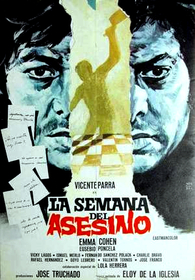
I was all set to do a linear, chronological account of the cannibal movie genre but then some bad labeling forced me to make an error. Next on my list was supposed to be Eloy de la Iglesia's video nasty Cannibal Man because I was under the impression it came out in 74, two years after The Man From Deep River. Well it turns out 74 is most probably when it got international distribution and its real name, La Semana del Asesino or Week of the Killer was changed to its more gruesome handle. It was actually finished in 1971 and widely released the year after. Regardless it isn't a cannibal movie like you and I might know them, but in fact a stylish little film that predates 80s movies like Maniac in its depiction of a man driven to insanity by his solitary crimes.

Cannibal Man
by Eloy de la Iglesia

Marcos is a blue collar guy with 1970s good looks (chubby with sideburns) with a girlfriend and a job at a meat processing plant. He lives in a one-horse town; kids play in trashy barren fields, wild dogs roam the streets, there seems to be one place to eat, and there's almost nothing to do in the evenings. He takes his girlfriend, Paula, out one night and gets into a scrap with a cabbie when they won't stop making out in the back seat. When Marcos doesn't want to pay him for being dropped in the middle of nowhere the cabbie runs tries to stop him and gets a rock to his cranium for his troubles. When they read in the paper the next day that the man died of his injuries, Paula wants to go the police, Marcos is a little less certain about what to do. Paula tells him that he needs to go the police or she will. We already know how well he deals with being pressured into doing things he doesn't want to do, so just imagine how this goes over. He tells her he'll go first thing in the morning, kisses her, and then strangles the life out of her.

Things spiral out of control pretty fabulously in the coming days. First Marcos' brother Esteban comes over and he tries to confide in him, but comes to the same conclusion that Paula did; he doesn't live to see daylight. The next morning, Esteban's fiance Carmen comes over wondering why her man never came home, and wants to check the spare bedroom; she gets her throat cut. In a final bit of bad luck for our hero, Carmen's father comes over looking for her daughter. He just thinks that she and Esteban wanted to squeeze in some pre-marital sex and wants to chide them soundly. When he sees they're face down in bed for quite another reason, he gets about 8 seconds to take in his error before Marcos cuts him down with a cleaver.

Now before you start wondering whether this is just a collection of scenes where Marcos just kills every poor bastard who tries to see the back room, allow me to introduce the intrigue. First is Rosa, the daughter of the local cafe owner. When Marcos shows up one night sans girlfriend, Rosa invites him in for dinner and lays on the charm. Marcos is obviously distracted, but clearly sees that dating Rosa might bring him back to normality, but how's he going to get around to courting her with a stack of corpses in his bedroom. Next is Nestor, the creepy guy who we spend the majority of the film thinking is homeless. He starts hanging out with Marcos whenever he can find him alone, which is always after he starts murdering close family and friends. They spend more and more time together to the point where you might think that Nestor has a thing for Marcos; this is made pretty clear when he invites the burly murderer to go swimming in his building's pool in the middle of the night. When Marcos is at the end of his tether he agrees to go to Néstor's place to unwind where one last revelation brings about the film's shocking conclusion; I can't say I didn't see it coming, but the aftermath was genuinely surprising.

A movie where a blue collar guy defends his way into multiple murders and who flirts with a hip gay man? Not your average sleaze film, I think you'll admit. The reason the original title, Week of the Killer is a bit more fitting than Cannibal Man is because the cannibalism is pretty much just implied. Marcos brings some of his victims remains to the meat processing plant (looking genuinely nervous, I must say) and mixes it with the cattle. There's a really great scene where his new girlfriend, the waitress brings him some soup and tells him the meat came from his factory. His facial expression is priceless as he stares at the spoon full of meat soup halfway to his face. Marcos doesn't actually eat anything but Iglesia implies that the rest of the town has been eating people all day. That's a pretty grim little aside, don't you think? That the film is so unconcerned with its namesake is just one of many surprises to be found here.

I was bowled over enough by its subject matter before I had to reckon with the fact that Eloy de la Iglesia is actually a tremendous director. He's been called out for cribbing from other directors before (his Murder in a Blue World is one of the more glaring Clockwork Orange copies out there), but I found nothing more odious than a few well-used cribs. Eloy appears to be a big Hitchcock fan as there more than a few visual quotes; the scene with the binoculars in Néstor's apartment is riddled with them. Unlike Brian De Palma, Iglesia knows how to keep his influences in check. Long takes and voyeurism aside, his style is pretty remarkable. The film starts with a dimly lit scene where a cow is killed in the slaughter house where Marcos works. The cow being killed is real but it feels more cribbed from Georges Franju's Le Sang Des Bêtes than Mondo Cane. It's an incredibly well photographed scene of some pretty grizzly stuff and it's one of the best scenes in the film despite my not being able to watch it all the way through.

There's another bit where Marcos, after killing his final victim, wanders around the downtown area of the closest city while blistering psych music plays behind him. He seems completely at odds with the world and just drifts around in a daze, lost in his own delirium. In any other film, he'd be on drugs and there'd be probably be a series of cuts to an animal doing something weird. That's about when I finally realized how much I like this film, when I realized it was about a man with some terrible luck. This movie is a product of the time it was made in and occasionally seems like its going to go down the drug-addled route of films like Swamp of the Ravens or Blood Freak, but maintains its composure throughout. In fact it even shows the lifestyle of the dirt poor people who live in Marcos' town; it all feels real. Marcos wanders around as his apartment smells more and more like rotting meat; we even hear the sound of flies buzzing about. That'd be enough to drive anyone crazy. He buys perfume from a convenience store to try and cover the smelll; when he pours it on his hand he sniffs it deeply, pleased as all get out not to have to smell his girlfriend and his brother decomposing in the next room. The little things like that make this one authentic killer movie.
The fact that Cannibal Man wound up on the video nasties list isn't the least bit surprising, but my question is why specifically it got banned. It's easy to criticize it for its violence, especially considering how well executed a lot of it is. When Marcos kills his brother with a wrench, it was actually one of the more convincing effect shots I can remember seeing in any film of this vintage (in fact ten and twenty years later effects didn't get as convincing as they are here). More than likely the BBFC never saw this movie all the way through but I would love to know if they banned it because of the homoerotic tension between Marcos and Nestor. The night swimming scene, on top of being really well directed, is about as close to two men flirting with each other that I can remember seeing in a horror film so wrought with murder. It's almost like Iglesia was making a real film and just had Atlas International over his shoulder telling him they wanted more sex and more violence (Iglesia actually cuts one of the film's two sex scenes out entirely and lets us infer it from the editing). I feel like if he'd been making it outside of the studio system he might have fared better. There's some pretty insidious dubbing, but it can't erase the great directing. There was a great film somewhere in Cannibal Man, but it got lost when the producer's got their grubby hands on it. This should have been one of the best introspective killer movies of its time, and I feel like it would have been if it hadn't been so horribly maimed in post-production.

Saturday, May 2, 2009

Cannibals: Sappy and Family-Oriented

The last segment of Where I Draw The Line is, as the last of these things typically are, a segue. What, you ask, could be worse than the worst of horror cinema? Why cannibal films of course! Cannibal movies are by any standard pretty indefensible. You can’t say they were educational, because largely they make up all the things they pretend to know. You can’t say they were sensitive because by nobody's definition were they that. You can’t say they were good, because by and large they aren’t. In fact the worst of them are some of the very worst I’ve ever seen. But before I say anything else superlative, let’s just take it one step at a time. Let’s start, as they say, from the top.

The Man From Deep River
by Umberto Lenzi
A man named John Bradley is in Thailand on assignment taking photographs. Following a run-in with some local toughs, one of whom he kills, he flees for his life to the Burmese border. So deep into cover does he go that he winds up in the hands of a stone-age tribe. His time with them is grueling to say the least. First he is bound and isolated, a thing of curiosity to be played with. One of the few attractive (by western standards) native women decides she can use him, the tribe places him in her employ. He builds a house for her and does other menial work until one of the elders drops a bombshell on him. This older woman finds him in secret and speaks to him in English, something he hasn’t heard in weeks. She tells him how best to get the hell away from this place; nothing good can come of his remaining here so he’s got to leave, even if it means braving the cannibal tribe blocking his way to civilization. Following an escape attempt where Bradley kills the tribe’s toughest warrior, he is finally accepted, but only after they put him through a series of cruel initiation tests that you’re probably not going to be as shocked by as Italians were in 1972. After a few days being left out in the sun he’s top dog, that attractive native girl is his bride and they’re expecting a child.

That sounds nice, doesn’t it? Yeah, it was right around the time that Bradley’s kid is born that I started wondering where the hell this film was going. Ok, so those cannibals the old woman told us about, they come in and raid the place and its up to Bradley to defend the tribe and when its all over, he’s got to decide whether or not he wants to stay in his new home. It’s a pretty weak and flowery ending and therein lies the biggest problem with Umberto Lenzi. Lenzi is a man easily swayed into believing that something is a good idea; he frequently tells interviewers that the real reason he wanted to make this or that movie is because he was doing the public a service. Think back to Nightmare City and my point will become a little clearer. He says that that film is supposed to be some kind of backwards AIDS parable (which lets just be clear, wouldn’t be classified until a year after his film hit grindhouses) and so thinks we should not only forgive his movie’s mistakes, but treat it as much more than a quick cash-in by Dalachi and Lotus Films in the wake of Zombie and Dawn of the Dead (Dalachi went bust right after Nightmare City, so that should tell you something about its reception). Lenzi believes way too much in his movies, but not in ways that count. I don't mind a little pride in your work, but I hate back peddling in defense of greed. He put all this energy into making sure we sympathize with one tribe but doesn't differentiate enough between this tribe and another. In fact aside from eating people, the only difference is that one of them is ok with white people. That doesn't exactly make for a compelling view. In fact if watching Keep The River On Your Right taught me anything it's that cannibals don't really care who they hang out with, as long as you're not a rival tribe. They're just people that happen to have customs that don't follow any of the rules of western, Anglo-Saxon society. That's why Lenzi's treatment feels so tactless. He doesn't understand the tribes, he's just guessing and wrapping the non-cannibals in sappy westernized-humanity with a kind of one-eye-shut exoticism.

A movie that glorifies one tribe but condemns another (not to mention the Thai people Bradley flees from) is really not my idea of sensitivity. Apparently someone else thought so too because the first two times I tried to rent this movie, I found the disc had been snapped in half by the previous recipient. You can tell watching this movie that he really felt he was telling a profound story about natives and the simple nature of their existence; that they’re the ones we should envy. Well…I’m not exactly Steve Jobs, but I’m not a luddite either. I do think that somethings are genuinely done better than they are in stone age tribes (like having the choice to not butcher animals everytime you want to eat something for one). And that’s the other thing, we have to take Lenzi’s word that the way he’s showing it is the way things are; that an outsider like John Bradley would be given exactly the kind of treatment he gets were he to wander into the wrong part of Burma. Personally, I’d want to see some research before I went parroting the things depicted in this film at parties. This goes doubly when you consider the murky waters this movie emerged from.
Remember Franco Prosperi and Gualtiero Jacopeti, the xenophobic dipshits behind Goodbye, Uncle Tom? The real reason The Man From Deep River got made is because of a film that gruesome twosome made in 1964 called Mondo Cane. That film was little more than a Faces of Death-esque collection of third world civilizations killing animals and walking around naked (and these two morons had the gall to wonder why people thought they were racists). Anyway, a whole bunch of similar films came out in the wake of Mondo Cane’s…well I hesitate to call it success because it was really as monumental a failure for the human race as could be imagined (these movies were something like the cinematic equivalent of Minstrel Shows in their intent), but they had legions of imitators. A little down the line you have Cannibal films like Deep River that blend cinematic interpretations of the rituals of natives (almost always including constant nudity and sex) and the real slaughter of animals. As far as those two things are concerned, they’re fairly reigned in, but they’re here. Stay tuned because they get a lot worse as the years tick by.

So combine Lenzi’s utterly naïve commitment to his story and a producer asking for more animals and tits and you get a pretty uneven kind of film. Ultimately it was Lenzi’s moralizing that won out because the strongest impression I get of this film is that it’s like a melodrama set in cannibal territory. The cannibals make exactly two appearance in the entire film, so this didn’t have much of a shot being remembered as the grindhouse masterpiece its banishment from video stores under the Video Nasties scare implies that it is. It’s really nothing special where gore or sex are concerned, which made it a fairly easy watch considering I’d just come from seeing Cannibal Holocaust when I first saw this film. It has moments of genuine emotion and sincere development on Lenzi’s part, like he really wanted to make a sweet movie, hence the enormous pitstop in marital bliss town. We spend more time with Bradley getting married and having one of the most “See how wholesome and pure this is” sex scenes in movie history than we do with gutmunchers. Lenzi went way out of his way to make sure that we saw what a pure-of-heart story he was telling like his life depended on the audience feeling good when the movie was over. It’s a cannibal film, not a Douglas Sirk film. If you wanted to make melodrama, why didn’t you? No one was stopping you. What, was nobody making romantic movies in Italy in 1970s? That’s what kills me about Umberto Lenzi, he goes on the record to make sure we all knew what a serious artist he was but all of his movies were just commissioned and basically interchangeable; if there was quality in his movies it was in the script, not his direction. These movies could have gone to anyone (and as we’ll see when we look at Jungle Holocaust, they frequently did). He wasn’t anything special, yet he always gets up in arms making sure that we see how poignant his sleaze films were, like that stupid scene in Nightmare City where the leads take a break from being chased by zombies to have a frank discussion over coffee about the ups and downs of nuclear fission. If they’d paid Lenzi to make porn, he’d have done it. He’s no different than Luigi Batzella or Sergio Martino, he just beat everyone to the cannibal punch purely by chance and now lords it over everyone like he fucking discovered cold fusion. You don’t get to brag when your biggest claim to fame is Make Them Die Slowly, ok? That’s how it works. You have the right to make terrible movies but you don’t get to, in hindsight, talk about how they were really more than sleaze films. Because, let's be clear, they weren’t. You don’t see Enzo Castellari or Giulio Questi begging to be taken seriously; that’s Quentin Tarentino’s job, not yours. You had your chance when you were MAKING THE FUCKING MOVIE!

Historical significance: break-out role for Me Me Lai, the pretty young cannibal who would go on to play that role twice more. Start of one of cinema’s most grim bastard genres. It’s an ok film, but at what cost?