Sunday, June 1, 2008

George A. Romero Month, Film 1

George A. Romero may be the most influential horror filmmaker of all time, and so I'm dedicating the month of June to looking into his impact on the world of film. Our first look into the boundless influence of Maverick filmmaker is a remake of his 1985 film Day of the Dead, the third in his series of Living Dead movies. I'll look into the original soon enough, just to show you what happens when a remake makes the original look so much better by comparison. Director Steve Miner has already screwed with many other horror franchises (Halloween and Friday the 13th among them), so I guess it's only natural he'd somehow get his hands on this one. Nothing's bulletproof, eh? Romero himself proved that with film 4.

Day of the Dead
by Steve Miner
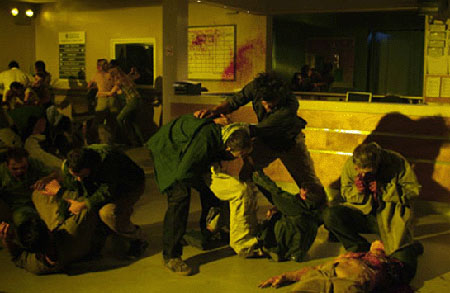
In some episodes of Mystery Science Theatre 3000, there would be times when a poor cutting choice would cause the frames to jump around, resulting in a few seconds where no one could tell what was happening. At times like these Mike or one of the bots would generally say "And the editor goes for an academy award." The kind of stupid editing they're making fun of, where things jump around crazily for dramatic effect, is now used in the bulk of new horror films (Saw and the like) and along with shitty acting and stupid dialogue, it's a recurring motif of Miner's remake of the much revered Day of the Dead. Day is like a retread of the Dawn Remake, only with zanier zombies, more intense gore effects, and no character development whatsoever.

We start in the town of Leadville CO, where some stereotypes are making out in a cabin in the woods. Two of the four are going at it a little more adamantly, and so the less motivated of the two couples, Trevor and Nina are their names, goes for a walk in the basement. It leads to a dank corridor, but they don't explore very far, opting instead to leave and make out in Trevor's living room. His mom has been sick and so the house is unsupervised. They take off so quickly that they leave the other girl behind, and she is quickly butchered by something. On the roads leading out of town, a cordon of soldiers in Humvees have blocked everything off. Apparently their orders are to keep everyone in town. They tell the parents of a sick child that they can't go to the hospital because of this, but when we see those people next they are in a hospital. Don't worry about it, though, Screenwriter Jeremy Reddick didn't, and Miner apparently doesn't know the difference. So we meet the boy from the cabin's sister Sarah. She's an army corporal and she hasn't been to her home town for a long time. Bringing one private with her, she heads off to check on her sick mom. The private's nickname, we learn, is Bud (this for anyone who's seen the original is foreshadowing, otherwise it's just annoying). She discovers her asshole brother hasn't been taking care of their mother, and has left her upstairs with a terrible sickness. If she thinks that's bad, wait until they get to the hospital.
The hospital (or military medical center) run by cocky Dr. Logan quickly becomes the sight of the zombie takeover scene, crucial to any film of the kind. Sarah and Trevor's mom, as well as Nina's parents are quickly done away with, as is Sarah's commanding officer (fans of quality will be sad to learn this is Ving Rhames, and when he goes, so goes any hope this movie had of not sucking). Soon all that's left of the people in town are Sarah, Bud, Dr. Logan, an asshole soldier named Salazar, and Trevor and Nina. Trevor and Nina whole up in the town's only radio station with token nutjob DJ Paul, who isn't long for this world. Sarah, Bud, Salazar, and Dr. Logan try to commandeer a vehicle after escaping from the hospital and in the process, Bud is bit on the hand. Logan abandons the party and disappears into the woods, while Salazar, Sarah and zombie Bud rescue Nina and Trevor from the radio station. With all other roads out of town blocked off they agree the only safe place to go (after stocking up on non-military issue weapons) is the cabin in the woods. Remember that dank tunnel, well it leads to a pristine, Resident Evil-type laboratory where the zombie virus originated. By the time Sarah and everyone else figures out that yes, this is where the zombies came from, and yes Logan's behind it, the audience has been twenty steps ahead and gone to sleep. So the only way to end it is to leave it open-ended and not end it at all. Way to go, team.

The first step in making a god-awful zombie film is to make sure that everyone of your characters is a stereotype, and a really lame one at that. We have a paranoid DJ (sample line: "As a part of the military-industrial complex, do you have the power of free thought?" This is why people hate liberals, because of fuck-ups like Jeffrey Reddick). Ian Mcneice who plays DJ Paul hasn't quite mastered his American accent; that coupled with his comic obesity basically makes his death palpable from the moment we set eyes on him. We have the screw-happy teen couple who are first on the menu; we have defiant girl, underdog boy, evil doctor, foul-mouthed black guy, and "go on without me" commanding officer. This is the kind of stupid screenwriting that Robert Rodriguez was lampooning in Planet Terror. To make matters worse, no one but Ving Rhames can act worth a good goddamn under Miner's incompetent direction. Then we have set-pieces stolen from better films in the Romero world. We have the re-animated soldier who does good (though it must be said, not that much good) taken from the original Day of the Dead. The chase scene through the tunnels is lifted from the 2004 remake of Dawn of the Dead (it actually worked in that film). And the ending is characteristic of many Romero films, but rarely in so tired a form as it is here. Bad script, no direction, bad movie.

The zombie make-up is nothing to write home about and the things that Miner has the zombies doing is ridiculous. They act more like the creatures from John Carpenter's Vampires than any zombie I've ever seen. The cinematography and the aforementioned stupid editing tricks make this one an incoherent mess. Zombie film fans can be an inarticulate bunch, but they know when a lines been crossed. Someone on IMDB said that when you make zombies jump several feet through the air, leap out of windows (this scene is utterly pointless, FYI), and in one glaring scene walking on the ceiling, then you are pissing on the whole Romero Legacy. That anonymous, inarticulate fanboy is absolutely right. Romero waited 10 years before making the first sequel to Night of the Living Dead, and then another 7 years before making another. Miner waited about three seconds after the remake of Dawn out-grossed The Passion of the Christ before this ill-conceived bastard was put into production. There were previews for the film as early as 2005, but funding problems delayed it's release until finally it was condemned to a direct-to-dvd release, which it so richly deserves. Steve Miner is such a shithead. He may have meant something to horror fans in the early 80s, but now he's just a hack. If I was smarter I would have stopped at this film's box art, which tastefully depicts a zombie vomiting up a big pile of green bile with an eyeball in it. Not a bad metaphor for the film itself; a big pile of celluloid vomit. 

Miner and Reddick watched the other guys make something delicious out of the same ingredients, but forgot to properly cook everything and just vomited it up for the world to see. I don't think I'd have put that on the menu either. It makes me wonder what Day of the Dead 2 must look like. When Romero dies, he'd better be cremated otherwise he's going to be doing a lot of spinning.

June

June, I've decided is George A. Romero Month. That means I'll be writing about the remaining films in his canon, and taking a look at the breadth of his influence of modern horror filmmaking, including remakes of his three most popular films. This means that my reviews of Garden of the Dead, a few new-school success stories, and a few of my favorite classic zombie films will have to wait until July. First up to the gallows, Steve Miner's remake of Day of the Dead, and from there we go backwards.

Saturday, May 31, 2008

Addicts of Necropolis

After stupidly giving Zombie Aftermath the time of day, I realized there were a few that never got that far. Hell of the Living Dead being one such example (why not just watch Dawn of the Dead, you miserable bastards?); I remember giving it about three sentences worth of write-off. It deserved one of two things; much more on how fantastically terrible it was, or no notice at all. Occasionally (as in Nightmare City and Vengeance of the Zombies) I'll go on for pages and pages about the twisted stupidity of some directors. In my defense those guys definitely deserve it, and the folks on the chopping block today deserve it just as richly (like Peter O'Toole deserves an oscar, they need chiding). And as there are far more eloquent complaints out there, I'll just say my bit and move on to bigger fish. Sort of like eulogies at a necropolis I suppose. That these movies are all from the 1980s is no coincidence, it's fate, friends. Also not coincidental: all these films have gratuitous, pointless nudity. Three continents and they couldn't think of anything better? Fuck everyone!

Hellgate
by William A. Levey

Some idiots with dubbed voices swap stories in a cabin waiting for a fourth party to arrive. The only guy tells a story about a biker gang (in actuality a couple of 50-60 year olds in leather), a resurrecting stone, and an undying ghost women. Then there's a haunted theme park full of zombies, I guess, at that point I had started a game of solitaire or something. This is bad in the way that only late 80s movies could be (it feels almost like a parody of itself, as these films often do). It's so deliriously awful that I had to turn it, like Hell of the Living Dead before it, off before the credits.

Burial Grounds
by Andrei Bianchi

Speaking of turning off before the credits, this little number is often cited (along with Zombie's 3 and 4) as the worst zombie film of all time. Minutes 1 and 2 show a bearded archaeologist unleashing some etruscan zombies from a cave (hopefully Karma has gotten Bianchi back for this film and the way it vomits all over history). Some people, including an incestuous kid (who at the time was nearing 30) who molests and eats his mother, have to fight the zombies. They do a better job of finding ways to get killed, and succeeds fully in aggravating and grossing the audience out. There's nothing right about this movie; it's like being trapped in a closet with a spider for an hour and a half

Dawn of the Mummy
by Frank Agrama

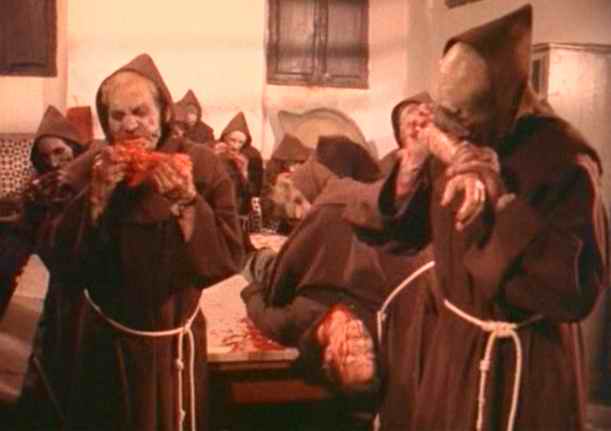
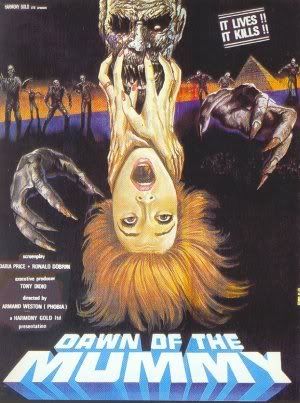
The only egyptian zombie film that ever made it over here (not that unusual considering Greece just got theirs over last year). Ancient curse...explorer goes to open a tomb...party of models use the tomb for a photoshoot...this one pretty much writes itself. Sort of like Oasis of the Zombies without so thick a haze of confusion (it's still confusing, mind you). The major difference between this and Franco's film is that there's a balls out gut munching scene towards the end. It's really bad. Like awful. Everyone is annoying either because they cannot act or because they're trying too hard. There is no hero and no villain, everyone's just disgusting and ignorant.

The reason I'm so upset with these films is because the handling of human beings and their interactions is so absolutely backwards that it's almost alien. People don't act like they do in these movies, in any culture. So why does Frank Agrama, an Egyptian, insist on making Egyptians look like fat idiots? Why does Andrea Bianchi, an Italian, insist on making the people in his films helpless and insufferable jackasses? Why does William Levey, an American, insist on directing people as if they were characters in a fourth-rate Hannah Barbara cartoon? Why? Why? WHY!?! What the fuck is the matter with film directors? Who's giving these morons money? What actor thinks to himself "A zombie film by the guy who did Strip Nude For Your Killer? Where do I sign?" I get why electricians and gaffers say yes; actors are given scripts to read, and if they aren't illiterate, they should be able to read lines like "You look just like a little whore, but I like that in a girl." and say reasonably that the man writing hasn't seen the sun in many, many years.

Wednesday, May 28, 2008

Nuclear War Is Too Good For You, Barkett!

It's very nearly four in the morning, and I'd definitely get to sleep if there wasn't something really, really irksome bothering the bejesus out of me. Steve Barkett is a boorish jackass and must have the smallest penis in all of Barstow. Never heard of him? GOOD! That means you're not me! You Lucky Devil! Steve Barkett was an amateur filmmaker/bad actor from the 1980s whose career didn't survive the 1990s. His debut film Zombie Aftermath (they called it, appropriately, Nuclear Aftermath in some countries) is a complete failure. I was really set to lump this in with Rome Against Rome as a film I couldn't fault because it believed in its own bullshit so strongly. But No! I could forgive a spaceship sequence lamer than the original KTMA Mystery Science Theatre 3000 opening (which intentionally lampooned shit like this). I could forgive the least threatening rape gang ever filmed. I could forgive the matte painting apocalypse. What I cannot forgive is the dullness of a post-apocalyptic zombie movie. I cannot think to forgive the idea that a tubby, hairy, and inexplicably wealthy guy filmed himself fighting a one-man gang war and screwing presentable women. And what I cannot forgive, the most unforgivable sins is the paucity of zombies in a movie called ZOMBIE FUCKING AFTERMATH! Well at least now I know that William Beaudine's The Living Ghost isn't the only war crime committed under the guise of a zombie movie

Zombie Aftermath
by Steve Barkett

Steve writes, directs, stars, produces, and fucks up this film without anyone's help. First of all, this film looks like it was recorded off of someone's Kaliko. The first few minutes even have tracking marks and warped sound from the VHS this was ripped from. Pathetic. If this film weren't quite so terrible I'd suggest Blue Underground or Anchor Bay get to work, but I can't in good conscious ask for this film to be saved. The apocalypse has come to earth, and all but a handful of people have been killed (actually this is an understatement. For the end of the world, there are dozens and dozens of people who keep showing up). Two Astronauts crash their spaceship into the ocean, while down below some really pathetic looking gang members led by Sid Haig kill everyone they can't rape. The astronauts wander around in Planet of the Apes fashion as Newman, the moustache-happy leader of the pair voice-overs his feelings about the whole mess. That night they are attacked by three zombies, whom they easily overpower. They wander around, find a few survivors, and adopt a little boy. Newman and the boy become very close, as do Newman and a woman who escaped from the clutches of the gang. When Cutter (Sid Haig) murders Newman's love interest he goes out looking for revenge.

Is that the sound of crickets? No, it's the two dimes Barkett didn't have to rub together while making this movie. There's a lazer gun in this movie! He couldn't afford to pay Forest Ackerman for more than a day's work, and Steve Barkett thought he could get away with a lazer gun! He called his movie Zombie Aftermath but didn't spend any money on zombie make-up. Six. Count 'em, SIX zombies appear in this film. Are you kidding me? This movie is about as interesting as watching two guys adjust the wiring on the roof of their house, like they were fiddling with the reception on their television, which actually happens at one point. The two 'astronauts' are obviously too unfit to have ever been admitted into the space program, let alone allowed in a fucking spaceship. Barkett looks, unsurprisingly, like an overweight, 40 something. Did that stop him from making his own Mad Max rip-off with himself as Mel Gibson? No, in fact it just made him want to do it more! "Gee, no one wants me in their movie! I'll show them. I'll make my own! I'll beat the whole gang up myself, and outsmart everyone, and have a love scene! That'll show you, God! Make me ugly, will ya!?!" That was apparently all the thought that went into this film because it is approximately an amalgamation of other films. The story is lifted wholesale first from Planet of the Apes, then from Mad Max. 'cept of course that no one's manly or drives a souped-up car or anything. The villains name is Cutter (villain in Mad Max: Toe Cutter. That's not enough for a lawsuit, is it? Not if nobody sees your movie!)

Just miserable. This has, however, inspired me to do capsule reviews of some of the worst Zombie films I've ever seen, so that'll be up in a few days. Steve Barkett as Mel Gibson! Inconceivable! And yet somehow he convinced women to take their clothes off in this film! When the revolution comes, we're going to his house first!

Sunday, May 25, 2008

It's Not White Zombie, but...

TCM or Turner Classic Movies is quite simply my favorite thing in the world. Two years ago when I went about planning the curriculum for Honors Zombie, I ran across the title of a film that sounded absolutely bonkers. It was, best as I could tell, a blaxploitation zombie film, and after two years of searching, TCM finally decided that I had suffered long enough and showed it as part of their Underground series (they never cease to amaze). I guess it was bound to happen; white people spent most of the early 1970s thinking up things to pit against black people. After Pam Grier's tough-gal schtick made Sam Arkoff and AIP a small fortune in 42nd street box office receipts, it was only logical that they would start mixing successful genres with their new one. The result wasn't nearly as powerful or compellingly sleazy to watch, but it was ten times as fun.

Sugar Hill
by Paul Maslansky

We start with the reason Black Power exists; a horribly exaggerated voodoo ceremony complete with dancing and chanting. I'm obviously grateful that there's a voodoo movie that centers around black people, but christ, can we have some dignity? Just as we think it might be this movies way of establishing location, we learn that it is the opening act at Club Haiti. Now, this is a little better, but I have a hard time believing the pretty young woman who sits at the bar when she tells the clubs owner that she really liked the dance. Writer Tim Kelly has a lot of explaining to do. Anyway, the young woman's name is Diane Hill or Sugar as her boyfriend christened her upon meeting her (this will be explained after his death at the hands of gangsters). Her boyfriend, the club's owner, is named Langston (You can't Be Serious!?!?!), and some local mob interests want to buy the club off of him. His refusal leads to his being beaten by a group of a half dozen men, led by local kingpin Morgan and stabbed to death mere seconds into the films running time. Sugar is crushed, but we in the audience are not. One because we know that this means revenge is on the way, and also because it's pretty hard to take someone seriously when they sob the name Langston!

Langston's death means two things plotwise. First is that Morgan thinks he can snatch up the club real easy now that Langston's out of the picture. He doesn't count on the club's ownership passing into the hands of Sugar Hill. As if this wasn't by-the-balls enough, Sugar decides to take an extra special brand of revenge. She visits a woman by the name of Mama Maitresse. Maitresse, when properly accented means Mistress in french; which Kelly either didn't know or didn't care about, because why would you call a priestess Mama Mistress unless you were purposely inciting sexual weirdness, which he is clearly not interested in (the woman looks to be in her 70s and has trouble walking)? Anyway, the purpose for Sugar's visit is because she knows Mama's got some voodoo secrets up her sleeve and Sug wants in. The two walk behind Mama's house to a cemetary where they summon Baron Samedi, the rabble-rousing voodoo surrogate satan. He's only too happy to help with a little revenge, but wants something more than just Sugar's soul. See, he's got plenty of those, but what he really wants is a bride. Sugar agrees and Samedi summons up a field full of zombies to help Sugar get her revenge. Morgan doesn't feel threatened by Sugar, even as his cronies start disappearing one at a time. Detective Valentine, the cop in charge of investigating the murders is an old flame of Sugars and so she has to play dumb whenever he shows up looking for answers, which he does more and more when clues start pointing at her as the mastermind. Even the knowledge that the hands that committed the first murder belong to corpses doesn't throw him off her scent.

Sugar Hill is lovely, but it's got lots of problems (thank you DFA 1979). It's briskly paced, delightfully loony, and a lot of fun. While I wouldn't call it scary, per se, I will say that the Zombies are pretty spooky looking. They look like 70s updates of the I Walked with a Zombie model. They both look and act like the old voodoo zombies: giving souls for service. I did find it a little silly when the prop cobwebs they're fitted with never come off during their weeks long revenging. I also laughed at the macabre revenge set-ups; the scene in the massage parlour had me giggling incessantly, in spite of the tiredness of the gag employed (it's older than the Three Stooges, though that didn't stop Clint Eastwood from doing it in Any Which Way But Loose, but I digress). Anyway, as a zombie almost-comedy, it succeeds and I'm elated at the opportunity to finally see the damn thing, but I have to admit I was expecting something bloodier, something meaner, something sleazier. I have trouble believing that a half-comedy is what American International Pictures had in mind when they put their money into it. This is where my problems with this film start; there's definitely something missing; that certain, indefinable something.

Sugar Hill can be said to be directly descended from Coffy, the movie that gave Pam Grier her start. Coffy is also a blaxploitation film (I'd say the penultimate after Shaft), and concerns a woman getting revenge after someone close to her is hurt by a local kingpin (drugs are the problem in Coffy). The difference between Coffy and it's many, MANY impersonators is that it was actually compelling to watch. It was brutal, violent, and at least partially believable. It had grit and believed in itself and so watching it is much harder than watching say Friday Foster. They had only to lose what made their first film so special in making rip-offs. The same thing happens when you watch Black Caesar and then watch Hell Up In Harlem! Black Caesar may not be the most gripping of films, but the difference between it and Hell Up In Harlem! is the difference between the Black Panthers and the cast of Family Matters. And so it was that as a revenge film, Sugar Hill is nowhere near effective. Part of this is because Marki Bey is no Pam Grier. As Sugar Hill, Bey spends most of the film smiling slyly as more and more people do or say things that become ironic because of the fact that she has an army of zombies at her beck and call. This is a pretty lame set-piece, because everything becomes ironic when a pack of slave zombies is involved. Tim Kelly gave her almost nothing to do but stand around in revealing clothes and issue lame quips and flash her smile. As the zombies do all the actual dirty work, everybody's performance is pretty flat; no one has menace, no one seems scared. In fact this might be the tidiest revenge movie ever made. Even Robert Quarry seems out of his element as the pompous Morgan. Gone are the elegance and confidence of his Count Yorga. He has trouble with what I take to be a Louisiana accent, and most of his effort goes into maintaining it. And most importantly every white villain has trouble convincingly acting like racists. These films work when there's some heinous bigot pulling the strings. Sugar Hill does NOT have that. Quarry and all his followers have a good deal of trouble acting like racists and Quarry and his girlfriend Celeste have a lot of trouble saying the 'N' word. In any other context I'd say good for you, but when you're playing the foil to what is supposed to be a Pam Grier character, you have to effectively match her power. We have to hate you as much as we like her. As it is, we neither hate you nor really care much about her. And in a film that goes so far as to call its martyred club owner LANGSTON, there's no way you can get away with this shameful mincing. I'm sure if you had asked Sam Arkoff if he thought his movies at AIP were empowering black people, he'd have choked on his cigar. "Emwhattening WHO? HAHAHA!" It's a shame no one ever tried the Blaxploitation Zombie movie after Sugar Hill, cause I feel like Jack Hill and Pam Grier could have done something really sleazy and good. Or Russ Meyer. Or George Miller. Or Michael Findlay. Or anyone, really, I just want another blaxploitation zombie movie.

Monday, May 5, 2008

Bob Clark And First Wave Independent Cinema, We Hardly Knew Ye

I've recently been put in a position where I have had to take sides about independent filmmaking. There's been a rash of it recently that's got people all abuzz. Mumblecore, I believe is the term they're going by (the latin classifcation, if you will). The Puffy Chair, Funny Ha Ha, Hannah Takes the Stairs, the list goes on. The players are Andrew Bujalski, The Duplass brothers (one of whom looks exactly like Jim Halpert from the Office), Joe Swanberg, Aaron Katz, and others. They're filled with tumultuous relationships, painful everyday life stuff, and a lot of awkward sexual behavior (Swanberg masturbates, Bujalski gets naked, Duplass and his girlfriend have to play out their relationship, in bed, onscreen). Personally, what little of these films I've seen bore me to fucking tears. I respect the hell out of these guys because they're making movies they want to make, they have total control and as far as I know they haven't had to pander to suits to get funding. Anyway, as I'm sure everyone knows (or at least I HOPE everyone knows) this is in no way a new phenomenon. First of all, there's been a dime-horror festival for the last ten years that shows no sign of stopping, so, there's that to consider. Then we have the films of Jim Jarmusch, Kevin Smith, Quentin Tarentino, John Sayles, Sam Raimi, and Allison Anders that long ago set the vanguard for the slacker film. Not to mention that nine times out of ten their movies were interesting. And before that there was John Cassavettes (and Allen Baron, and Orson Welles, but circumstances prevent their inclusion in the one-man vangaurd), who invented the American independent film as we know it. There was independent horror between Cassavettes and Sam Raimi that no one's really spoken of. Herk Harvey, Irvin Yeoworth, Paul Morrissey, Jack Woods, and the subject of today's double feature, Bob Clark, all made horror films for peanuts in the 60s and 70s. There was also Harold P. Warren, the fertilizer salesman who made Manos: The Hands of Fate on a bet. Bill Rebane may as well be included because when he wasn't paying for his films himself, they were produced by companies that went bankrupt after the films wrapped. He was also probably the only man making films in Wisconsin at the time. But those guys' films were absolutely dreadful and Clark made decent films most of the time. Clark started making shoe-string scare films with his partner and friend Alan Ormsby. Once he made a name for himself Clark graduated onto bigger things, including the seminal proto-slasher Black Christmas, and then ran over to the other end of the spectrum to make the seminal actual-holiday film Christmas Story. Tragically, Clark passed away last year having a painfully small resume to his name, but he made invaluable contributions to American film. Clark also has the distinction of being the person who gave make-up genius Tom Savini his start (indirectly). Of course, you might not guess that Clark had a brain in his head from his debut feature.

Children Shouldn't Play With Dead Things
by Bob Clark
Our story begins with a grave digger on a cemetery island off of Miami, being assaulted by what looks like two zombies and then one of them buries the other in a coffin. A while later a Jewish theatre troupe lands their sail boat on the island with a box of costumes. They're led by suppurating douche bag Alan (Alan Ormsby, looking like he just climbed out of a Renaissance Festival). Their intent is to resurrect a corpse for some amateur theatrical stunt. Don't ask me. After they dig up the guy in the corpse paint from the prologue and the initial shock wears off, they dig up the body they hope to resurrect and can't wake him up. Then what happens? Well, we're treated to an hours worth of bickering, swearing, name-calling, complaining, pestering a dead body, and whatever else these insufferable jackasses thought to do with their screen time. It isn't until...11 minutes? 9 minutes before the closing credits that we actually see the zombies? When they show up, the thinning of the bodies is interesting because it shows that these pasty creeps didn't really think about their plan too much before deciding to piss off a corpse. The footage of the zombies coming out of the ground was also a film first, far as I know. The scenes of them breaking out of their resting places in the misty night is pretty spooky and would be copies again and again (by everyone from Lucio Fulci to the Simpsons).
This film isn't great. It isn't even good. But it has the undeniable spirit of the independent film director. Ormsby and Clark did not know how to balance talk and play back then, but when it was time to munch guts they stopped fucking around. They do that revenger's zombie thing of giving the villain his due pretty excellently. (It's tough to know whether the scene in Let Sleeping Corpses Lie came first or not, but I can definitely tell you that they couldn't possibly have influenced each other. The Let Sleeping Corpses Lie screenplay had been kicking around for three years or so before Jorge Grau said yes to directing it. But of course there's no way that a penniless filmmaker in Miami had any knowledge of the plans of a hackneyed Italian production company). We also have the ending scene which Fulci basically lifted wholesale for his Zombie in 1979. The scene features the zombies high-jacking the boat Ormsby and Co. road in on and heading to the big city. This scene looks pretty silly, but it's a nice metaphor for Clark's career. He was leaving the tiny island and heading for the big city (or at the very least the suburbs).

Deathdream
by Bob Clark
Clark had a bigger budget this time around and he had real live actors too. John Marley of Cassavettes' Faces and The Godfather plays the father of a returning Vietnam veteran, Andy. Everyone's real happy to see the boy, cept, of course that he's supposed to have been killed in action; they got the letter weeks ago. They would also feel a lot better if he weren't acting so strange; he's ignoring his girlfriend, shrugging off the neighborhood kids, and strangling the neighborhood dogs. His dad gets the local doctor to check in on the young man. The MD concurs that something's definitely screwed wrong up in the young boy's head, and shell shock can't possibly explain his unreasonable switch between violence and passivity. Andy seems all too aware that the doctor is close to uncovering whatever secrets he's been keeping and so pays him a visit in the middle of the night. A syringe is involved. Well, Andy's mom and sister want to try one last ditch effort to dig the old, lovable Andy out of his crazy new body. What they don't realize is that his skin is peeling off because he needs blood. Yeah, how do you like that?

This film is actually pretty excellent. The handling of the zombie lore is pretty original and the creature design is legitimately spooky. Also competent: the acting. John Marley, Richard Backus, Anya Ormsby, and Lynn Carlin all make good showings of themselves as the conflict Brooks family. When Andy starts to disintegrate, equally believable is Mom's attachment to her son, Dad's initial reluctance, and Sis' total freakout. The film has a decent story (I understand that the story is borrowed from some hundred-year-old folk tale or other, but it's Vietnamization works as well as any. Certainly better than it was in Pumpkinhead 2) and Clark does some pretty excellent things with it. The scene where we confront decaying Andy in the dark kitchen has some menace. The effects are also just as good, if not better, as it was in Let Sleeping Corpses Lie. It was here that young war photographer Tom Savini got his first glimpse of the workings of the world of film make-up. Fitting that it should be a post-Romero zombie film; as he would hit his stride on his Dawn of the Dead.

Deathdream is a solid film, one of emotional maturity, well-thought out scenes and dialogue, and naturalistic performances. That's right, all this for less than a million dollars by a second-time filmmaker in the 70s. The new guys, the mumblers are being hailed as these cathartic, solid, movie kings who know something the rest of us don't; they aren't the first and they won't be the last, but they might be the dullest (ed. Having since seen Joe Swanberg's Nights & Weekends, I recant this statement in full because that film is just amazing. Much love to Aaron Katz, as well, while we're on the subject. But The Puffy Chair is still fucking awful. I yield to few in my hatred for it). When I've covered all of the Zombie films out there, I may come back and do Clark's Black Christmas, which is definitely one of my favorite films. Clark had a head on his shoulders and had too few opportunities to use it.

Friday, April 25, 2008

It's About Time

You know, it takes someone truly feckless and eccentric to make Robert Rodriguez look like a really concise filmmaker. This film, part of the infamous Grindhouse pairing Rodriguez and Quentin Tarentino put out last year, may not have struck me as such a success were it not followed by what I call the failure of Tarentino’s film, Death Proof. What happened to him, exactly? When did the name Quentin Tarentino start to elicit so many groans from one-time fans? I don’t know, but, what we have here is a complete reversal of expectation: Rodriguez’s film works in almost every way, it even succeeds in being The Thing tribute that Slither failed to be; Tarentino’s is the Shark Sandwich of his career. Who’s ready to hear me say something I hoped I would never say?

Planet Terror
by Robert Rodriguez
And here I thought no one could do filth right anymore. The plot is silly enough: a troop of military grunts seizes control of a base in Texas after a green gaseous toxin is released by a disreputable chemist named Abby who likes castrating his clients. It’s all very unclear and Italian, but the boys in uniform all walk right into the cloud of green gas that starts spraying everywhere. Meanwhile, a couple of slimy plot threads are all about to converge; a go-go dancer with the unfortunate stage name Cherry Darling leaves the stage in tears after one of her routines and heads to a barbeque joint where a cute mechanic named El Wray shoots the breeze with the proprietor TJ. TJ, as it turns out, is also the brother of the town’s sheriff, and El Wray, in a similar twist of fate, is Cherry’s ex-boyfriend. She walked out on him, leaving his pride less than intact and he’s been searching for her ever since. He agrees to give her a lift to town, but that plan goes south when they swerve to avoid missing a deer, flip the car on its side, and then the poor girl gets her leg torn off by a bunch of freaks in the woods. Wray gets hauled off by the sheriff for questioning (apparently Wray and the sheriff have met before in a professional capacity) and Cherry is committed to the E.R.

The hospital where she stays employs a strange bunch, indeed. There’s Dr. Block, the cuckolded wife of Dakota, the anesthesiologist (when we meet her she’s texting her lover with one hand and calling a babysitter with the other), Skip, the creepy paramedic who seems only to enter rooms at 45-degree angles and Dr. Felix (Rodriguez’s real-life MD), the disease obsessed physician who diagnoses the first zombie bite of the night. When Dakota’s girlfriend shows up in the ER with a big hole where her brain should be, Block (once again) becomes suspicious of his wife. When the incidence of viral infections and pussing sores becomes too high Felix skedaddles and Block decides to use his wife’s anesthetic needles to get some answers about her extra-marital activities; she barely escapes with her life. Her attempt to save her son goes about as poorly as possible (more on this later) and she (once again just barely) makes it alive to her father’s house. In the meantime Wray rescues Cherry from the hospital, and everyone heads to JT’s place. They agree that the safest thing to do is get out of town, but don’t get very far before the military stops them and brings the survivors back to base. In the military jail, Abby, the only survivor from the intro, explains how screwed everyone is. Wray, of course, doesn’t let this stop him from rescuing everyone and fashioning a fancy new set piece for his girlfriend to walk on (and save the day with).

I liked it. THERE! I said it. I liked the zombie comedy. How could I not, everyone looks like they're having a blast. And there's Michael Biehn, and he's hilarious. There are a few things every reader should probably be made aware of. The first: I generally hate horror comedies, especially zombie horror comedies. Occasionally, a Shaun of the Dead will come out of nowhere and make me forget all my reservations (it helps of course that Edgar Wright knew how to balance his influences), but for the most part the zombie comedy gets no love from me. Dead Alive, Cemetery Man, even Slither didn’t really do much for me. I think that it takes a really light touch for the zombie comedy to do anything but slip on its own entrails. One thing I’d never considered in the formula for success is what happens when instead of setting out to make a horror movie with comedic or romantic elements, you set out to make a straight-up comedy. This is actually an incredibly smart strategy because it means that every over-the-top element makes sense and is, for the most part, welcome. In a horror movie, for me anyway, every time we’re asked to accept a stupidly excessive trick (the zombie baby in Dead Alive, the banjo player in Dead & Breakfast) we are pulled out of the mission of the horror movie (which, need we forget, is to scare people) and told to laugh at something that’s genuinely tasteless. To have to go from laughter to sadness because the frat boy behind the camera thinks he’s clever is really irksome. (Aside: this whole notion of horror moviemaking where you “play with the conventions” is just about the stupidest thing I’ve ever encountered. I thought they sent you to film school to step away from that bullshit!) This is, of course, to say nothing of the nonsense Tarentino's been up to. If I had to pick one word to sum up Death Proof, it would be 'Masturbatory'. Some people are looking into the future; he's stuck blowing himself for rediscovering some things in the past.

So, in the midst of my anger at the state of horror films, imagine my surprise when the person who comes along with a solution is my cinematic nemesis Robert Rodriguez. The second thing people should know about me is that Rodriguez and I have been in something a Sergio Leone type showdown ever since I rented From Dusk Till Dawn in the fourth grade. “I paid $5 for THIS!?” My friend and I spent that whole evening with our mouths open, wondering who thought this was a good idea. Evidently Quentin Tarentino thought it was great, cause he helped him direct it, wrote a big check for it, and put himself in the sleaziest role. Why couldn’t he have latched onto Wong Kar-Wai? I would have liked to have been able to see Fallen Angels in the theatre, and I don’t think I would have minded a Tarentino cameo either. Whatever genius Rodriguez once proved to everyone he possessed when he made El Mariachi, every film after that went a long way towards making everyone (himself included) forget that it had ever existed. Desperado? Spy Kids? From Dusk Till Dawn 2 and 3? Essentially he’s made a career out of making off-season Matrix type films that everyone in my high school loved. I didn’t get those films, and still don’t, for the most part. I’m a firm believer in needing more than breasts and explosions to make a film watchable. So, with all this on the table, let’s head back to the reason I’m writing this.

Planet Terror works in the one way I never thought it could: as a comedy. Having sat through Death Proof, I was fully expecting the Desperado of zombie films. What I got instead was the Airplane! of zombie films. Now, before we all get carried away, there were weak spots: the effects, namely. I’ve recently come to see that I really hate the Greg Nicotero School of gore effects. The excessive, breakneck vileness of his work really grosses me out in the wrong way. You’ve seen it in all of Rodriguez’s films and in Land of the Dead, Cabin Fever, and any number of made-for-sci-fi sequels and originals. I find it crass and think it’s deeply at odds with the Tom Savini and Rob Bottin effects I grew up on. I realized that his effects account for my dislike of a lot of recent horror films, but, they weren’t enough to make me dismiss Planet Terror, neither was Rodriguez’s insistence on using cheap effect shots whenever possible (explosions, men thrown out at cars and exploding under the wheels of trucks. I get that it’s supposed to be over-the-top, but this movie could have been perfect if he had just cut back a little bit). Also, why would you cast your son in a movie if you're just going to have him shoot himself in the face? For that...I...have no words.

The reason that no horror movie mistakes could ruin Planet Terror is because it’s not a horror film. It does perfectly capture the feel of old Italian horror films and it boasts everything that usually sinks a horror film, but it uses it to its advantage in the smartest way I’ve ever seen. It flaunts genre knowledge without being smug. Little things keep piling up outside the horror that loosen you up: the sheriff refuses to give Wray a gun in the most abject circumstances because he’s a criminal, Bruce Willis explains his war experience with all the gravitas he can muster, which includes accidentally killing Osama Bin Laden, Dr. Brock pops up in completely illogical locations to menace his wife with a syringe, El Wray rides a miniature motorcycle during a pulse-pounding chase; all of it is wonderfully hysterical. It’s much like watching the things that ruined some of the best and worst zombie movies all right in a row. It was immensely entertaining, and I just found myself laughing harder and harder (I even admit to not minding that preposterous machine gun leg thing; nevermind that it's completely impossible, that's precisely the point!). This is a labor of love with both a heart and a brain.
Interesting to note that the zombies towards the end look a good deal like the ones in Umberto Lenzi’s Nightmare City. And here I thought that movie would never help anyone! I guess anything really is possible.